CAREER GUIDE
Dr. Vinay Rattan
07-01-2026

For many young learners, Computer Science Engineering (CSE) is more than a course; it’s a journey into logic, innovation, and problem-solving. But what does it genuinely feel like to step into this world as a student? The answer lies somewhere between long coding nights, breakthrough moments, team projects, and the thrill of seeing your ideas come alive on a screen.
This is a real, grounded look at computer science engineering student life, the challenges, the excitement, and everything in between.

The First Year: Foundations and New Perspectives

The CSE journey begins with a shift in mindset.
 Students soon learn that engineering isn’t about memorising theories, it’s about applying concepts to real problems.
The first year focuses on:
  • Programming basics
  • Mathematics and logic building
  • Physics and digital systems
  • Problem-solving frameworks
  • Understanding the CSE course structure
This stage lays the foundation. Even the simplest programs teach consistency, patience, and attention to detail.

Coding Becomes Your Second Language

If you ask any second-year student what defines computer science engineering student life, the answer is simple: coding.
Coding labs and assignments introduce students to:
  • Algorithms and data structures
  • Python, Java, C++, and other languages
  • System design
  • Debugging strategies
  • Real-time problem solving
At first, every error feels overwhelming. But gradually, logic starts flowing naturally, and the joy of fixing a bug becomes unmatched.

A Day in the Life of a CSE Student

A typical day in the life of a CSE student includes a healthy mix of theory, labs, projects, and brainstorming sessions. Here’s what it looks like:
  • Morning lectures on operating systems, networking, or AI
  • Afternoon lab sessions where concepts turn into working code
  • Project meetings with teammates
  • Time spent learning tools like GitHub, Docker, or Figma
  • Evenings filled with coding practice or club activities
  • Occasional late-night debugging marathons
What makes this routine exciting is that every day, students learn something that brings them closer to the industry.

Projects, Hackathons, and Beyond

By the second and third year, students shift from learning concepts to building things.
They work on:
  • Full-stack applications
  • AI/ML models
  • Cybersecurity tools
  • Cloud-based architecture
  • Mini-projects that evolve into final-year ideas
This is also the stage when clubs, coding competitions, and hackathons become central to the B.Tech computer science experience. These platforms build curiosity, collaboration, leadership, and industry exposure.

Choosing Your Path in CSE

As students progress, they begin identifying areas they enjoy.
 The CSE course structure opens doors to specialisations such as:
  • Artificial intelligence and machine learning
  • Data science and data engineering
  • Cloud computing
  • Cybersecurity
  • Game development
  • Internet of Things (IoT)
  • Blockchain
  • Human–computer interaction
Each specialisation offers a different flavour of engineering, allowing students to tailor their journey according to their interests.

The Amity Edge

Studying CSE at Amity University Noida goes beyond classroom learning.
  • State-of-the-art labs with high-performance computing technologies
  • Specialisation tracks aligned with top industry demands
  • Access to coding clubs, hackathons, and innovation cells
  • Mentorship from industry experts and academic leaders
  • Strong placement preparation that shapes students for real-world challenges
Amity ensures the B.Tech computer science experience is future-ready, skill-driven, and industry-aligned.

Conclusion

Studying Computer Science Engineering is challenging, dynamic, and incredibly rewarding. It teaches resilience, analytical thinking, creativity, and discipline. Most importantly, it shapes students into independent thinkers who can build, innovate, and solve real-world problems.
If you enjoy technology, logic, and the thrill of creating something from scratch, CSE is not just a degree; it’s a journey that changes how you see the world.

FAQs

1. What defines a computer science engineering student's life daily?

Computer science engineering student life includes coding practice, lab work, lectures, peer collaboration, and hands-on projects that help students develop real-world problem-solving abilities.

2. What should I expect from the CSE course structure during my B.Tech journey?

The CSE course structure includes programming fundamentals, algorithms, system design, networks, AI, and project-based learning, all of which shape the B.Tech computer science experience and support practical learning.

3. What does a day in the life of a CSE student typically look like?

A typical day in the life of a CSE student involves attending technical lectures, participating in coding labs, collaborating on group projects, practising algorithms, and preparing for hackathons or coding competitions.

4. How does the B.Tech computer science experience prepare students for placements?

The B.Tech computer science experience prepares students for placements through practical labs, coding assignments, real-world projects, competitive programming, internships, and exposure to industry tools.

5. How can students make the most of computer science engineering student life?

To maximise computer science engineering student life, students should join coding clubs, participate in hackathons, explore specialisations early, practise consistently, and engage in collaborative learning through peer networks.

Dr. Vishant Singh
06-01-2026

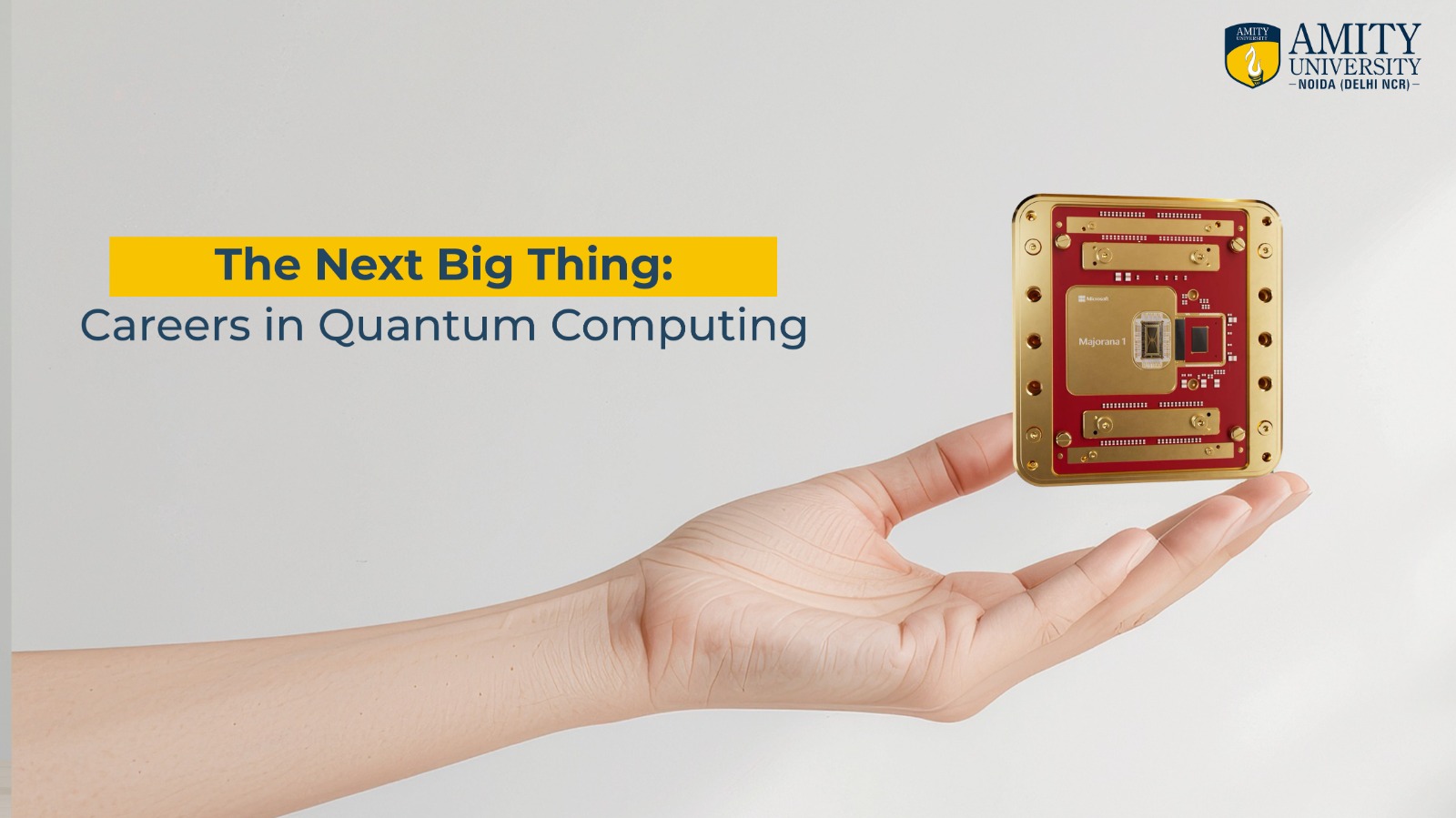
Quantum is the next Marvel superhero, venturing where no machine has gone before. It’s already outsmarting supercomputers, solving problems in seconds, and teleporting data across dimensions. The result? Mind-bending innovation and brand-new career paths. With the global quantum computing market projected to cross $1 trillion by 2035, this field is rewriting the future of technology and work.
A recent McKinsey report notes that companies like Amazon, Google, IBM, and Microsoft are driving quantum breakthroughs across three core pillars: quantum computing, communication, and sensing, together expected to generate $97 billion in revenue by 2035.

What is Quantum Computing

Quantum computing combines physics, maths, and computer science to solve complex problems faster than regular computers. They use qubits or quantum bits, which exist in multiple states. These can be linked together to solve problems simultaneously, leading to millions of solutions faster. Besides deployment in weather forecasting and tracking climate change patterns, quantum computing can also be used to ensure the efficiency of delivery routes, make unbreakable codes, and more.

Quantum in Action: Industry Applications

  • Cybersecurity – Uses quantum algorithms to analyze massive datasets and secure communication networks.
  • Robotics – Enhances computing power and software optimization for advanced automation.
  • Agriculture – Improves fertilizer production and crop-yield efficiency.
  • Automotive – Accelerates R&D, supply-chain optimization, and intelligent product design.
  • AI & ML – Enables breakthroughs in parallel processing, boosting analysis and machine learning accuracy.
  • Drug Discovery – Simulates molecular interactions at quantum speed for faster, more precise research.
  • Finance – Strengthens fraud detection and portfolio optimization.
  • Logistics – Perfects routing and shipping efficiency across global networks. 

Quantum-Driven Careers

Quantum technology is spawning an entirely new class of professionals:
  • Quantum Algorithm Developer: Designs algorithms that help quantum computers solve complex problems in record time.
  • Skills: Quantum mechanics, Python, analytical problem-solving.
  • Quantum Software Engineer: Builds frameworks and user interfaces for quantum programs.
  • Skills: Cirq, software testing, debugging, UI design.
  • Quantum Systems Engineer: Integrates software and hardware for seamless system performance.
  • Skills: Systems integration, troubleshooting, interdisciplinary collaboration.
  • Quantum Systems Designer: Crafts layouts for qubits, cooling systems, and control mechanisms.
  • Skills: CAD modeling, cryogenic, and electrical engineering expertise.
  • Quantum Ethics Specialist: Evaluates ethical, social, and security implications of emerging quantum technologies.
Skills: Ethical analysis, regulatory knowledge, risk assessment, stakeholder communication.

What is the future of Technology Careers?

The tech wave will keep reshaping work, introducing innovations and job titles that don’t exist yet. Success will hinge not just on technical expertise but also on soft skills like emotional intelligence, adaptability, creativity, problem-solving, and leadership. Data literacy will remain a defining edge. Roles such as Big Data Specialists, FinTech Engineers, AI & ML Experts, and Software Developers are projected to grow at record speed. Amity University Noida equips students with the technical knowledge, industry-aligned skills, and soft skills needed to thrive in these emerging careers.

Conclusion

The future is not about replacing humans with machines; it’s about collaboration and augmentation. As McKinsey’s 2025 report states, “Human–machine interaction is entering a new phase defined by natural interfaces and adaptive intelligence.” From haptic robotics to voice-driven co-pilots, technology is becoming more responsive to human intent, creating a future where man and machine evolve together. Quantum computing isn’t just the next big thing. It’s the next giant leap, and the future is already loading.

FAQs

1. What is quantum computing?

It’s computing using qubits that can solve complex problems faster than traditional computers.

2. What jobs are in quantum computing?

Roles include Quantum Algorithm Developer, Software Engineer, Systems Engineer, Designer, and Ethics Specialist.

3. Which industries use quantum computing?

Cybersecurity, AI, robotics, finance, healthcare, logistics, and agriculture.

4. What skills are needed for quantum careers?

Quantum mechanics, Python, software development, systems integration, and problem-solving.

5. How can students start a quantum career?

Gain technical knowledge, coding skills, soft skills, and hands-on experience with projects.

Dr. Ankur Verma
05-01-2026

Landing your dream job as a fresh graduate is no longer just about having high marks or a prestigious degree. Today’s hiring landscape demands more adaptability, people skills, and the ability to perform in uncertain, fast-changing environments. Recruiters are not looking for perfection; they are looking for potential, resilience, and relevance.
Understanding what HR truly values can help students prepare smarter, from building a resume to confidently facing interviews.

What HR Really Looks for in Fresh Graduates

Contrary to popular belief, HR is not searching for flawless candidates or extraordinary prodigies. The expectations are practical. Graduates who can handle pressure, adapt to change, learn continuously, and collaborate effectively stand out. Domain knowledge is important, but it is no longer sufficient on its own. Soft skills and people skills now play a decisive role in hiring and workplace success.
Recruiters value candidates who demonstrate:
  • Resilience in uncertain situations
  • Creativity and problem-solving ability
  • Communication and interpersonal effectiveness
  • Willingness to learn and upgrade skills

Building a Resume That Reflects Real Potential

A strong resume today goes beyond listing qualifications. It reflects mindset, skill readiness, and learning orientation.
Key skills that attract HR attention include:
  • AI and Machine Learning awareness
  • Data analytics and data storytelling
  • UX/UI understanding
  • Cybersecurity fundamentals
  • Cloud computing knowledge
  • Project management exposure
  • Blockchain basics
These skills signal readiness for modern workplaces and show that a candidate understands current industry needs.
Equally important is how these skills are presented, clearly, honestly, and with examples of application rather than generic claims.

The ‘Wow Factor’ That Actually Works

What truly differentiates candidates is the combination of technical understanding and human skills. Employers increasingly value graduates who communicate well, think critically, reason logically, and collaborate effectively. In today’s GenAI-driven world, being adaptable and multi-skilled is essential. Recruiters appreciate candidates who can balance technical competence with emotional intelligence and teamwork abilities.

How to Perform Strongly in Interviews

Interviews are designed to assess more than answers; they evaluate attitude, awareness, and growth potential.
Key traits that impress interviewers include:

Self-Awareness

Understanding your strengths, weaknesses, triggers, and motivations shows emotional maturity. Self-aware candidates respond thoughtfully rather than react impulsively.

Growth Mindset

Candidates who treat failures as learning experiences and show persistence, discipline, and time management demonstrate long-term value to organisations.

Networking Ability

Building authentic professional relationships reflects reliability and openness. Recruiters value candidates who can connect across teams and hierarchies.

Openness to Feedback

The ability to accept constructive criticism positively signals transparency and readiness for self-improvement, qualities essential for professional growth

Thriving in a BANI World

The modern workplace is often described as BANI: Brittle, Anxious, Non-linear, and Incomplete. Graduates who display composure, humility, resilience, and community connection are better equipped to navigate this reality. These qualities are increasingly seen as leadership indicators by HR professionals.

Amity Edge

From campus to global careers, Amity University Noida focuses on building launchpads for future-ready professionals.
  1. Curriculum with Corporate Accent: Programs are aligned with current and emerging industry needs.
  2. Global Exposure: Students gain access to internships, research collaborations, and international opportunities.
  3. Placements That Matter: Strong placement support reflects career preparedness.
  4. Expert Mentorship: Industry-led sessions and mentoring help students prepare effectively for interviews and professional life.

Conclusion

While degrees continue to matter, they are no longer the sole determinant of career success. In an AI-driven world, human values, resilience, adaptability, creativity, and empathy have become the real growth engine of workplaces. Students who prepare holistically, from resume to interview, position themselves not just for jobs, but for meaningful, sustainable careers.

FAQs

1. What do recruiters really look for in fresh graduates?

Recruiters value candidates who can adapt, handle pressure, learn continuously, collaborate well, and demonstrate strong soft skills like communication and problem-solving.

2. How important are soft skills compared to technical knowledge?

Soft skills are now equally, if not more, important than technical knowledge because they play a key role in workplace success and adaptability.

3. What key skills should be highlighted on a resume?

Skills like AI and Machine Learning awareness, data analytics, UX/UI understanding, cybersecurity basics, cloud computing, project management, and blockchain basics attract recruiters.

4. What qualities impress interviewers beyond technical answers?

Self-awareness, a growth mindset, networking ability, and openness to constructive feedback are traits that interviewers find especially valuable.

5. How does Amity University Noida prepare students for careers?

It offers industry-aligned programs, global exposure, strong placement support, and expert mentorship to help students develop both technical and soft skills needed for future-ready careers.

Dr. Renu Oberoi
04-01-2026

The world of work no longer fits inside a cubicle. As industries evolve and Gen Z challenges traditional expectations, the definition of a “career” is rapidly being rewritten. Today, young professionals aren’t just looking for jobs; they’re searching for purpose, flexibility, creativity, and identity in the work they choose.
This shift has led to a surge in alternative careers, where passion meets practicality and unconventional jobs aren’t just accepted, they’re celebrated. If you’ve ever felt that the 9-to-5 corporate ladder isn’t your calling, you’re not alone. For millions of young people, career exploration for Gen Z now includes paths that are dynamic, digital, and deeply personal.
Let’s dive into the world of non-traditional career paths that are breaking the mould.

Why Alternative Careers Are Rising

Gen Z is the most entrepreneurial and self-aware generation today. They want flexibility, impact, and authenticity, values that traditional roles often struggle to provide. Technology has further opened doors to unconventional jobs that didn’t exist a decade ago.
From digital creators and ethical hackers to sustainability coaches and professional gamers, the new workforce isn’t waiting for opportunities; they’re creating them.

Alternative Careers That Are Redefining Success

1 Digital Content Creator / Influencer

A dream job for many, content creation blends storytelling, branding, and creativity. With platforms like Instagram, YouTube, and LinkedIn booming, creators who build niche communities are turning their passion into full-time careers.

2 Ethical Hacker

A highly in-demand profession, ethical hacking lets you break into systems legally to protect companies from cyber threats. This non-traditional career path is perfect for tech-savvy problem-solvers.

3 Sustainability Consultant

As brands adopt eco-conscious practices, sustainability experts advise companies on green policies, impact strategies, and climate solutions. This is one of the fastest-growing alternative careers.

4 UX Writer / Conversation Designer

Love words and tech? UX writing is a blend of psychology, writing, and digital experience design. A perfect fit for Gen Z professionals seeking unconventional jobs with global relevance.

5 Fitness & Wellness Coach

India’s booming wellness industry has created space for coaches, trainers, and mental health advocates. This path blends purpose with passion and is ideal for those who want to help others grow.

6 Esports Athlete / Game Designer

Gaming is now a billion-dollar industry. Whether you design games, test them, or compete professionally, this career exploration for Gen Z favourites is here to stay.

How to Choose the Right Non-Traditional Career Path

  • Identify what excites you , passion fuels consistency.
  • Explore short-term courses to test interest before committing.
  • Talk to professionals in the field.
  • Start small, freelancing, internships, or volunteer projects.
  • Be patient. Growth in alternative careers takes time, discipline, and creativity.

The Amity Edge

At Amity University Noida, students are empowered to explore non-traditional career paths with clarity and confidence.
  • Industry-Relevant Curriculum: Courses designed to help Gen Z discover alternative careers aligned with future skills.
  • Global Exposure: International internships and collaborations introduce students to unconventional jobs across borders.
  • Innovation & Experimentation: Incubators and labs encourage students to test ideas, build portfolios, and launch creative projects.
  • Career Mentorship: Experts guide students through career exploration for Gen Z, helping them choose paths that match their strengths and passions.

Conclusion

The future belongs to those who dare to explore beyond the expected.
Whether you choose an office or a studio, a start-up or a stage, what matters is building a life that reflects your values, curiosity, and ambition. Because real success isn’t found in traditional titles, it’s found in the courage to choose your own path.

FAQs

1. What are some alternative careers for Gen Z today?

Popular alternative careers include content creation, ethical hacking, sustainability consulting, esports, and wellness coaching.

2. Are unconventional jobs stable?

Yes, many unconventional jobs, such as UX writing, AI training, and freelancing, offer long-term stability with the right skills.

3. How do I begin career exploration for Gen Z roles?

Start with online courses, mentorship, internships, and researching career exploration for Gen Z options through trusted platforms.

4. What makes non-traditional career paths appealing to Gen Z?

Flexibility, creativity, purpose, and independence are key reasons why non-traditional career paths attract young professionals.

5. Can alternative careers offer a good income?

Absolutely. Many alternative careers, like ethical hacking, digital marketing, and esports, offer competitive salaries and rapid growth.

Vijay Kumar
03-01-2026

Gen Z is rewriting the rules of money management. Unlike earlier generations that often associated financial planning with restriction or sacrifice, today’s students and young professionals are approaching money with clarity, intent, and long-term vision. Budgeting and saving are no longer about denial; they are tools for freedom, flexibility, and mental well-being.
At the heart of this shift is a growing awareness that financial independence begins early, not after decades of work. Gen Z is actively exploring structured saving habits, diversified income streams, and informed investing to take control of their future

Why Budgeting Matters More Than Ever for Gen Z

Budgeting is not about cutting joy out of life; it’s about giving direction to money. A well-planned budget helps students:
  • Track spending patterns
  • Prioritise long-term goals
  • Reduce financial anxiety
  • Build confidence in decision-making
Many young earners are already saving a significant portion of their income, but not everyone starts from the same place. That’s why understanding budgeting fundamentals early is essential.

Smart Saving Starts with Clear Goals

Effective saving begins with defining goals. Whether it’s building an emergency fund, preparing for higher education, or planning long-term independence, clarity makes saving purposeful.
Key principles include:
  • Selecting a long-term financial goal
  • Estimating how much needs to be saved
  • Creating a fixed monthly savings target
  • Treating savings as non-negotiable
Saving consistently, even before income increases, creates discipline that compounds over time

Diversification: Don’t Rely on Just One Source

One of the strongest financial habits among Gen Z is diversification. Rather than depending on a single income or saving method, many students are spreading their money across:
  • Fixed deposits
  • SIPs and mutual funds
  • Stocks
  • Emergency reserves
Relying on multiple instruments helps manage risk and prepares students for market fluctuations and unforeseen expenses.

Budgeting Beyond Income: Planning for Uncertainty

Real financial planning includes preparing for the unexpected. Healthcare costs, emergencies, or sudden life changes can disrupt even the best plans.
This is why financial awareness today includes:
  • Emergency funds
  • Health and life insurance
  • Regular review and rebalancing of plans
Budgeting is not static—it evolves as life circumstances change.

Multiple Income Streams and Financial Confidence

Side hustles, short-term gigs, and flexible work options are becoming a core part of Gen Z’s financial strategy. Multiple income sources reduce dependence on a single paycheck and strengthen savings potential.
Combined with budgeting, this approach supports both financial stability and personal freedom

The Amity Way: Building Financially Aware Professionals

At Amity University Noida, financial awareness is supported through:
  • Industry-relevant curricula aligned with evolving career paths
  • Mentorship by industry leaders offering real-world insights
  • AI-powered career discovery platforms supporting employability
  • Internships and skill-building opportunities that encourage early earning and saving habits
This ecosystem helps students understand money not just as income, but as a long-term planning tool.

Conclusion

Budgeting and saving are not restrictive habits; they are empowering skills. For Gen Z, financial confidence comes from early planning, diversified strategies, and consistent review. By understanding money deeply and acting intentionally, students can build a future that offers both security and choice.

FAQs

1. Why should Gen Z start budgeting early?

Early budgeting builds discipline, reduces financial stress, and helps students make informed decisions about saving and spending.

2. How much should students aim to save each month?

The amount varies, but setting a fixed savings goal and treating it as non-negotiable is key to long-term success.

3. Is diversification important for young savers?

Yes. Diversifying across savings and investment options helps manage risk and supports financial stability.

4. Why are emergency funds essential for students?

Emergency funds protect against unforeseen situations like medical expenses or sudden income loss.

5. How do multiple income sources support better budgeting?

Multiple income streams increase financial flexibility and strengthen the ability to save consistently.

Dr. Renu Oberoi
02-01-2026

What do people want? Big Data is the algorithmic crystal ball that answers this question, predicting what you’ll buy, watch, or click next.
It tracks online behaviour, interprets trends, and helps brands make smarter, faster, and more precise decisions. In other words, it’s the invisible strategist behind your favourite shopping deals, playlists, and recommendations.
By 2028, Big Data is projected to hit $400 billion, creating 11.5 million new jobs by 2026. And that’s just the beginning.

The Big Deal About Big Data

Big Data is revolutionising how organisations function, from forecasting sales to preventing fraud. Here’s why it’s reshaping every business on the planet:
  • Charms Consumers: It helps companies understand and engage their customers better, identifying new opportunities and addressing ‘at-risk’ clients with precision. Impact: Personalised experiences, stronger brand loyalty, and smarter customer retention.
  • Gives the Competition a Headache: According to Forrester (2024), companies leveraging data-driven strategies experience 85% higher sales growth compared to those that don’t.  Impact: Businesses gain faster insights, sharper marketing, and measurable performance advantages.
  • Makes HR Shine: Big Data enhances talent spotting, aligns resumes with roles, and supports employee retention strategies. It empowers HR teams to analyse performance, design better training programs, and predict workforce trends. Impact: Happier teams, reduced turnover, and smarter workforce planning.
  • Flags the Online Baddies: Data analytics monitors location, behaviour, and transaction patterns to detect anomalies, identifying suspicious activity before it causes damage.  Impact: Real-time fraud prevention and enhanced cybersecurity.
  • Transforms Supply Chains: Companies like Amazon run their global empires on data. Real-time analytics ensures inventory levels sync with customer demand, eliminating waste and improving efficiency. Impact: Optimised logistics, predictive restocking, and faster delivery cycles.
  • Dodges Business Bullets: Big Data identifies risks such as market fluctuations, supply disruptions, or economic shocks, helping companies adapt quickly. Impact: Reduced uncertainty, better forecasting, and faster decision-making.

Top Careers in Big Data

The rise of Big Data has opened the floodgates for career opportunities across industries.
 Here are the most in-demand roles of the decade:
  • Data Scientist
 Turns numbers into narratives, extracting meaning from raw data to drive innovation.
 Skills: Machine Learning, Python/SQL, Data Visualisation, Cloud Platforms.
  • Business Intelligence Analyst
 Converts complex datasets into actionable business insights.
 Skills: Statistical Modelling, Power BI, Database Management, Data Visualisation.
  • Quantitative Analyst
Blends finance, mathematics, and programming to predict market risks.
 Skills: Python, R, MATLAB, C++, Algorithmic Modelling.
  • Data Analyst
 Interprets data trends to support decision-making and optimise business operations.
 Skills: Python, Excel, Data Visualisation, Machine Learning Basics.
  • Data Architect
 Designs and manages an organisation’s data infrastructure.
 Skills: Database Design, Big Data Integration, Data Modelling, Cloud Management.
  • Generative AI Specialist
 Develops AI systems capable of creating human-like outputs from images to strategy.
 Skills: Natural Language Processing, Machine Learning, Deep Learning Frameworks.
  • Machine Learning Engineer
 Builds and trains AI models that learn from data and improve over time.
 Skills: Coding, Algorithms, Model Optimisation, Neural Networks.

The Amity Edge

  • Ticket to the World Stage: From internships with top industry players to international research collaborations, Amity connects ambition with opportunity.
  • Toolkit for a Byte Hero: Students apply design thinking to solve real-world problems through industry-live projects and AI-integrated learning.
  • Innovation Playground: State-of-the-art labs powered by advanced technologies nurture leadership, collaboration, and agility.
  • Record-Breaking Placements: From ₹2 crore packages to placements across 500+ corporates, including Fortune 500 companies, Amity graduates set benchmarks every year.

Conclusion

In a world ruled by speed, data, and precision, Big Data is the new CEO steering strategies, shaping decisions, and predicting the future before it happens. At Amity University Noida, insight-driven learning powers tomorrow’s data leaders because in business today intuition is not enough insight is everything.

FAQs

1. What is Big Data and why is it important?

Big Data refers to large, complex datasets analysed to uncover patterns, trends, and insights that help organisations make faster and smarter decisions.

2. How does Big Data benefit businesses?

It improves customer experience, boosts sales, prevents fraud, optimises supply chains, and helps businesses manage risks more effectively.

3. What industries use Big Data the most?

Industries like e-commerce, finance, healthcare, HR, cybersecurity, logistics, and entertainment heavily rely on Big Data analytics.

4. What skills are required for a career in Big Data?

Key skills include Python, SQL, data visualisation, machine learning, cloud platforms, statistics, and problem-solving.

5. Why study Big Data at Amity University Noida?

Amity University Noida offers industry-aligned curriculum, advanced innovation labs, global exposure, and strong placement opportunities in data-driven roles.

Get Up to 100% Scholarship
Alternate Text