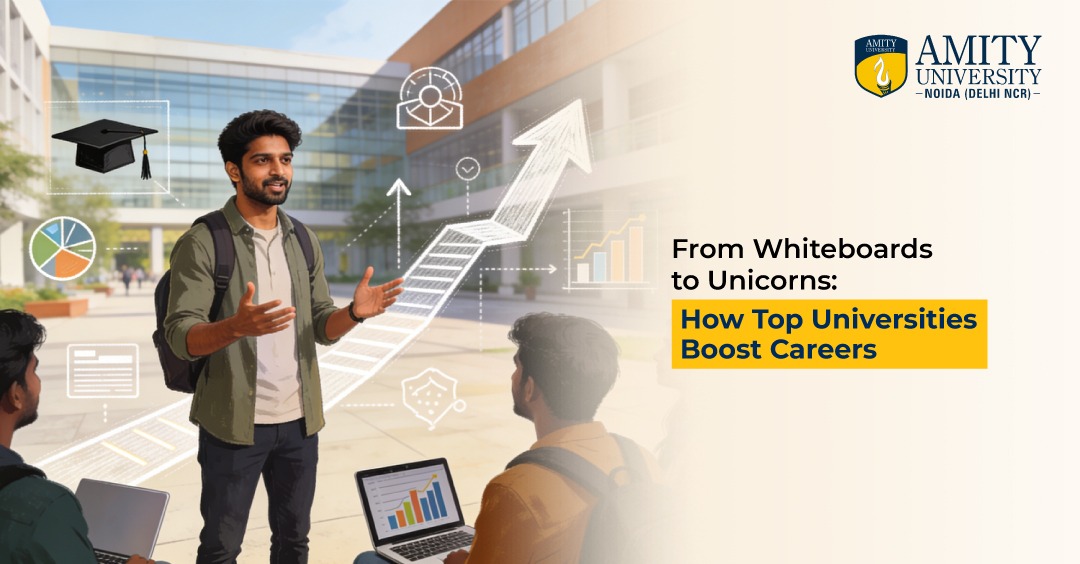
Isn’t it hard to imagine giant industry leaders like Tim Cook, Elon Musk, Narayan Murthy and Indira Nooyi as college students? In their youth, even they couldn’t have predicted the scale of their empire or success. Of course nothing works succeeds like hard work. But as demonstrated by these examples, the right university and program can catapult you from the classroom to the boardroom, with the right knowledge and skills. In today’s globally competitive world, it’s important to choose the right university.
Checklist: What is the ‘Right’ Premier University
-
Global Exposure
-
Industry Mentorship and Networking
-
Placements and Incubation Support
-
Research
How Amity Makes A HUGE Difference
-
Placement Cell
Students receive continuous support through skill development programmes, internships, live projects, industry mentoring, and career counselling. Regular workshops on resume building, interview preparation, group discussions, aptitude training, and professional etiquette ensure that students are well-prepared for campus placements. Recruiters value Amity graduates for their adaptability, communication skills, ethical grounding, and ability to apply theoretical knowledge in real-world scenarios. These qualities play a critical role in improving job placements and sustaining long-term career growth for alumni.
-
Amity School of Behavioural Science (AIBAS)
AIBAS provides practical training to students to enhance theoretical concepts and professional expertise in Psychology and Behavioural Science. The academic activities entail teaching and learning, research and industrial consultancy.
The academic training and innovative pedagogy enable students to work in a broad range of settings and profiles, including hospitals, industry, consultancy, research centre, counselling, private practice, academic writing, educational institutes, corporate, wellness centres and so on.
Equipped with relevant knowledge, skills and training, the AIBAS graduates, post graduates and researchers are actively engaged in various industry domains and contribute towards development and nation building. The institute runs undergraduate, postgraduate and doctoral programmes.
Impact of Behavioural Science on Careers
-
Understanding Consumers and Customers: Designing products and delivery by figuring out customer aspirations, challenges and needs.
-
Better Influence: Besides increasing compliance, behavioural science also make pitching ideas, negotiations more impactful and engaging.
-
Enhanced Decision Making Abilities: Expedites informed decision making by studying all aspects.
-
Negotiations and Conflict Resolution: It helps in transparent communication, reading body language to managing emotions which are critical in business contracts, deals and solving contentious situations.
-
Incubation Cell
The Amity Innovation Incubator is a pioneering concept in the context of Indian Universities. Supported by DST, Ministry of Science & Technology, GOI, 'Amity Innovation Incubator ' has earned an enviable position for itself with start-ups which have regularly been on top of the innovation curve and have been recognized on platforms like 'The Power of ideas', Read Herring Global winner, Tata NEN and NASSCOM Innovation Awards among others. Already, over $40m invested in Incubatee companies through Mergers & Acquisition and Angel Investments and it has launched virtual Incubation in 17 cities like Mumbai, Ahmedabad , Kolkata, Hyderabad, Chennai, Kochi, Bangalore etc.
Highlights
-
100 + Companies Incubated (physical & virtual); all showing significant financial & operating growth
-
Employment generated for more than 3500 people
-
263 + patents filed by Incubator for entrepreneurs, faculty and researchers
-
Ground breaking technologies being commercialized and utilized by groups such as Delhi Metro, LG Electronics, Microsoft, GreenSocs, Cadence Design Systems.
-
Research
Amity University Noida has established 50 hi-end Research Centres and Research Labs across diverse domains of Applied Science, Technology, Management, and Liberal Arts. These Research Centres serve as advanced Research Facilities dedicated to academic research and university research, and are striving to commercially scale up innovations to find solutions to some of the most pressing issues affecting the world. The Amity team of faculty members, scientists, and researchers has filed over 2,600 research patents across a wide spectrum of disciplines, including Nanotechnology, Biotechnology, Biosensors, Forensic Science, Pharmaceuticals, Microbiology, Software, Information Technology, Herbals, Photovoltaics, Electronics, and Food Processing.
-
Global Edge
Dual Degree Program- This innovative program lets students begin their studies at Amity University in India before transferring to a leading international partner university. Covering fields from business and psychology to engineering and commerce, it's designed for ambitious students seeking global perspectives.
Students graduate with two valuable credentials - one from Amity University and another from your chosen international institution. This approach significantly reduces the financial burden compared to completing an entire degree abroad.
Courses: BS Computer Engineering/ AI/ Data Science/ Comp. Sc., Master of Artificial Intelligence, BS Business Administration, BSc (Hons) Business Management, / Business Management with Year in Industry (Management/ Marketing/ Others), BA (Hons) International Business and Management, Bachelor of Science Advanced (Honours), MBA Business Analytics, MSc Management, BSc Computer Science/ Artificial Intelligence and Computer Science, BS Psychology, Bachelor of Science (BS) in Biomedical Science and more
Amity’s 3C Program- This program offers a supplement degree of Amity University with certificates from 2 other foreign institutions. Here, students gain a unique exposure via studying in 3 different continents namely Asia, Europe and America. While the initial semesters are completed at Amity University, as part of the program students spend 3 Months in U.K. and 3 Months in the US. Students pursue a part of their course in India while undergoing rigorous training in various technologies, cross-cultural issues, foreign languages and international practices.
Courses Offered: B.Tech CSE, B.Tech Biotechnology, B.Tech Civil Engineering, B.Tech Mechanical Engineering, B.Sc Hons Biotechnology, B.Sc Hons Medical Biotechnology, B.Com, BBA, BBA (International Business and AI), MBA, B.Des. Fashion Design, BA Hons International Relations, M.A. International Relations, B.A. Journalism and Mass Com, BA Hons Applied Psychology.
5. Amity Edge
-
Ticket to the world stage: Whether you’re aiming to be an insights sleuth through researcher or a data miner wanting to prove your mettle to the planet, Amity provides internship opportunities with top industry giants and research projects.
-
Toolkit for a Byte Hero: Students are encouraged to have a design thinking mindset by unearthing every possible solution or innovation to tackle real-world challenges through industry-live projects.
-
Innovation Playground: Our labs which are equipped with globally competitive machines and technology. Besides technical prowess, you will pick up in-demand skills like leadership, teamwork, risk taking, risk management, agility and flexibility.
-
Placements: Amity’s placements create benchmarks every year from garnering Rs 5 crore annual job package to placement in 500 corporates in campus recruitment including top Fortune 500 employers.
Conclusion
In the end, learning is not about education or degrees alone but sharpening the workplace and life skills from an ecosystem that channels the best of everything.