Best BA Colleges in India 2026: Rankings, Fees, Eligibility & Admission Process






The Common University Entrance Test (CUET) has revolutionized undergraduate admissions in India. Launched to ensure a common portal for students belonging to various boards and streams, the CUET is now one of the most prominent entrance exams in the country.
With the announcement of the CUET UG 2026 results, the admissions cycle has formally kicked off at universities. The University of Delhi has already opened up its admissions portal and begun the process of counseling and filling preferences.
For lakhs of students, the next question is not "When will the result be declared?" but "What should I do after getting my result?" This is where the knowledge about the entire admissions process and about universities like Amity University Noida comes into play.
The Common University Entrance Test (CUET) is administered by the National Testing Agency (NTA) to facilitate admissions into the undergraduate courses at Central Universities, State Universities, Deemed Universities, and Private Universities in India. The test serves as a one-window solution where applicants can apply to various universities based on their CUET score.
The results of CUET UG 2026 were declared on 23rd June 2026 by the National Testing Agency on its official website, where candidates can download their score cards through their application number and date of birth.
Post results announcement, universities have initiated the process of counselling and admissions. Many universities have started the first phase of the Common Seat Allocation System (CSAS).
Some of the benefits of CUET include:
A standardized admissions process for more than one university.
Opportunity for students to have equal chances from various schools.
No reliance on very high cut-off scores in board examinations.
Flexibility in choosing universities and courses.
In addition, the exam has increased the awareness of students to look for universities other than conventional ones and study in universities that offer good academic and career prospects.
Upon completion of the declaration of the results, the students should:
1. Download and Validate the Scorecard- Carefully check your percentile, scores per subject, and personal information.
2. Investigate Universities- Each university has different eligibility requirements and counselling procedures for admission.
3. Get Required Documents Ready- The list includes:
Mark sheets for class X & XII
CUET scorecard
Proof of identity
Passport-sized photographs
Category certificates (if any)
4. Apply to Desired Universities- Most universities consider applications through their portals or counseling procedures.
While selecting universities after clearing CUET, admission cannot be the only factor for students to consider. It must be the selection of an institute that will offer excellence in academics, career prospects, industry experience, and a wonderful campus life.
Widest Variety of Undergraduate Courses
Amity University Noida provides more than 100 undergraduate courses in varied domains like:
In this way, students with varied academic backgrounds can get courses that match their career aspirations.
Scholarships based on Merit
The cost of higher education is one of the major worries for both students and parents. Scholarships based on merit are offered by Amity University Noida to deserving students depending on:
Performance in Class XII
Scores on entrance examinations
Academic excellence
Students now consider the future job prospects while choosing a college. Amity University Noida has made excellent industry linkages and gives its students:
Internship programs
Industry interface
Job interview training
Skill development programs
Career counseling and mentoring services
The Corporate Resource Centre of the university works in tandem with the students for their successful recruitment and professional development.
Creativity and innovation form the cornerstone of the contemporary workplace. Some of the various activities that are encouraged at Amity University Noida include:
Research projects
Innovative schemes
Entrepreneurial ventures
Incubation programs
Industry collaborations
Global exposure and on-campus experience
University life is not limited to academics alone, but personal growth is an integral part of it. Some of those ways for students to achieve this at Amity University Noida are:
Students' societies/ clubs
Cultural activities
Sports
International partnerships
Positions of leadership
Choosing the Right University After CUET
Though your CUET score does matter, there are other things you need to consider while choosing the right university:
Quality of education
Expertise of faculty
Job placements
Scholarships and financial assistance
Campus atmosphere
Exposure to industry
Higher studies and research
The university you choose now may have a major role in shaping your career in the coming years.
Announcement of CUET UG 2026 results is the start of a very important period for Indian students. As the counseling process is now initiated, along with the commencement of admissions portals for the universities, students should make their decisions based on more than just rankings and cut-off scores.
Amity University Noida, with its multidisciplinary environment, industry exposure, scholarships, and multiple options of programmes, stands out among these options after the CUET exam.

Most Class 10 students get asked the same question dozens of times in the month of March. Which stream are you going to opt for in class 11th - science, commerce, or arts? Honestly, there is no definite answer to this question. The main reason is that the right stream depends on students' capability, ability to grasp subjects, interests, marks obtained in the 10th standard and similar other factors.
In the last 10 years alone, so many new career paths have opened up in tech, design, finance, and public policy. The old stereotypes about each stream are starting to look outdated. Picking between science vs commerce vs humanities after 10th isn't just about marks scored in Class 10 anymore. Let's explore other aspects as well.
A surprising number of students assume science is the "safest" stream because it keeps every option open. That used to be partly true earlier, but it isn't really the case anymore. Today, commerce graduates can easily move into data analytics and fintech roles. Some of these roles didn't even exist a decade ago. When it comes to humanities students, they increasingly land in UX research, public policy, and content strategy, fields that pay well. Traditionally, these job roles didn't attract humanities students at all.
|
Stream |
Core Subjects |
Best Suited For |
Common Career Paths |
|
Science |
Physics, Chemistry, Maths/Biology |
Analytical, detail-oriented students |
Engineering, medicine, research, IT |
|
Commerce |
Accountancy, Business Studies, Economics |
Numbers-driven, business-minded students |
CA, finance, management, entrepreneurship |
|
Humanities |
History, Political Science, Sociology, Psychology |
Curious, expressive, socially aware students |
Law, civil services, journalism, design |
Science is very demanding. Science students need concept clarity and an in-depth grasp of subjects like Physics and Chemistry. Last-minute cramming sessions will not help science students. Moreover, Maths or Biology adds another layer of complexity depending on whether a student leans towards engineering or medicine. Students who do well in science tend to share a few traits:
They enjoy solving problems methodically rather than memorising large volumes of text
They're comfortable with abstract concepts (vectors, chemical bonding, calculus)
They can sustain long study hours, since most competitive exams (JEE, NEET) demand serious preparation
If a student dreads numerical problems or finds Physics genuinely confusing rather than just unfamiliar, forcing science purely for prestige usually backfires by Class 12.
Commerce has successfully shed its old reputation as the "backup option". It's now one of the more practical choices for students interested in the functionality of businesses or how money works.
|
Career Track |
Typical Path |
Approximate Entry-Level Salary (India) |
|
Chartered Accountant |
B.Com + CA |
₹6-10 LPA |
|
Investment Banking |
₹8-15 LPA |
|
|
Business Analyst |
BBA/B.Com + Certifications |
₹5-8 LPA |
|
Entrepreneurship |
Varies |
Highly Variable |
Commerce suits students who like structure but also want flexibility, since it opens doors into finance, law (through CLAT), management, and even civil services later.
Humanities gets dismissed too quickly by students who haven't actually looked at what it covers. Psychology, Political Science, Sociology, and Economics involve serious analytical thinking, just applied to people and systems rather than equations. This stream works well for students who:
Read widely and enjoy forming opinions backed by evidence
Want careers in law, civil services, journalism, or social research
Are drawn to understanding why people and societies behave the way they do
Civil service aspirants, in particular, often benefit from a humanities background, since UPSC's syllabus overlaps heavily with subjects like History, Polity, and Sociology.
Among the most searched career options after 10th, here's a realistic breakdown:
|
Goal |
Recommended Stream |
|
Engineering, medicine, research |
Science |
|
CA, MBA, Business Ownership |
Commerce |
|
Law, Civil Services, Design, Media |
Humanities or Commerce |
|
Defence Services |
Any stream (with PCM preferred for technical entries) |
It's worth noting that students can switch streams later. Suppose a student chooses to shift from science to commerce; it is possible, but it adds friction. Although switching from the humanities to science is far harder. As it involves the foundational gap in subjects like Physics and Chemistry.
There isn't a single best stream after 10th for all students. Students should evaluate their capabilities and interest to choose among the various streams.
Science offers the widest range of technical careers to students. But it also demands the most consistent effort. Whereas commerce balances stability with flexibility. It increasingly leads to high-growth roles in finance and analytics. On the other hand, Humanities, often underrated, open doors into law, governance, and the fast-growing world of UX, research, and policy work.
The students who do well in any stream usually share one trait: they chose based on genuine interest rather than on peer pressure or family expectations. A mediocre student in a "prestigious" stream usually performs worse than a strong student in a stream that actually suits them.
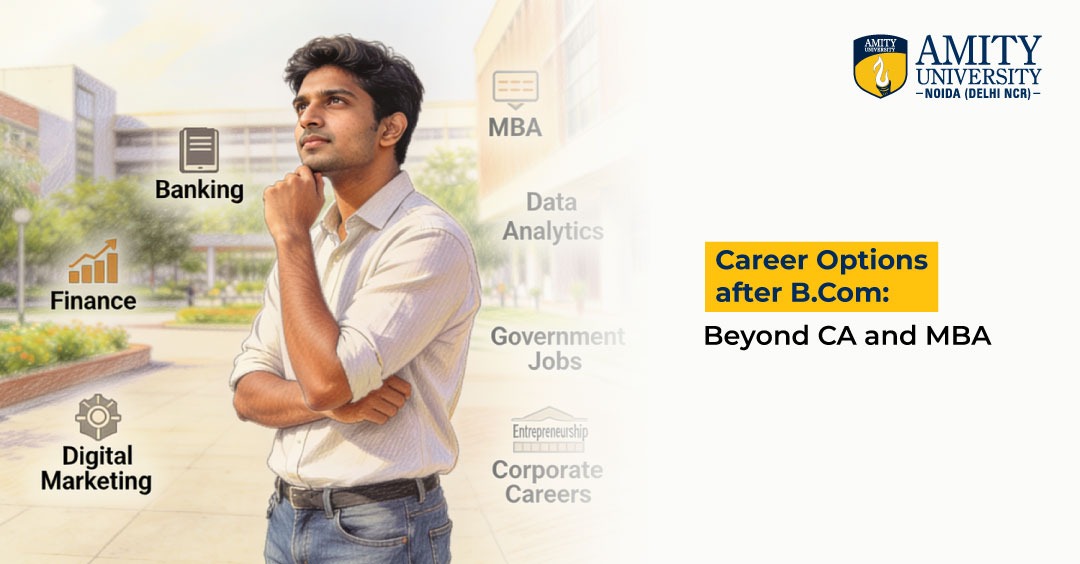
The pathway to becoming a BCom student in India was always cut and dry – either pass the tough Chartered Accountancy (CA) exams or start preparing for CAT right away to get an MBA. But, as we move towards 2026, the economic infrastructure and ecosystem of corporations have changed in many ways.
The emergence of predictive data analysis tools, quantitative algorithms, decentralized financial infrastructure, and stringent regulatory frameworks for environmental concerns has made things different. Modern business environments value dynamic and specialized professionals over all-purpose ones.
As a BCom student, who is looking ahead towards 2026, the typical corporate hierarchy has evolved into a more dynamic network of career options. Let us look into the most lucrative alternative career paths after bcom that are shaping up the corporate world today.
There may not be anything more explosive in terms of job opportunities in 2026 than the convergence of corporate finance and data analytics. It is not only historical numbers in the ledger books any longer, but rather a live system of predictive finance engines.
Both traditional banking firms and new-age FinTech giants need finance graduates who have the ability to speak through programming languages. Financial Data Analysts are responsible for interpreting massive transaction data, measuring key performance indicators, and communicating findings in numerical terms. As per international recruitment standards in technology, an annual pay scale for analysts ranges between ₹4.5 LPA to ₹10 LPA, way ahead of old-fashioned bookkeepers.
* Financial modeling & predictive analysis
* Knowledge about interactive visualization tools such as Power BI or Tableau
* Algorithmic trading pattern & automated risk management frameworks
Although the immediate corporate employment seems very appealing to many, some other people are aware of the fact that academic strength leads to better executive advantage in the future. It is precisely this understanding that has led to a huge comeback in advanced master's courses.
Taking up M.Com Admission 2026 gives you much more than just a continuation of undergraduate studies. The postgraduate programs have been structurally designed in accordance with global standards. In fact, opting for a highly specialized course in M.Com Finance makes students acquainted with advanced concepts such as corporate tax planning, stochastic risk processes, and behavioral finance.
Alternative Finance Career Framework - 2026
┌──────────────────────────────────────┐
│ Postgraduate Specialization (M.Com) │ ──► Strategic Research & Advisory
├──────────────────────────────────────┤
│ Global Professional Certifications │ ──► Equity Analysis & Portfolio Ops
├──────────────────────────────────────┤
│ Technological Convergence (FinTech) │ ──► Quantitative Risk Mitigation
└──────────────────────────────────────┘
A successful design for an academic trajectory will call for identifying a progressive institute that provides metrics of integration between traditional curriculum and digital transformation. Prestigious learning institutions, such as Amity University Noida, offer architecture at the masters' levels where financial accounting is successfully merged with progressive modules of forensic accounting and fraud assessment.
If you are keen to be active within major global financial centers, it will be important for you to hold certificates that will not require crossing any borders.
The corporate world today operates with multinational harmony, which demands experts skilled in international accounting measurements.
US CPA Path: US Certified Public Accountant certificate is used as a benchmark for international accounting clarity. CPAs are extremely valued in the four big auditing firms and multinational conglomerates dealing with cross-border financial transactions.
US CMA Path: For the aspirants with corporate strategies as their interest area instead of auditing, the Certified Management Accountant certificate can prove to be helpful.
The capital markets of 2026 have become increasingly rapid and intricate compared to the past. This speed necessitates high-level analysts capable of assessing risks, creating strong portfolios, and managing major mergers and acquisitions.
Graduates of the BCom program with quantitative aptitude may move into upper finance roles:
Investment Banking Analyst: These analysts focus on capital infusion strategies, assessing the valuations of companies, and creating financial structures for IPOs.
Wealth Management Analyst: This role operates on both the institutional and high-net worth individual levels and focuses on creating strong asset portfolios.
The idea of seeing a BCom qualification as simply a stopgap towards becoming a CA or an MBA is now out-of-date in terms of official status. As we move further into the year 2026, what business requires are professionals who are specialists, data literate, and global in their perspective. You could opt for the specialist route in data analytics, become an internationally accredited accountant, or take the route to becoming a scholar through the integrated master’s program. Your options have never been more varied.
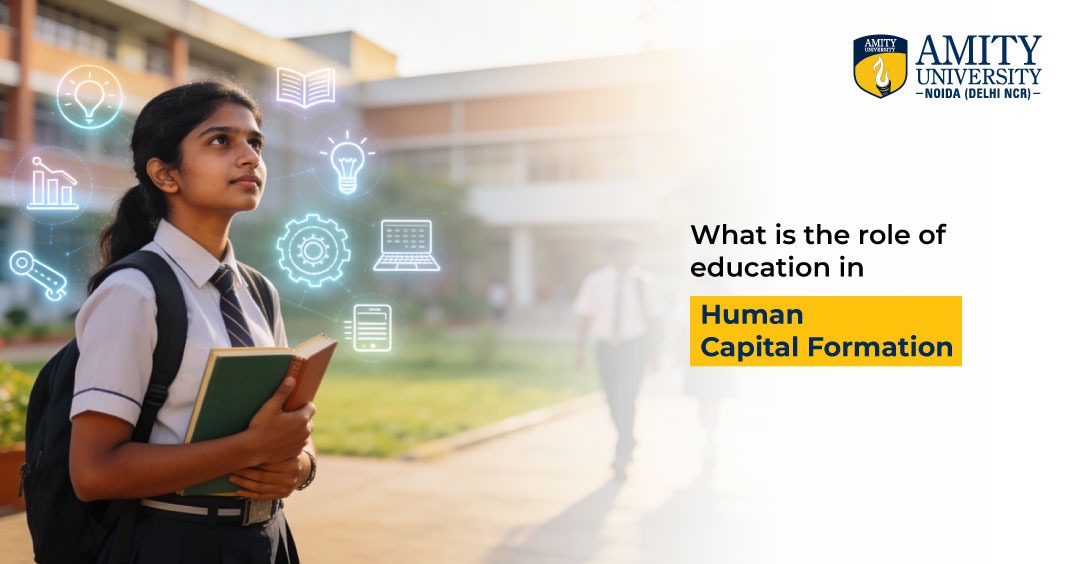
With the advent of the knowledge-based economy in modern times, the most valuable resource of any country is no longer its natural wealth or infrastructure, but people. The skills, knowledge, health, and abilities of individuals constitute human capital as defined by economists. Amongst several elements responsible for the creation of human capital, education holds the greatest significance.
The role of education in human capital formation goes beyond the acquisition of knowledge alone. Through education, individuals gain skills and become productive and more likely to get employed, and ultimately help drive economic and social development. Countries investing significantly in education are seen to be growing economically and socially at a faster rate.
In this blog, the concept of human capital formation and the role of education in its formation are discussed. With the advent of the knowledge-based economy in modern times, the most valuable resource of any country is no longer its natural wealth or infrastructure, but people. The skills, knowledge, health, and abilities of individuals constitute human capital as defined by economists. Amongst several elements responsible for the creation of human capital, education holds the greatest significance.
Human capital formation is all about the process of making people knowledgeable and healthy enough so that they become capable of contributing to the economic processes and development of society.
This concept has become popular owing to the works of certain economists like Theodore Shultz and Gary Becker, who suggested treating education and training as an investment and not just as a cost. Human capital formation may include such elements as:
Education and training
Skills acquisition
Healthcare and nutrition
Research and innovations
Professional experience and learning
Among these components, education plays a fundamental role as other elements are based on it.
Education assists individuals in gaining knowledge, developing skills, and building problem-solving and adaptation capabilities. It makes people ready to work in the market and contribute to economic development. There are several ways in which education facilitates the process of human capital creation.
1. Increases Knowledge and Skills- The main aim of education is to provide people with technical knowledge, cognitive skills, and competencies that will make them efficient and productive. For instance:
Primary education increases literacy and numerical abilities.
Secondary education improves the capacity for analysis and communication.
Higher education and vocational training offer special competencies.
The World Bank suggests that each year of education brings considerable income gains and increases productivity.
2. Increases Productivity and Economic Growth- Educated people are likely to be more productive because they can make effective use of technology, cope with the dynamic work environment, and address difficult situations. The countries that are characterized by high levels of educational attainment usually have:
Greater labour productivity
Higher per capita income
Greater innovativeness and entrepreneurship
Economic competitiveness
For example, there is always a close correlation between the two variables (educational attainment and economic performance) according to the OECD statistics.
3. Enhances Career Prospects and Wages- Education enhances career prospects because it equips individuals with skills to perform in a wide range of careers. The educated people are likely to have:
Greater employment prospects
Greater wage levels
Career mobility
Reduced the chances of being unemployed
It has been found by the ILO that the unemployment rate is lower for educated individuals than for uneducated people.
4. Promotes Innovation and Technological Developments- Innovation is highly dependent on the availability of educated and skilled people who can perform research, develop technology, and improve the current processes. Universities, research facilities, and technical training institutes play a critical role in:
Scientific innovations
Technological innovations
Innovations in products
Development of the entrepreneurship ecosystem
South Korea, Singapore, and Finland are good examples of countries that managed to undergo technological and economic transformation because of investment in education.
5. Promotes Social Development- Education plays not only an economic but also a social role in human capital formation by:
Improving health status
Promoting gender equality
Encouraging civic activities
Creating social inclusion
Reduction of poverty
Educated people are usually well-informed about healthcare, the environment, and civic affairs, which helps them build stronger societies.
6. Encourages Adaptability in a Changing Economy- In the contemporary world, the workforce is changing fast owing to automation, artificial intelligence, and digital transformation. An education enables people to:
Learn about new technologies
Keep reskilling and upskilling throughout their career lives
Keep adapting to new job demands
Engage in new emerging industries
Thus, lifelong learning is becoming a key feature of human capital development in the digital age.
7. Promotes Entrepreneurship and Leadership- Education develops the skill sets such as critical thinking, decision making, and problem-solving skills needed for entrepreneurship and leadership. The entrepreneurs need education to be able to:
Spot opportunities
Run businesses
Know about the financial system
Find innovative solutions
The educational background leads to the building of companies that create jobs and economic growth.
Educational systems are typically considered an investment by economists due to the fact that investments yield profits both at the individual and social levels. A few of the personal benefits are:
Higher salary
Career prospects
High standard of living
Job stability
Social benefits
Economic growth
Productivity
Poverty alleviation
Tax income
Well-developed institutions
Human Capital Index, compiled by The World Bank, emphasizes the point that nations that invest in health and education experience more prosperous economic development.
These countries have proved that proper investments in education bring positive outcomes.
Even though education plays a crucial role in building human capital, some obstacles that hinder the process include:
In the light of growing knowledge-based economies, the educational system is evolving towards:
Digital literacy
Critical thinking
Interdisciplinary approach
Life-long learning
Industry-oriented training
The future of human resource development would depend not only on expanding access to education but also on ensuring the quality of education.
Educational investment as an instrument of building up the stock of human capital is a very important component for success on a personal level as well as on a nationwide level. The process of learning leads to increasing knowledge, acquiring skills, improving labor productivity, developing innovations, and social prosperity.
Continuing to change, the world still provides educational investment as one of the most successful tools for building up human capital.
For the majority of students completing Class 12, choosing the ideal undergraduate course is often the first major decision of their educational life. One of the courses that has always been quite popular in India is the Bachelor of Science (BSc). In recent times, many changes have taken place in BSc courses, as they have become more relevant to meet industrial needs.
If you are looking forward to applying for BSc Admissions 2026, knowing about specializations, admission procedure, selection process, and career prospects can be helpful.
A Bachelor of Science (BSc) degree is an undergraduate program that usually lasts for about three to four years. The focus of the BSc program is on learning in terms of science, analysis, and research. Some fields of study include:
Physics
Chemistry
Mathematics
Biotechnology
Microbiology
Psychology
Environmental Science
Data Science
Artificial Intelligence
Computer Science
Bachelor of Science Information Technology (BSc IT)
There are many institutions today offering programs that involve research as well.
Although there may be some differences in terms of eligibility criteria for different institutes, the basic criteria for BSc Admission 2026 will be:
Academic Criteria
Class 12 from a recognized board.
Qualifying marks to be secured as per the university’s criteria.
The science stream is usually preferred for most of the BSc courses.
However, interdisciplinary courses can be an exception to this rule.
Certain specialisations may require specific subjects in Class 12:
|
Specialisation |
Preferred Subjects |
|
Physics |
Physics, Mathematics |
|
Chemistry |
Physics, Chemistry |
|
Biotechnology |
Biology, Chemistry |
|
Mathematics |
Mathematics |
|
Psychology |
Any stream (varies by university) |
|
BSc IT |
Mathematics and Computer Science preferred |
Universities usually have one of the following systems for admitting students:
Merit-Based Admission- Admissions are granted on the basis of Class 12 results. Universities usually declare merit lists by evaluating the academic profile of the candidate.
Entrance-Based Admission- In some universities, entrance tests are held, and national-level exam marks are also taken into account.
Interview/ Counselling- For research programs and interdisciplinary courses, there can be further rounds of evaluation, including interview/counselling.
The admission process usually includes:
Online application
Verification of documents
Merit/ Entrance evaluation
Granting of admissions
Payment of fees and enrollment
Increased demand for specialized skills has increased the field of education in BSc.
BSc Information Technology (BSc IT)- One of the fastest-growing undergraduate programs, BSc Information Technology provides skills in software development, cloud computing, cybersecurity, databases, and other digital technologies. Modern BSc IT includes:
Programming languages
Database systems
Web technologies
Networking
Artificial intelligence basics
Cybersecurity basics
Data analytics
With the digital revolution picking up speed in all sectors, graduates can consider their career opportunities in tech firms as well as non-tech organizations.
Selecting the appropriate university for one’s study is a crucial step in the admission process of BSc Admission 2026. Students must select universities depending upon the quality of the university, faculty, research facilities, industry exposure, infrastructure, and career development services of the university.
BSc admission into Amity University Noida provides the advantage of studying in an institute that offers both quality and practical education. Whichever option you choose, whether it be B.Sc. (Hons.) Clinical Psychology with Research, Biotechnology, Mathematics, or Physics, etc., the courses will not only enable you to acquire comprehensive knowledge but also provide practical education through lab work, research work, exposure in the field, etc. The student will get the benefits of having experienced teachers, equipped labs, research-oriented teaching, and an outcome-based academic program.
Amity University Noida also differentiates itself from other universities due to its focus on innovation, research, and holistic development of students. Students are given chances to get involved in research work, interact with industry experts, and develop problem-solving and analytical skills, along with gaining exposure to the latest scientific discoveries. It has state-of-the-art infrastructure along with collaboration with the industry to create an ecosystem for students to build their academic as well as professional strengths.
Some other BSc and BSc (Hons.) programs are offered at Amity University Noida in various fields such as Information Technology, Psychology, Biotechnology, and Applied Sciences. The university focuses on providing research-based learning, industry exposure, state-of-the-art laboratories, international tie-ups, and a multidisciplinary approach towards education. One such program of BSc (Hons.) Information Technology with Research equips students with both technical and research skills.
One of the myths associated with BSc degrees is that such education restricts the number of available job options. In fact, the BSc can be used to start various career paths.
Technology Jobs: Useful particularly for the students who completed BSc IT programs:
Software Developer
Systems Analyst
Network Administrator
Database Administrator
IT Support Specialist
Cloud Support Associate
Data Analyst
Research and Science Jobs: Possible career options for graduates with science majors include:
Research Assistant
Lab Analyst
Scientific Associate
Quality Control Officer
Clinical Research Coordinator
Healthcare & Life Sciences: For the students with specializations in biotechnology, microbiology, etc:
Pharmaceutical Industry
Healthcare Organizations
Diagnostic Services
Biotechnology Companies
Education & Training: Popular career path for many graduates:
Academic Research
Teaching
Content Creation for Education
Training & Skill Development
A number of government institutions employ science graduates by conducting competitive exams and recruiting processes specific to them.
Higher Education Opportunities for Post BSc- Some students prefer pursuing further studies. Possible postgraduate studies include:
MSc
MCA
MBA
MTech (via suitable routes)
MA in Psychology
Programmes in Data Science and Analytics
Specialisation in Artificial Intelligence
International postgraduate degrees
BSc 2026 Admissions offer students multiple options in terms of education and career. Be it in the field of healthcare, technology, analytics, psychology, or scientific research, there is no dearth of opportunities for those who choose an appropriate BSc course. As the trend of multidisciplinary and research-based approaches continues to be adopted by universities, more opportunities await the students.

The modern office is changing super fast, offering cool chances for those ready to evolve. With industries adopting new tech, working together globally, and needing specialized expertise, industries look for people with more than just a bachelor’s degree. That's where a postgrad program really makes a difference.
More than just another course, a PG degree is a serious investment. It's about boosting your career, honing leadership skills, deepening industry knowledge, and setting you up for success in the long run. No matter if you wanna climb the ranks where you are, switch to something else, dive into research, or prep for management, going postgrad gives you the edge to do great things in today’s cutthroat world.
The demand for specialized talent is growing across sectors such as technology, management, finance, healthcare, media, data analytics, artificial intelligence, and entrepreneurship. Organizations are looking for professionals who can contribute strategic insights, solve complex problems, and adapt to emerging industry trends.
This shift has made upskilling for career growth a priority for ambitious professionals. A postgraduate degree offers structured learning, industry-oriented training, and advanced subject knowledge that helps individuals remain relevant in an ever-changing job market.
Unlike short-term certifications, a PG programme provides comprehensive learning that combines theoretical foundations with practical application. Students gain a deeper understanding of their discipline while developing transferable skills such as critical thinking, leadership, communication, collaboration, and decision-making.
Pursuing a postgrad degree gives you access to more career options. Employers tend to look for candidates with advanced qualifications for specialized roles, management positions, consulting, and research roles. It shows you're dedicated to your field, can tackle tough tasks, and are an expert in your area.
Graduates can explore opportunities in areas such as:
Business and Management
Data Analytics and Artificial Intelligence
Marketing and Digital Strategy
International Business
Public Policy
Media and Communication
Research and Development
Entrepreneurship
This expanded career scope allows professionals to pursue roles aligned with their interests, strengths, and long-term aspirations.
A key advantage of postgraduate studies is the emphasis on industry-relevant learning. Today's leading universities design programmes in collaboration with industry experts, ensuring that students acquire practical knowledge that aligns with current market needs.
Students engage in:
Live industry projects
Case studies
Simulations
Research assignments
Internships
Industry interactions
Capstone projects
These experiences bridge the gap between classroom learning and workplace expectations, helping students build skills that employers actively value.
For professionals wondering how to improve employability after graduation, a postgraduate programme provides a structured pathway to acquire both technical expertise and workplace competencies.
Nowadays, organizations need professionals who can lead teams and make strategic calls, not just a senior executive. Leadership is expected at many levels. That's where a grad degree comes in; it grows those skills through group projects, talks, fixing problems, and biz classes.
Students learn to:
Analyze complex business challenges
Manage teams effectively
Communicate ideas confidently
Resolve conflicts constructively
Make informed decisions under pressure
Drive innovation within organizations
These skills contribute significantly to professional advancement and prepare graduates for leadership roles across industries.
Career success is often influenced by both expertise and professional connections. Postgraduate education provides opportunities to interact with faculty members, industry leaders, alumni, researchers, entrepreneurs, and fellow professionals from diverse backgrounds.
This network can prove valuable throughout a person's career by offering:
Mentorship opportunities
Industry insights
Collaborative projects
Internship referrals
Career guidance
Professional partnerships
Strong professional networks often open doors to opportunities that may not be accessible through conventional job-search methods.
As industries become increasingly specialized, employers seek candidates who possess deep expertise in specific domains. A postgraduate degree allows students to develop advanced knowledge in areas that align with their career goals.
Whether pursuing a Master's in Business Administration, Data Science, Artificial Intelligence, Finance, Biotechnology, Psychology, Media Studies, or International Relations, students gain specialized skills that distinguish them in the job market.
This specialization enhances professional credibility and creates pathways to higher-level positions that require advanced subject expertise.
The future workplace will continue to be shaped by digital transformation, automation, sustainability initiatives, and global interconnectedness. Professionals who continuously learn and adapt will be best positioned to succeed.
A PG degree equips students with future-ready skills such as:
Analytical thinking
Data interpretation
Innovation management
Digital literacy
Strategic planning
Research capabilities
Cross-cultural communication
These competencies help graduates remain agile and competitive as industries evolve.
For individuals seeking career advancement through higher education, postgraduate studies offer a strong foundation for navigating future opportunities with confidence.
The worth of a postgraduate degree relies a lot on how good the university is. Students should go for universities that mix top-notch teaching with practical experience, links to industries, chances to learn globally, and help with finding jobs.
Places like Amity University Noida really focus on experiential learning, doing this through research, working with industries, fostering innovation, setting up internships, and making international connections.
This sort of setup lets students face real-world issues and build the skills today’s job market demands.
Students pursuing postgraduate education benefit from:
Industry-oriented curriculum
Global academic collaborations
Research-driven learning environment
Internship and live project opportunities
Innovation and entrepreneurship support
Modern laboratories and learning infrastructure
Strong corporate engagement
Extensive placement opportunities
These experiences help students build practical expertise while preparing for successful careers across sectors. The university's focus on innovation, employability, leadership, and industry readiness aligns closely with the expectations of modern employers.
Upskilling is now a key way to boost your career in today's ever-changing work world. Getting a postgrad degree isn't just about getting another piece of paper; it gives you deep knowledge, specialized skills, leadership abilities, industry insight, and pro connections that can really amp up your job chances.
As firms look for smart candidates who can manage complex tasks and spark creativity, advanced study keeps being a top route to pro success. If you pick the right program and setting, you can line yourself up for awesome career paths, bigger duties, and long-term growth in a super competitive global job market.

Selecting the right college after Class 12 can prove to be a very significant decision, particularly when the choice is made between BA colleges in India. With so many universities having several different courses and specializations, it becomes rather tough for students to decide which BA college in India would suit them best.
It is not true anymore that a Bachelor's of Arts course includes only conventional humanities subjects. Nowadays, various universities provide courses in Economics, Psychology, English, Political Science, Journalism, Sociology, Public Policy, International Relations, and much more, which train students for careers in Civil Services, Media, Research, Law, Management, Education, and the corporate sectors.
In this guide, you will come across all those BA colleges in India that are topmost and offer all these things in addition to providing a lot of information about the fee structure, eligibility, selection procedure, etc.
|
College |
Location |
Approx. Annual Fees |
Admission Process |
Popular BA Specialisations |
|
Miranda House |
Delhi |
₹15,000–₹20,000 |
CUET UG |
English, Political Science, Economics, History |
|
Hindu College |
Delhi |
₹20,000–₹30,000 |
CUET UG |
English, Sociology, Political Science, History |
|
Lady Shri Ram College (LSR) |
Delhi |
₹20,000–₹35,000 |
CUET UG |
Psychology, Economics, English, Journalism |
|
Amity University Noida |
Noida |
₹1.4–2.5 lakh |
Merit-Based / Entrance & Personal Interview (programme-specific) |
Psychology, Economics, English, Journalism, Political Science |
|
Christ University |
Bengaluru |
₹80,000–₹2 lakh |
Entrance Test & Interview |
Psychology, Economics, English, Media Studies |
|
Loyola College |
Chennai |
₹60,000–₹1 lakh |
Merit-Based |
English, Sociology, Economics, History |
|
Symbiosis College of Arts & Commerce |
Pune |
₹40,000–₹80,000 |
Merit-Based |
Economics, English, Psychology |
Note: Fees are approximate and may vary depending on the programme and academic session
The Miranda House College is among the best colleges of India for humanities and social sciences. The college has earned fame for its excellent academics, experienced faculty members, and lively campus activities, and thus draws the finest students to itself from all over the country. The courses of study are based on analytical skills, research, communication, and critical reasoning.
Features
NAAC A++ Accreditation
Very competent faculty members
Outstanding academic record
Alumni networks
Excellent placement records and higher education achievements
Hindu College is well known for its academic excellence and holistic development of the student. There are various popular BA courses offered by the college in the fields of humanities and social sciences. The students get a chance to interact with different types of discussions, research sessions, internships, and extra-curricular activities, which help in developing their personality.
Popular BA Courses
English
Political Science
Sociology
History
Philosophy
Lady Shri Ram College is one of the best colleges for women in India. The college stands out because of courses like Psychology, Economics, Journalism, and English. The students get the opportunity to study under experienced teachers who use advanced methodologies in teaching and give exposure to research and industry experts. LSR alumni are doing well in their lives as civil servants, journalists, policymakers, educators, corporate employees, and entrepreneurs.
Amity University Noida is one of the best BA colleges in India, where you get career-focused education with practical exposure in addition to theoretical knowledge through interactions with industries, internships, research, skill development programs, etc. You can opt for various specializations within BA, such as Psychology, Economics, English, Journalism & Mass Communication, Political Science, Liberal Arts, etc.
The syllabus keeps getting revised based on changing needs of the industry and academia. What is also great about Amity University Noida is that it offers holistic development of its students, providing them with modern classrooms, advanced learning resources, collaboration with international institutions, participation in various clubs, innovation centers, conferences, competitions, research works, and much more.
Career services, internships, corporate interaction, etc., also help the students to explore themselves in the fields of media, education, public policy, consultancy, corporate communication, research, and many others.
Why Should You Choose Amity University Noida?
Various BA specializations
Curriculum oriented to the needs of the industry
Faculty members with a lot of experience
Modern infrastructure of the campus
Internships and placement assistance
Research and innovation
Academic collaborations globally
Holistic student development
One of the most distinctive features of Christ University is its interdisciplinary nature and focus on hands-on experience of learning by combining classroom instruction with internships and other activities. The courses of BA in Psychology, Economics, English, and Media Studies offered by this institution continue to be very popular among students. Christ University also has a good industrial interface that helps students get practical experience while pursuing their studies.
Loyola College has earned a good reputation for humanities education over many years. The college emphasises academics but also promotes leadership, ethics, and social responsibility. There is an experienced faculty, a thriving research community, student organizations, and alumni networking.
Some of the popular B.A. subjects are:
English Literature
Economics
Sociology
History
Philosophy
The Symbiosis College is known to provide quality education at an undergraduate level, where there is a proper balance of academics, extracurricular activities, and professional aspects of the course. The BA program develops critical thinking and communicative abilities among students, along with interdisciplinary knowledge. Moreover, students get involved in seminars, internships, workshops, and industrial visits as part of the course.
The following are the processes followed for admissions in most of the top BA colleges in India:
Visiting the official website of the preferred university.
Filling up an online application form.
Submitting the necessary academic documents.
Making payment of the application fee.
Attending the entrance exam, if any.
Going through the counseling/personal interview process, if needed.
Getting the admission offer and verifying documents.
Paying the admission fee to secure your seat.
Early application gives you an edge over others for admissions.
The need for IT professionals has been increasing day-by-day with the increase in dependence of businesses on digital technologies, artificial intelligence, cloud computing, cybersecurity and data analytics. Among those students who have completed their Class 12th and wish to pursue a career in technology field, Bachelor of Computer Application (BCA) course is the most desired bachelor programme.
Selecting among the best BCA colleges would help you a lot in making your experience of learning better and give you better exposure in industry. Besides curriculum and teaching faculty, there are many other aspects such as collaboration with industries, infrastructure, placements etc. that will be useful in deciding the right college.
This guide will discuss about the best BCA colleges in India for the year 2026 and many more details including comparison of various features, eligibility and admission criteria.
|
Rank |
College |
Approx. Annual Fees |
Admission Process |
Highlights |
|
1 |
Christ University, Bengaluru |
₹2–3 lakh |
Entrance Test + Interview |
Academic excellence, industry exposure, strong placements |
|
2 |
Symbiosis Institute of Computer Studies and Research (SICSR), Pune |
₹3–4 lakh |
SET/Institute Process |
Emerging technology specialisations, project-based learning |
|
3 |
Amity University Noida |
₹2–3 lakh |
Merit/University Selection Process |
Industry-oriented curriculum, advanced labs, global exposure, placement support |
|
4 |
Loyola College, Chennai |
₹60,000–₹1 lakh |
Merit-Based |
Affordable education and strong academic reputation |
|
5 |
Jain (Deemed-to-be University), Bengaluru |
₹2–3 lakh |
Merit/University Process |
Innovation-driven learning and industry certifications |
|
6 |
Chandigarh University |
₹1.5–2.5 lakh |
CUCET/Merit |
Industry collaborations and international exposure |
Note: This list is an editorial comparison based on academic reputation, curriculum, industry exposure, infrastructure, placement support, and student opportunities. It is not an official government or NIRF ranking.
Christ University is renowned for the standards of academics and its comprehensive approach towards higher education. The BCA program emphasizes development of sound knowledge regarding programming, software engineering, databases, networking, and new technologies. Students are provided an opportunity to get involved in live projects, research, code-related events, and technical associations which promote experiential learning. There is a strong linkage between Christ University and the industry via internships, workshops, seminars, and lecture sessions arranged by industry experts. Well-equipped labs along with highly qualified faculty members ensure practical learning throughout the duration of the course. The alumni of Christ University have always achieved good placements in IT industries and also pursued further education in computer application and other specialized technological fields.
SICSR is recognized for its provision of technology-based education by means of an industrial curriculum. The BCA course is designed in such a way that the combination of theory and practice will enable students to gain proficiency in programming languages, software development, database administration, mobile application development, cloud computing, and cybersecurity. The students take part in internships, research projects, coding contests, and other activities which will prepare them for their future career. Modern computing facilities and faculty play a major role in making the learning process interesting. Moreover, there is a great deal of focus on the skills of communication, teamwork, and innovation at the institute.
Amity University Noida has emerged as one of the top BCA colleges in India, offering a combination of both theoretical knowledge and industry experience. The curriculum is formulated keeping in view the objective to provide training to students to become competent professionals in the field of software development, cloud computing, artificial intelligence, cyber security, web technology, and data analytics. Students get to enjoy state-of-the-art computer labs, project work, hackathons, coding competition, and internship at reputed organizations. The university provides scope for earning industry certifications, innovation program participation, and interaction with industry experts. Placement assistance, career counseling, and collaboration with technology firms are also provided by the institution to increase employability prospects of students. The curriculum is kept up-to-date with industry standards to help students pursue careers in IT companies or MCA/MBA programs.
Loyola College is still amongst the top ranked institutes in India offering quality higher education at an affordable cost; hence, it is often considered one of the best BCA Colleges. The course offers a well-balanced knowledge of programming, operating systems, database management, Web technology, and software engineering. The students get the opportunity to learn from qualified faculties, have access to well-stocked computer labs, and participate in various academic clubs. Loyola College also encourages innovation and extracurricular activities along with classroom study. The alumni either work as developers, IT consultants, or digital technologies specialists or join in higher education in computer applications.
The BCA course offered by Jain University is one which comprises of technology, innovation, and interaction with the industry. The students get an exposure to programming, artificial intelligence, machine learning, cloud computing, cyber security, and data science. Entrepreneurship, innovation competitions, hackathons, and skill enhancement activities are encouraged by the university as additional means along with the academic curriculum. The industry certifications, internships, and interaction with technology professionals make the students industry-ready. With advanced infrastructure, expert faculty, and placement assistance, the graduates of Jain University are prepared for a career in software development, business analytics, information technology consultancy, and other new technology sectors.
Chandigarh University has gained recognition for its technology-driven curriculum and emphasis on industry partnerships. The BCA programme equips students with practical skills in programming, software engineering, web development, database management, cloud computing, and cybersecurity. Students participate in internships, live industry projects, coding competitions, innovation centres, and international collaborations that strengthen practical knowledge. Modern laboratories and advanced digital infrastructure support experiential learning throughout the programme. The university also focuses on personality development, communication skills, and placement preparation through dedicated career services. Graduates are well-positioned for employment in software companies, technology startups, consulting firms, and multinational organisations, as well as postgraduate studies.
Selecting one of the best BCA colleges in India is an important step toward building a successful career in the rapidly evolving technology sector. While factors such as rankings and fees are valuable, students should also evaluate curriculum quality, practical learning opportunities, faculty expertise, infrastructure, and placement support. Universities that offer industry-oriented education, hands-on projects, internships, and exposure to emerging technologies can better prepare graduates for future opportunities. Before making a final decision, compare multiple institutions, review the latest admission requirements, and choose the programme that best aligns with your career goals.
Demand for IT specialists is on the rise, as companies in all spheres adopt new technologies such as digital transformation, artificial intelligence, cloud computing, cybersecurity, and data analytics. If you plan to build a career in any of these specializations, then pursuing a Master of Computer Applications (MCA) could be among the most rewarding postgraduate courses for you in India.
Whereas a course like MCA ensures technical competency of its students, the selection of the right institution becomes even more important in such a case. The Top MCA Colleges in India do more than just teach; they provide relevant coursework, well-qualified teachers, modern computing laboratories, internships, research options, and excellent placements. All these become important for developing skills for a career in technology companies and other big firms.
With multiple universities providing MCA programmes, comparison becomes difficult. In order to make it easy for you to compare universities and select the best one, we bring to you a list of the Top MCA Colleges in India. They have been selected based on their reputation in academics, curriculum, faculty qualifications, infrastructure, industrial connections, and placement records.
|
Rank |
College |
Approx. Total Fees |
Admission |
Best Known For |
|
1 |
National Institute of Technology Tiruchirappalli (NIT Trichy) |
₹2–2.5 Lakhs |
NIMCET |
Academic Excellence & Placements |
|
2 |
National Institute of Technology Warangal |
₹2–3 Lakhs |
NIMCET |
Research & Technical Learning |
|
3 |
Birla Institute of Technology (BIT) Mesra |
₹5–6 Lakhs |
Merit/Institute Process |
Industry-Oriented Curriculum |
|
4 |
Vellore Institute of Technology (VIT), Vellore |
₹2.5–3 Lakhs |
Merit |
Global Exposure & Innovation |
|
5 |
Amity University Noida |
₹4–5 Lakhs |
Merit + PI |
Industry Projects & Career Support |
|
6 |
Christ University |
₹3–4 Lakhs |
University Selection |
Holistic Learning |
|
7 |
SRM Institute of Science and Technology |
₹3–4 Lakhs |
Merit |
Emerging Technologies |
|
8 |
Chandigarh University |
₹2–3 Lakhs |
CUCET/Merit |
Skill-Based Learning |
|
9 |
Lovely Professional University |
₹2.5–3.5 Lakhs |
LPUNEST/Merit |
Corporate Exposure |
|
10 |
Banaras Hindu University |
₹40,000–60,000 |
CUET PG |
Affordable Quality Education |
Fees are indicative and subject to change based on the latest admission cycle.
Known for its high-quality education and stringent admission procedure, National Institute of Technology Tiruchirappalli (NIT Trichy) is one of the best MCA Colleges in India. Admission into the MCA course takes place through NIMCET and hence, is one of the most popular MCA courses. The syllabus not only includes the basics of computer science but also includes emerging technologies such as artificial intelligence, cloud computing, machine learning, cybersecurity, and software engineering. The students get exposure to these concepts by indulging in various coding labs, technical projects, hackathons, and other forms of research work. Not just the experience and knowledge gained from the faculty members, but the well-equipped infrastructure along with the technical culture of the college make it one of the best learning institutes. In addition to this, the institute also has great industry contacts, through which the students can avail an internship and placements at top-notch technology companies.
Why choose NIT Trichy for MCA?
Admission through NIMCET
Industry-oriented curriculum with emerging technologies
Modern computing laboratories and research facilities
Good placement records with leading IT firms
National Institute of Technology Warangal is a prominent technical university offering high-quality education, including an MCA program for professionals seeking employment in the IT sector. Admission to the university depends on NIMCET, which attracts the most brilliant students from across the nation. The program’s curriculum includes software engineering, databases, computer programming, cloud computing, AI, and web technologies, and also emphasizes learning through projects, coding contests, internships, and laboratory sessions. The technical skills of the students are further enhanced via clubs, innovation programs, and workshops. Due to the qualified faculty members and the up-to-date computing laboratories, the university offers a great academic atmosphere where graduates gain the knowledge necessary to enter a career in software development, consulting, cloud technologies, and data analysis. With its placements too the National Institute of Technology Warangal continues being one of the Top MCA Colleges in India.
Why Choose NIT Warangal for MCA?
Admission on the basis of NIMCET
Updated curriculum
Focus on research and innovation
Placement support
Coding clubs and other technical events
BIT Mesra, being renowned for its technical education, provides the programme of MCA, which combines both theory and practice. The course includes such subjects as software engineering, cloud computing, artificial intelligence, machine learning, database management, cybersecurity, and web technologies. Practical learning in the programme is done by means of coding, live projects, internships, hackathons, and industry-related workshops. Innovation and entrepreneurship among students are fostered here via research programmes and technical clubs. Students get access to modern laboratories and qualified professors who help them gain great programming and problem-solving skills. BIT Mesra graduates are hired by famous IT and consulting firms as developers, cloud computing specialists, business analysts, and consultants in the sphere of technology. Academic reputation and industry relations are what make this institute one of the Top MCA Colleges in India.
Why choose BIT Mesra for MCA?
Industry-oriented programme
Practical education via projects and internships
Qualified professors and modern laboratories
Well-established alumni base
Great placement in IT firms
Of the best private universities that impart knowledge in technology, VIT Vellore University provides its students with an MCA programme, which helps them get into software development and new-age technologies. The course consists of modules on programming, software engineering, cloud computing, artificial intelligence, machine learning, cybersecurity, and data analysis, coupled with practical training and industrial engagements. The students also get to experience modern laboratories, innovation centers, coding events, international collaboration, research, and all this improves their technical as well as professional abilities. With its vast connections in the industry, the university is capable of helping students gain experience through internships, certification, and placements with some of the best companies in the industry. With its innovative approach to learning and its global outlook, VIT has been named one of the Top MCA Colleges in India.
Why Choose VIT Vellore for MCA?
Technologically and industrially focused curriculum
International partnerships and innovation center
State-of-the-art laboratories and research facilities
Excellent internship and placement opportunities
Experience in emerging technologies and certification
With the emphasis on hands-on learning and industrial orientation, Amity University Noida is now the preferred destination for students seeking admission to an MCA program. The program is designed in a way that it includes basic concepts of computer science along with advanced topics like artificial intelligence, machine learning, cloud computing, cybersecurity, full-stack development, and data analytics. Hands-on exposure can be gained by means of live projects, coding contests, technical workshops, internships, and industry visits. Furthermore, students will be provided the opportunity to use advanced computer laboratories, research centers, innovation centers, and academic collaborations around the world. The Corporate Resource Centre (CRC) at Amity helps students with career guidance, aptitude training, resume preparation, mock interview sessions, and placements.
Why should you choose Amity University Noida for MCA?
Curriculum oriented towards industries and specialization in emerging technologies
Modern computer labs, research centers, and innovation hubs
Live projects, internships, and technical workshops
Corporate Resource Center (CRC) for placement assistance
Industrial collaboration and academic exposure across the globe
Christ University, known for its academic excellence and holistic education, provides an MCA program where theoretical learning is integrated with practical applications. Students learn software engineering, programming, databases, operating systems, artificial intelligence, cloud computing, web technologies, and data analytics, which enable them to pursue different career paths within the IT industry. Live projects, software development projects, workshops, and technical events are recommended for students to gain practical exposure. In addition to technical learning, the university stresses the importance of communication, personality development, and leadership to make students industry-ready. Backed by experienced faculty members, modern laboratories, and industry relations, Christ University enjoys a good reputation among recruiters. The graduates have been placed in jobs such as software developers, consultants, analysts, and IT services, among others. Thus, it is one of the most popular private universities offering an MCA course.
Reasons for Choosing Christ University for MCA
Industry-based curriculum with practical learning
Experienced faculty members and modern computing labs
Live projects, workshops, and technical events
Personality and leadership development
Regular placement with reputed companies
SRM Institute of Science and Technology (SRM IST) is known to provide students with an innovative technology-based MCA program that is in line with the current industry trends. The course syllabus comprises software engineering, cloud computing, artificial intelligence, cybersecurity, machine learning, databases, and application programming in such a way that students get practical knowledge during lab sessions, coding exercises, internships, and industrial projects. There are also various research, innovation, entrepreneurship, and technical workshop facilities available at SRM IST, which enable students to develop their technical and problem-solving skills. In addition to this, there is good collaboration between the institute and industries, helping students in getting practical exposure as well as job placements in IT services, product companies, and consultancy firms. Thus, with state-of-the-art facilities and career-oriented programs, SRM IST is one of the Top MCA Colleges in India for students aspiring to have a technological career in the future.
Why Choose SRM IST for MCA?
Curriculum aligned with industry and new technologies
Modern laboratories and research facilities
Focus on innovation and entrepreneurship
Internship and industrial projects facilities
Good placement facilities in the IT and consultancy sector
The reputation of Chandigarh University as an excellent option for MCA candidates is because of the industrial linkage of the curriculum and a high focus on hands-on learning experience. The programme offers knowledge and skills related to software development, cloud computing, artificial intelligence, cybersecurity, database management, and full-stack development, along with live projects, code competitions, internships, and certificate programs for the students. Moreover, it has collaborated with technology firms for industry exposure in the form of expert sessions, workshops, and innovation challenges. Students get benefits from up-to-date computing labs, skills development programs, and career counseling that help them get ready for the current employment scenario. Furthermore, Chandigarh University, having a good base of recruiters, is considered one of the best MCA colleges in India.
Why Study MCA at Chandigarh University?
Industry-integrated and applied curriculum
Certificate courses in new technologies
Live projects and internships
Career development services
Advanced computing laboratories in a modern campus
The Lovely Professional University (LPU) provides its students with an MCA course that helps them in becoming proficient in areas of software development, cloud computing, artificial intelligence, cybersecurity, and data analytics. The program is a combination of academic knowledge and practical exposure to the field via assignments such as coding, live projects, internships, hackathons, and various workshops. Students get access to advanced laboratories, an innovation ecosystem, research work, and industry certifications that help in developing their skills. Additionally, LPU also emphasizes entrepreneurship and industry collaboration to help its students gain experience in the industry prior to completing their studies. Placement ecosystem here connects its students with recruiters from IT services, consulting, e-commerce, fintech, and product-based organizations. Given its industry-oriented and skill development curriculum, this institute has become one of the most sought-after private universities offering MCA programs in India.
Why Choose LPU for MCA?
Industry-oriented MCA curriculum
Advanced laboratories and an innovation ecosystem
Industry certifications and live project exposure
Placement assistance and recruiter network
Entrepreneurship-focused university
Banaras Hindu University (BHU) is amongst India’s premier public universities, and it has made a name for itself owing to its reputation of providing high-quality education at reasonable fees. In addition, the MCA program at BHU ensures that students acquire expertise in areas like programming, software engineering, operating systems, database management, networking, and applications development. This program is made possible through highly qualified faculty, well-equipped laboratories, project-based learning, and participation in seminars, workshops, and research. It is thus clear that BHU offers an academic environment that not only cultivates technical skills but also enables students to become excellent analysts. While its fee structure is much cheaper compared to that of many private universities, its graduates are still able to build flourishing careers as software developers, in governmental organizations, research institutions, and educational institutions. Such factors have seen it earn a place as one of the Top MCA Colleges in India.
Why Choose BHU for MCA?
Reasonable fees with high academic value
Qualified faculty and a research-driven environment
Highly equipped laboratories
Well-reputed institution and alumni network
Good return on investment
Quick Verdict:
Best for Research: NIT Trichy
Best Private University: Amity University Noida
Best ROI: BHU
Best for Industry Exposure: VIT Vellore
Best for Skill-Based Learning: Chandigarh University

Selecting the right MBA college becomes one of the most crucial choices when it comes to your career after graduating. When you search for the best MBA colleges in Delhi NCR, you are definitely searching for one of the best education and corporate capitals of India.
Delhi NCR has everything that you want as an MBA aspirant—good business colleges, great faculties, good corporate experience, internship facilities, and good placement records. Irrespective of whether you want a government college that gives you a good return on investment or a private university that gives global exposure and industry-based learning, Delhi NCR has all to cater to your needs.
This post will cover the best MBA colleges in Delhi NCR along with their fees, eligibility criteria, admission process, placement prospects, and specializations to help you make the right choice for admissions in 2026.
The reason why Delhi NCR has emerged as one of the favored places of management education in India is that it provides excellent education along with proximity to important commercial areas such as Gurugram, Noida, and Delhi. The main advantages are:
Top-notch government and private B-schools
Good placement prospects in various industries
Opportunities with Fortune 500 firms and startups
Alumni network
Better internships
Different MBA specializations
Exposure to corporations both at a national and international level
There are several institutions present in this area that rank nationally, thus making it one of the most competitive places for pursuing an MBA in India.
|
College |
Location |
Approx. Total Fees |
Accepted Exams |
|
Faculty of Management Studies (FMS) |
Delhi |
₹2–3 Lakhs |
CAT |
|
Department of Management Studies (IIT Delhi) |
Delhi |
₹12–14 Lakhs |
CAT |
|
Management Development Institute (MDI) |
Gurugram |
₹25–27 Lakhs |
CAT |
|
Indian Institute of Foreign Trade (IIFT) |
Delhi |
₹22–24 Lakhs |
CAT |
|
International Management Institute (IMI) |
Delhi |
₹21–24 Lakhs |
CAT, XAT, GMAT |
|
FORE School of Management |
Delhi |
₹20–23 Lakhs |
CAT, XAT, GMAT |
|
IMT Ghaziabad |
Ghaziabad |
₹20–22 Lakhs |
CAT, XAT, GMAT |
|
BIMTECH |
Greater Noida |
₹13–15 Lakhs |
CAT, XAT, CMAT, MAT |
|
Amity University Noida |
Noida |
Varies by programme |
CAT, MAT, XAT, CMAT, GMAT and more |
|
Jaipuria Institute of Management |
Noida |
₹14–16 Lakhs |
CAT, MAT, XAT, CMAT |
Fees are approximate and may vary depending on the programme and admission year.
1. Faculty of Management Studies (FMS), Delhi
FMS enjoys a reputation for providing one of the best returns on investments in India. FMS not only has relatively lower tuition fees but also has one of the best placement packages and recruiters from consulting, finance, and technology industries.
Specialisations
Marketing
Finance
Operations
Human Resources
Strategy
2. IIT Delhi - Department of Management Studies
The MBA course offered by IIT Delhi focuses on innovation and technological aspects along with management education. Students can leverage the engineering eco-systems present at IIT Delhi and its recruiter network.
Key Points
Excellent ROI
Analytical Curriculum
High Placement Packages
Project-based learning
3. MDI Gurugram
MDI still ranks among India’s finest private management institutes. Situated close to India’s corporate capital, students receive excellent industry exposure throughout the program. Popular recruiters are consulting firms, FMCG companies, banks, and MNCs.
4. Indian Institute of Foreign Trade (IIFT)
IIFT specializes in International Business and Global Trade Education. It is highly popular among students who have aspirations in international business and exports.
5. IMI Delhi
IMI Delhi provides industry-integrated management education with international collaboration and a vast alumni network.
6. FORE School of Management
FORE has earned its fame by providing experiential learning, interaction with corporates, live projects, and placements.
The students can opt for various fields of functional or emerging management domains.
7. IMT Ghaziabad
The oldest private B-School of India, IMT Ghaziabad, is famous for its marketing, finance, and leadership programmes. It also provides a good alumni network in all industrial sectors.
8. BIMTECH Greater Noida
BIMTECH lays stress on industry-oriented education with emphasis on sustainability, entrepreneurship, and innovation. It provides AICTE-approved PGDM programmes in multiple specializations.
9. Amity University Noida
The Amity University Noida has been established as one of the most preferred destinations for an industry-oriented experience of an MBA. The program involves classroom learning with live projects, internships, corporate mentoring, international exposure, and skill-based training programs.
Specialization options include Marketing, Finance, Human Resources, Business Analytics, International Business, Entrepreneurship, and Operations, among others.
10. Jaipuria Institute of Management, Noida
The Jaipuria Institute of Management, Noida, provides a practical approach to business education via case studies, industry orientation, internship programs, and skill development programs.
One of the biggest advantages of studying in Delhi NCR is the availability of specialised MBA programmes. Popular options include:
Marketing
Finance
Human Resource Management
Business Analytics
Operations Management
International Business
Digital Marketing
Entrepreneurship
Supply Chain Management
Healthcare Management
Retail Management
Information Technology
Data Analytics
Despite different eligibility criteria at different colleges, some of the MBA colleges of Delhi NCR that demand are:
Graduated from a recognized university
Minimum aggregate of 50% marks (45% for reserved categories in certain colleges)
Valid score in the entrance test
Group discussion/ written ability test/personal interview as per the college
Direct admission in certain universities or colleges also takes place based on the admission procedure of their own or through a national-level entrance test.
Most leading B-schools accept one or more of the following entrance exams:
CAT
XAT
MAT
CMAT
GMAT
NMAT
ATMA
CUET PG (accepted by select institutions)
The accepted exam depends on the institution's admission policy.
Placements remain one of the biggest reasons students choose Delhi NCR for management education.
Top recruiters frequently visiting MBA campuses include:
Deloitte
EY
KPMG
PwC
Accenture
Amazon
Microsoft
HCL
Infosys
TCS
Wipro
ICICI Bank
HDFC Bank
Axis Bank
Nestlé
ITC
Marico
Graduates secure roles in consulting, banking, marketing, finance, business analytics, operations, product management, sales, and strategy across diverse industries. Placement outcomes vary by institute, programme, and student profile.
An MBA course from any of the top MBA colleges in Delhi NCR will help boost your career opportunities. There are many colleges in the region with various types of options like government colleges, top-notch private management institutions, and multi-disciplinary universities.
While choosing colleges for MBA courses, don't just stick to rankings. Take into account the curriculum, faculty, industry connect, specializations, placement record, and overall ROI offered by the institute. Choosing the right program according to your career objectives will give you an edge in the competitive world of business.
Engineering remains one of the most popular choices among students for careers after Class 12. However, choosing the right institute becomes equally as crucial as choosing the right stream. Some of the best B Tech Colleges in Delhi NCR combine a high-quality academic curriculum along with modern labs, industrial exposure, internships, research work, and good placement assistance.
Delhi NCR has emerged as one of the largest centers for education in India, consisting of many institutes that serve as educational centers for various streams of engineering, like Computer Science Engineering, Artificial Intelligence, Electronics, Biotechnology, Mechanical Engineering, Civil Engineering, and many more.
This article provides a comparison between some of the best B Tech Colleges in Delhi NCR based on academics, infrastructure, placements, industrial collaborations, and more.
|
College |
Location |
Popular Specialisations |
Approx. Annual Fees* |
Placement Highlights |
|
Indian Institute of Technology Delhi (IIT Delhi) |
New Delhi |
CSE, Electrical, Mechanical, and Engineering Physics |
₹2.4–2.6 lakh |
Excellent global and national placements |
|
Delhi Technological University (DTU) |
Delhi |
CSE, IT, Mechanical, Civil |
₹2.2–2.5 lakh |
Strong recruiter base and high placement rate |
|
Netaji Subhas University of Technology (NSUT) |
Delhi |
CSE, IT, Electronics, AI |
₹2.3–2.6 lakh |
Consistently strong placement performance |
|
Amity University Noida |
Noida |
CSE, AI, Data Science, Biotechnology, Robotics, Electronics |
Varies by programme |
1,250+ recruiters, 13,000+ placements, highest package ₹75 LPA (2024–25) |
|
Jaypee Institute of Information Technology (JIIT) |
Noida |
CSE, IT, Electronics |
₹3–3.5 lakh |
Good placements in the IT and software sector |
|
Galgotias University |
Greater Noida |
AI, CSE, Cloud Computing, Data Science |
Varies |
Growing industry partnerships and placements |
|
Bennett University |
Greater Noida |
AI, CSE, Robotics, Electronics |
₹3.5–4 lakh |
Industry-oriented curriculum with corporate collaborations |
* Fees are approximate and may vary by programme and admission year.
IIT Delhi is one of India’s premier institutes of engineering studies. Renowned for its tough academic standards, state-of-the-art research infrastructure, innovative culture, and international cooperation, the institute draws some of the finest JEE Advanced students in the country.
It has state-of-the-art laboratories, an entrepreneurial mindset, international exchange programs, and jobs in multinational firms from various industries, including consulting and research.
Once known as Delhi College of Engineering, DTU has built itself up as one of the top engineering universities in India. Its robust alumni network, quality faculty, and practical courses have made it the go-to place for engineering hopefuls. The university provides good placement opportunities, particularly in Computer Science, Information Technology, Electronics, and Mechanical Engineering.
NSUT is known for its excellent performance and good placements. NSUT's emphasis lies in the fields of innovation, technology, entrepreneurship, and research-based learning. There are well-equipped laboratories, incubators, technical clubs and societies, and industry interactions available for students at NSUT, which help them gain experience in the field of emerging technologies.
Amity University Noida has earned its name among the best B Tech colleges in Delhi-NCR due to its unique combination of academic learning and industrial exposure. There are many specialization streams available in Amity University Noida, which include Computer Science Engineering, Artificial Intelligence, Data Science, Robotics, Electronics and Communication Engineering, Biotechnology Engineering, and Mechanical Engineering. There are many advantages available for students, such as advanced laboratories, research activities, hackathons, innovation hubs, internships, and international academic collaboration.
Career services are also offered by the university’s Corporate Resource Centre (CRC), which facilitates technical training, aptitude tests, resume preparations, mock interviews, and industry interactions. In the placement season of 2024-25, over 1,250 recruiters were involved, leading to more than 13,000 placements with the best salary of ₹75 LPA. Scholarships on the basis of merit are also offered to eligible candidates.
JIIT is well-known for providing quality education in Computer Science, Information Technology, and Electronics. There is an excellent industrial partnership, and projects are actively encouraged by the institute. Good internships and placements can be availed, especially in the software and IT sectors.
Galgotias University has diversified its engineering education with courses that are based on new-age technology like Artificial Intelligence, Machine Learning, Cyber Security, and Cloud Computing. The university gives much importance to industrial certification, practical learning, internships, and placements, which help in developing the skills of the students.
With the support of Times Group, Bennett University has built an advanced engineering environment where innovation, entrepreneurship, and experiential learning take place. Bennett University incorporates industrial projects, internships, research, and interdisciplinary studies in its engineering programs.
Some of the best colleges for engineering in India are available to students in Delhi NCR. Whatever your interest may be, whether research, industrial exposure, placements, entrepreneurship, or specialized engineering colleges, there are many great choices for you.
The best B. Tech colleges in Delhi NCR are known for their unique features. Although IIT Delhi, DTU, and NSUT are top-rated competitive public universities, Amity University Noida, JIIT, Bennett University, and Galgotias University are modern private universities. Comparing your personal preferences, specialization, budget, and plans can help you select the right engineering college.
Amity University Noida's Official Blog: Your Destination for Career Guidance, Course Insights, Rankings, and Expert Tips for a Future Full of Possibilities.
Contact us: admissions@amity.co.in