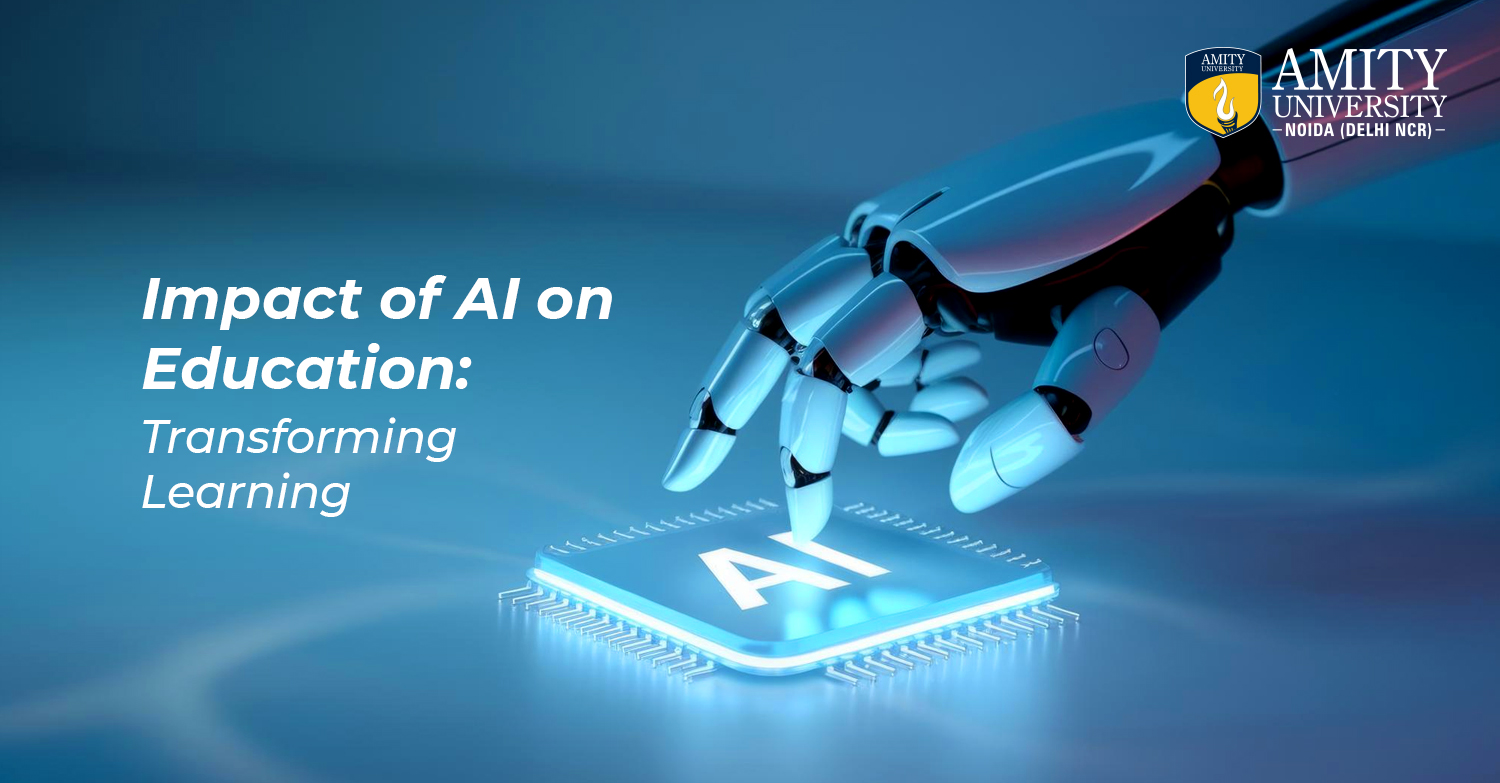
There has never been a time when education does not adapt as and when society finds an improved means of understanding, communicating, and solving issues. This case is no exception when it comes to the advent of AI. What sets this time apart is the rate at which AI is being adopted from specialized labs to normal educational environments.
The effects of AI in education are not limited to the replacement of books by software but are affecting how students gain knowledge, practice what they learn, receive feedback, and get ready for their jobs. In doing so, they are making educators rethink how assessment, integrity, privacy, and learning happen.
From one-size-fits-all learning to personalised support
The most exciting uses of AI in education include personalization. Traditional classroom education is always performed with a group of learners despite the fact that there are many differences between the learners' paces, previous knowledge, and ways of interacting with a subject matter.
Using AI-based education platforms, one can analyze the response and discover the parts where the learner requires more practice. The AI application can present the concept in easier language, give an additional example, and provide practice tasks. If used appropriately, this does not take away the role of the teacher from him or her; on the contrary, it provides information for the teacher about what needs attention.
It is important to make this distinction. Personalized education should not involve the situation in which an algorithm decides what a learner needs without any human intervention. UNESCO's guidance on generative AI in education emphasizes the human-centeredness of the process.
The teacher's role is changing, not disappearing
Projections about AI replacing teachers misunderstand how education really works. Teachers do not only transmit information to their pupils; they inspire them, recognize their puzzlement, ignite their curiosity, lead discussions, and help them link knowledge to practical situations.
AI can decrease the number of routine actions performed by a person. It can support such tasks as developing exercises, structuring information, providing feedback, and rephrasing explanations. This can free more time for teachers to perform activities involving judgment and social interaction.
The problem here is preparation. According to the Stanford 2025 AI Index, 81% of U.S. computer science teachers were convinced that AI was to be included in the foundational teaching of computer science, but less than half of them felt ready to teach this subject. As another survey quoted in the same report showed, 88% of CS teachers required additional resources for AI professional development.
The example is quite relevant for the world outside the USA because the success of AI integration largely depends on the readiness of the teachers.
Generative AI is changing how students study
The advent of Generative AI has brought yet another major revolution. Students can now ask their AI system to explain complex concepts, compare theories, generate ideas, or evaluate drafts in mere seconds. Such functions may aid independent learning considerably, especially if the student is stuck after school hours.
However, ease can be detrimental if it substitutes for critical thinking. The student may be tempted to accept the answer from the AI system without evaluating its logic and sources and finish the assignment without acquiring the required skill.
That is why AI literacy is gaining significance in today's educational process. Students must be made aware that fluency is not always reliable. They have to know how to evaluate AI-generated responses, find out the truthfulness of the claims, detect possible biases, secure personal data, and use AI appropriately.
According to UNESCO's global survey conducted in 2025, almost two-thirds of higher education institutions in its network either had developed guidance regarding the use of AI or were working on developing it.
AI and the future of assessment
The hardest question is perhaps assessment. If an AI system can complete the assignment – writing an essay, solving a problem, or coding a program – then assessing only the result will not help us understand the student’s comprehension level.
This does not mean that assessment tasks must be made harder just because they can. Assessment tasks can become more realistic.
Oral presentations, viva, project logs, demonstrations, problem-solving tasks and assignments with multiple iterations allow teachers to see the student’s reasoning process. In addition, teachers can ask their students to evaluate an AI-written response, finding out the mistakes in it or improving the faulty solution.
In such a case, AI will become an integral part of the learning process rather than some kind of secret trickery. The goal is not to develop an educational system where AI will never be used. The goal is to develop an educational system where using AI would require skills, understanding, and responsibility.
India: building AI readiness through education
This conversation takes a different turn in the Indian context. There is a growing presence of artificial intelligence at a time when the country boasts a large and varied education system.
The National Education Policy 2020 acknowledges new technologies and includes modern subjects like artificial intelligence at different stages in schools. The government has also been concerned about building the capacity of teachers and educators to use artificial intelligence in pedagogical practices.
India's opportunity is not only about becoming a source of artificial intelligence engineers but also about students who study management, law, medicine, media, design, commerce, and science fields, coming across artificial intelligence as professionals. In other words, basic AI literacy could become as important as digital literacy did.
This is especially true of universities because they operate on the border between education, research, and employment. For instance, Amity University Noida, is developing specific academic expertise in artificial intelligence, including generative AI, large language models, computer vision, and responsible AI.
A global shift towards skills, not just degrees
This evolution is as much about employability as it is about technology. According to the World Economic Forum's Future of Jobs Report 2025, 39% of workers' essential skills will undergo change by 2030. AI and big data are part of the skill groups that see the highest growth rate, along with technological literacy, analytical thinking, creative thinking, and adaptability.
This is an important combination. The future is not reserved for those who have learned to use AI technologies. Instead, it belongs to those who are able to combine their technological know-how with judgement, communication, creativity, and specialization.
The educational process, therefore, should not be limited to learning how to use AI technologies. It should also include when to use them, when not to use them, and how to dispute their results.
The risks cannot be treated as an afterthought
However, the application of AI in education is not without risks. Inequality of access can increase the already existing educational divide. AI technologies that are poorly designed could replicate biases. Students can give away their personal information to AI technology, unaware of the way in which their information is used. The information generated by AI technologies can also be misleading.
Another issue is the academic integrity of students. In cases when students use AI-generated works as their own, they will get grades for assignments without having the knowledge they are supposed to obtain. On the other hand, too strict policies will limit students' opportunities to learn proper usage of AI.
Thus, a more effective method would be governance. It implies the development of policies that clearly define what usage, privacy, disclosure, and assessment mean. UNESCO promotes the same idea of ethical, safe, equitable, and meaningful usage of generative AI.
What the classroom of tomorrow may look like
The most effective model of the role of AI in education is not the one of classrooms dominated by machines, but rather that of classrooms in which technology deals with certain routines, and the work of deep learning falls into the lap of humans.
For example, a student could employ an AI tutor for mathematics practice, a teacher could use analytics for spotting common misconceptions, and a research student could use AI to help sort out a large body of literature before independent evaluation. All these uses of AI can save time, but at the end of the day, the last word would fall to humans.
Perhaps this is the most crucial thing to understand about the role of AI in education. This technology is not just another digital tool.
Conclusion
It is important to note that the future of education should not depend on the amount of AI that is going to be introduced into classroom settings. The best practice of using AI in the classroom environment is when intelligent technologies go hand-in-hand with teachers, critical thinking, and moral judgment. Students should learn to use AI while being capable of critically evaluating it. Teachers should use technology to facilitate the process of learning and not only make it faster.