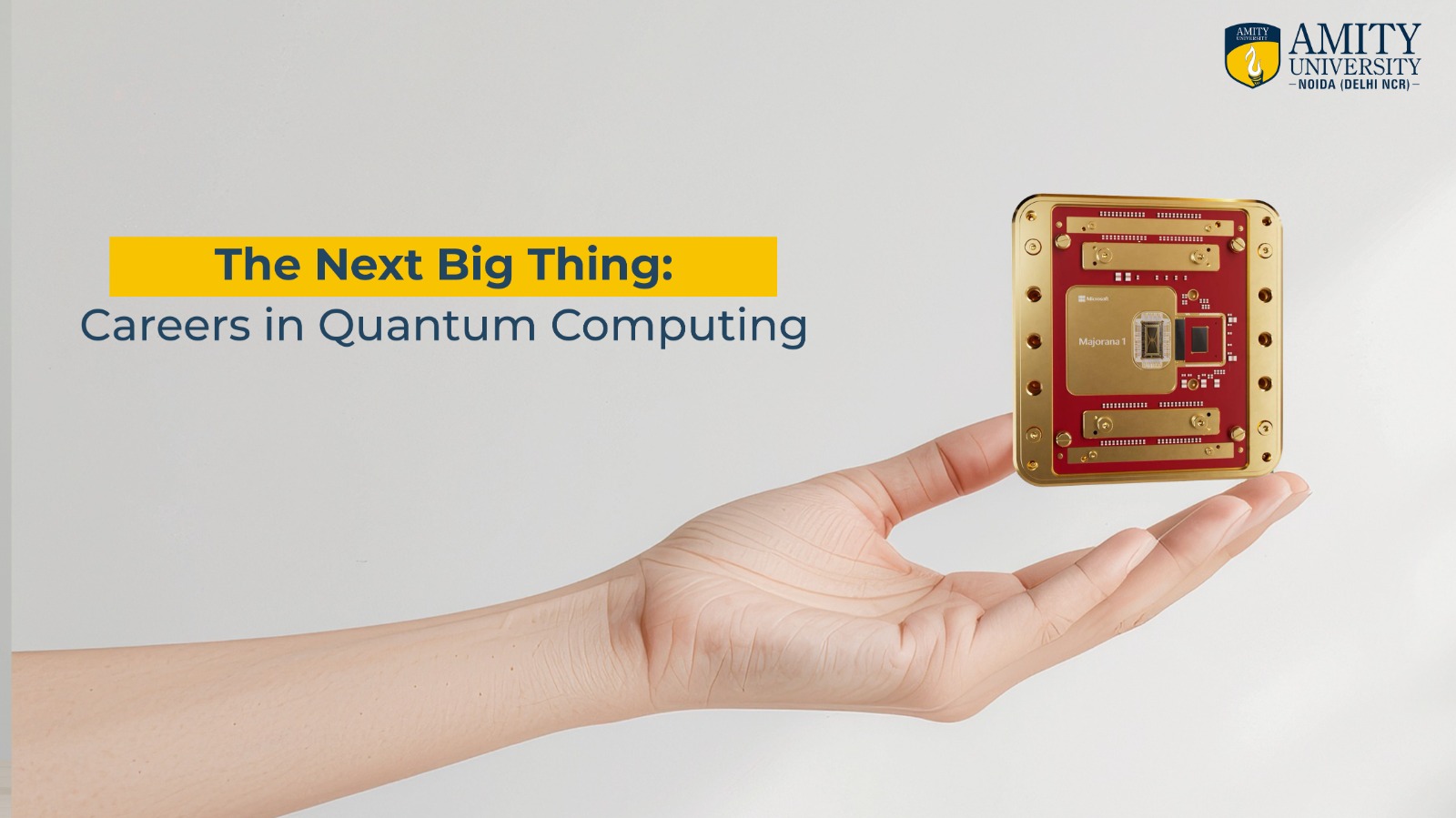
Quantum is the next Marvel superhero, venturing where no machine has gone before. It’s already outsmarting supercomputers, solving problems in seconds, and teleporting data across dimensions. The result? Mind-bending innovation and brand-new career paths. With the global quantum computing market projected to cross $1 trillion by 2035, this field is rewriting the future of technology and work.
A recent McKinsey report notes that companies like Amazon, Google, IBM, and Microsoft are driving quantum breakthroughs across three core pillars: quantum computing, communication, and sensing, together expected to generate $97 billion in revenue by 2035.
What is Quantum Computing
Quantum computing combines physics, maths, and computer science to solve complex problems faster than regular computers. They use qubits or quantum bits, which exist in multiple states. These can be linked together to solve problems simultaneously, leading to millions of solutions faster. Besides deployment in weather forecasting and tracking climate change patterns, quantum computing can also be used to ensure the efficiency of delivery routes, make unbreakable codes, and more.
Quantum in Action: Industry Applications
- Cybersecurity – Uses quantum algorithms to analyze massive datasets and secure communication networks.
- Robotics – Enhances computing power and software optimization for advanced automation.
- Agriculture – Improves fertilizer production and crop-yield efficiency.
- Automotive – Accelerates R&D, supply-chain optimization, and intelligent product design.
- AI & ML – Enables breakthroughs in parallel processing, boosting analysis and machine learning accuracy.
- Drug Discovery – Simulates molecular interactions at quantum speed for faster, more precise research.
- Finance – Strengthens fraud detection and portfolio optimization.
- Logistics – Perfects routing and shipping efficiency across global networks.
Quantum-Driven Careers
Quantum technology is spawning an entirely new class of professionals:
- Quantum Algorithm Developer: Designs algorithms that help quantum computers solve complex problems in record time.
- Skills: Quantum mechanics, Python, analytical problem-solving.
- Quantum Software Engineer: Builds frameworks and user interfaces for quantum programs.
- Skills: Cirq, software testing, debugging, UI design.
- Quantum Systems Engineer: Integrates software and hardware for seamless system performance.
- Skills: Systems integration, troubleshooting, interdisciplinary collaboration.
- Quantum Systems Designer: Crafts layouts for qubits, cooling systems, and control mechanisms.
- Skills: CAD modeling, cryogenic, and electrical engineering expertise.
- Quantum Ethics Specialist: Evaluates ethical, social, and security implications of emerging quantum technologies.
Skills: Ethical analysis, regulatory knowledge, risk assessment, stakeholder communication.
What is the future of Technology Careers?
The tech wave will keep reshaping work, introducing innovations and job titles that don’t exist yet. Success will hinge not just on technical expertise but also on soft skills like emotional intelligence, adaptability, creativity, problem-solving, and leadership. Data literacy will remain a defining edge. Roles such as Big Data Specialists, FinTech Engineers, AI & ML Experts, and Software Developers are projected to grow at record speed. Amity University Noida equips students with the technical knowledge, industry-aligned skills, and soft skills needed to thrive in these emerging careers. Conclusion
The future is not about replacing humans with machines; it’s about collaboration and augmentation. As McKinsey’s 2025 report states, “Human–machine interaction is entering a new phase defined by natural interfaces and adaptive intelligence.” From haptic robotics to voice-driven co-pilots, technology is becoming more responsive to human intent, creating a future where man and machine evolve together. Quantum computing isn’t just the next big thing. It’s the next giant leap, and the future is already loading.
FAQs
1. What is quantum computing?
It’s computing using qubits that can solve complex problems faster than traditional computers.
2. What jobs are in quantum computing?
Roles include Quantum Algorithm Developer, Software Engineer, Systems Engineer, Designer, and Ethics Specialist.
3. Which industries use quantum computing?
Cybersecurity, AI, robotics, finance, healthcare, logistics, and agriculture.
4. What skills are needed for quantum careers?
Quantum mechanics, Python, software development, systems integration, and problem-solving.
5. How can students start a quantum career?
Gain technical knowledge, coding skills, soft skills, and hands-on experience with projects.