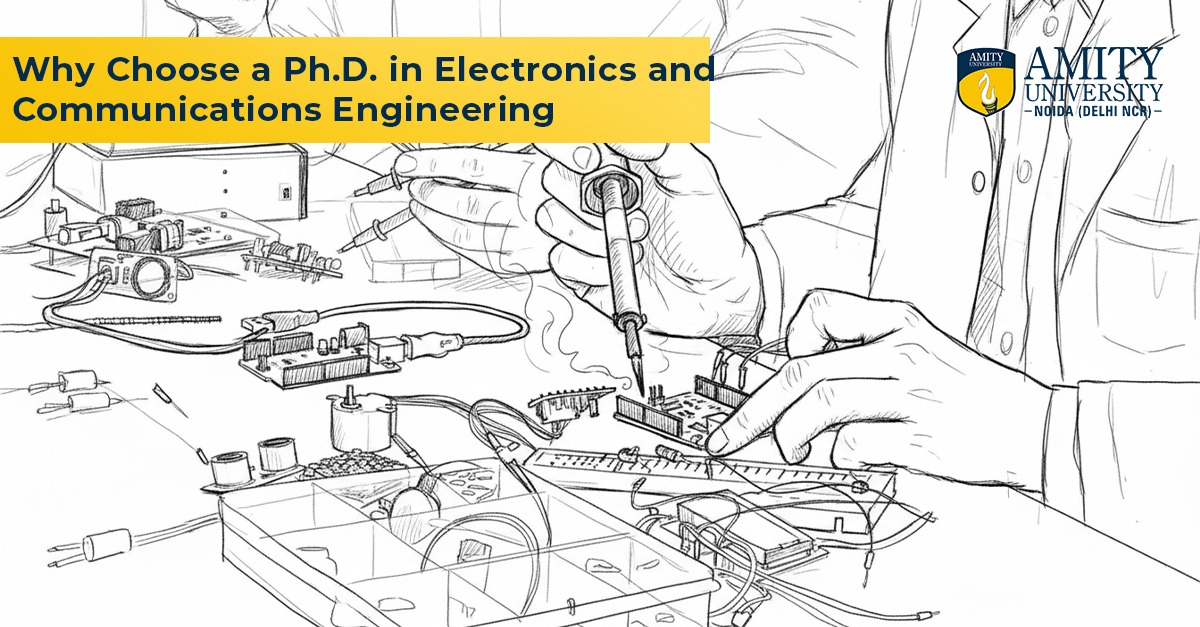
Neuromorphic chips mimic the human brain’s structure and power devices like security cameras to detect suspicious activities, real-time decision making in drones and robots in complex environments. They’re also known to cut AI energy consumption by 80 percent. These smarter faster technologies have generated from Electronics and Communications Engineering. A PhD degree in this field is the gateway to transformative ideas that are impactful in real-world situations and futuristic industries.
PhD in Electronics and Communication Engineering
The Doctor of Philosophy (PhD) in Electronics and Communication Engineering is a research-driven program designed for those passionate about advancing technology in the fields of electronics, communications, and signal processing. The program covers areas like wireless communication, embedded systems, semiconductor technology, and digital signal processing, allowing students to explore cutting-edge developments in the field. Through rigorous research and practical application, students contribute new knowledge to evolving technologies. The program prepares graduates for leadership roles in academia, research institutions, and the tech industry, equipping them with the skills to drive innovation in areas such as telecommunications, electronics, and IT.
PhD in ECE Eligibility
A Master's in ECE/relevant field with min 55% (or 60% in some cases) OR a 4-year B.Tech with min 75% for direct PhD admission, plus qualifying the Amity Research Aptitude Test (ARAT) or holding a valid fellowship/NET/GATE score, with a relaxation of 5% for reserved categories. A direct 4-Year Bachelor's Route requires a B.E./B.Tech degree in ECE or relevant Electronics Engineering, with a minimum 75% marks or 7.5 CGPA.
Who should go for this?
- Those passionate about cutting-edge technologies and a passion for problem-solving.
- Aspiring researchers and innovators.
- Ideal for those in wireless technologies or embedded systems.
PhD in ECE: Top Career Prospects problem-solving
- Telecommunications Engineer: This professional designs, builds and maintains data transmitting or communication machines & systems like internet, phones, satellites.
- Signal Processing Engineer: Enhances, analyses and interprets senor, audio and video signals.
- IoT Architect: Plans and designs IoT systems for seamless functioning of networks and devices.
- Hardware Engineer: Develops and tests computer components like circuit boards etc.
- Power Generation Engineer: Designs, builds and maintain systems that generate electricity.
- Robotics Engineer: Uses his technical expertise to design, build and maintain automated machines.
- Chip Design Engineer: Designs circuits that control machines or electronic designs in terms of their battery, usage, function etc.
Deciphering the Future Trends
- Quantum Communication: Is the highest form of data protection and sending secure information using quantum mechanics like entanglement and superimposition. It’s most useful for sectors like Defence and Finance.
- AI and ML Smarts: They will uncover hidden patterns via data analysis, solve complex-problems, enhance safety, revolutionise healthcare with accurate medical diagnosis and accelerate scientific research.
- Green Communication: Harnessing natural and renewable energy sources like wind and solar energy to power data stations, using AI to manage traffic and using 6G that works on very low power and green materials.
- Edge Computing: Processes data close to where its generated and enables faster real time decisions.
- Photonics and Optical Communication: Light based technologies like Li-Fi, Silicon to replace traditional technologies.
Conclusion
A PhD in ECE is a passport to the future and cutting-edge technologies. If you’re passionate about technological transformations that can change lives, then this is the degree for you.