
The Secret to Career Success: A Step-by-Step Guide to Continuous Learning
31-12-2025

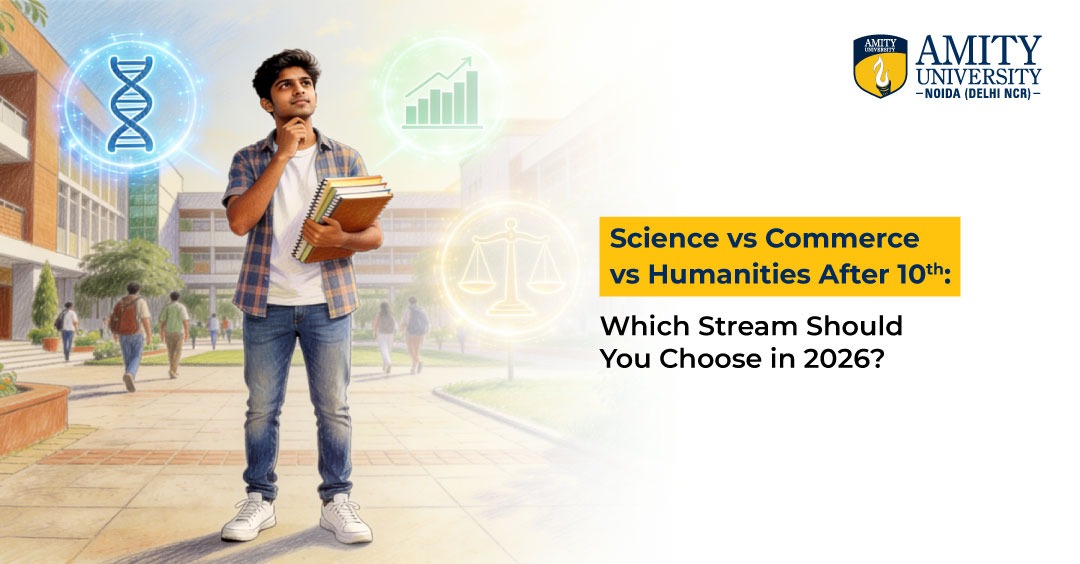
Most Class 10 students get asked the same question dozens of times in the month of March. Which stream are you going to opt for in class 11th - science, commerce, or arts? Honestly, there is no definite answer to this question. The main reason is that the right stream depends on students' capability, ability to grasp subjects, interests, marks obtained in the 10th standard and similar other factors.
In the last 10 years alone, so many new career paths have opened up in tech, design, finance, and public policy. The old stereotypes about each stream are starting to look outdated. Picking between science vs commerce vs humanities after 10th isn't just about marks scored in Class 10 anymore. Let's explore other aspects as well.
A surprising number of students assume science is the "safest" stream because it keeps every option open. That used to be partly true earlier, but it isn't really the case anymore. Today, commerce graduates can easily move into data analytics and fintech roles. Some of these roles didn't even exist a decade ago. When it comes to humanities students, they increasingly land in UX research, public policy, and content strategy, fields that pay well. Traditionally, these job roles didn't attract humanities students at all.
|
Stream |
Core Subjects |
Best Suited For |
Common Career Paths |
|
Science |
Physics, Chemistry, Maths/Biology |
Analytical, detail-oriented students |
Engineering, medicine, research, IT |
|
Commerce |
Accountancy, Business Studies, Economics |
Numbers-driven, business-minded students |
CA, finance, management, entrepreneurship |
|
Humanities |
History, Political Science, Sociology, Psychology |
Curious, expressive, socially aware students |
Law, civil services, journalism, design |
Science is very demanding. Science students need concept clarity and an in-depth grasp of subjects like Physics and Chemistry. Last-minute cramming sessions will not help science students. Moreover, Maths or Biology adds another layer of complexity depending on whether a student leans towards engineering or medicine. Students who do well in science tend to share a few traits:
They enjoy solving problems methodically rather than memorising large volumes of text
They're comfortable with abstract concepts (vectors, chemical bonding, calculus)
They can sustain long study hours, since most competitive exams (JEE, NEET) demand serious preparation
If a student dreads numerical problems or finds Physics genuinely confusing rather than just unfamiliar, forcing science purely for prestige usually backfires by Class 12.
Commerce has successfully shed its old reputation as the "backup option". It's now one of the more practical choices for students interested in the functionality of businesses or how money works.
|
Career Track |
Typical Path |
Approximate Entry-Level Salary (India) |
|
Chartered Accountant |
B.Com + CA |
₹6-10 LPA |
|
Investment Banking |
₹8-15 LPA |
|
|
Business Analyst |
BBA/B.Com + Certifications |
₹5-8 LPA |
|
Entrepreneurship |
Varies |
Highly Variable |
Commerce suits students who like structure but also want flexibility, since it opens doors into finance, law (through CLAT), management, and even civil services later.
Humanities gets dismissed too quickly by students who haven't actually looked at what it covers. Psychology, Political Science, Sociology, and Economics involve serious analytical thinking, just applied to people and systems rather than equations. This stream works well for students who:
Read widely and enjoy forming opinions backed by evidence
Want careers in law, civil services, journalism, or social research
Are drawn to understanding why people and societies behave the way they do
Civil service aspirants, in particular, often benefit from a humanities background, since UPSC's syllabus overlaps heavily with subjects like History, Polity, and Sociology.
Among the most searched career options after 10th, here's a realistic breakdown:
|
Goal |
Recommended Stream |
|
Engineering, medicine, research |
Science |
|
CA, MBA, Business Ownership |
Commerce |
|
Law, Civil Services, Design, Media |
Humanities or Commerce |
|
Defence Services |
Any stream (with PCM preferred for technical entries) |
It's worth noting that students can switch streams later. Suppose a student chooses to shift from science to commerce; it is possible, but it adds friction. Although switching from the humanities to science is far harder. As it involves the foundational gap in subjects like Physics and Chemistry.
There isn't a single best stream after 10th for all students. Students should evaluate their capabilities and interest to choose among the various streams.
Science offers the widest range of technical careers to students. But it also demands the most consistent effort. Whereas commerce balances stability with flexibility. It increasingly leads to high-growth roles in finance and analytics. On the other hand, Humanities, often underrated, open doors into law, governance, and the fast-growing world of UX, research, and policy work.
The students who do well in any stream usually share one trait: they chose based on genuine interest rather than on peer pressure or family expectations. A mediocre student in a "prestigious" stream usually performs worse than a strong student in a stream that actually suits them.





Amity University Noida's Official Blog: Your Destination for Career Guidance, Course Insights, Rankings, and Expert Tips for a Future Full of Possibilities.
Contact us: admissions@amity.co.in