
The Secret to Career Success: A Step-by-Step Guide to Continuous Learning
31-12-2025

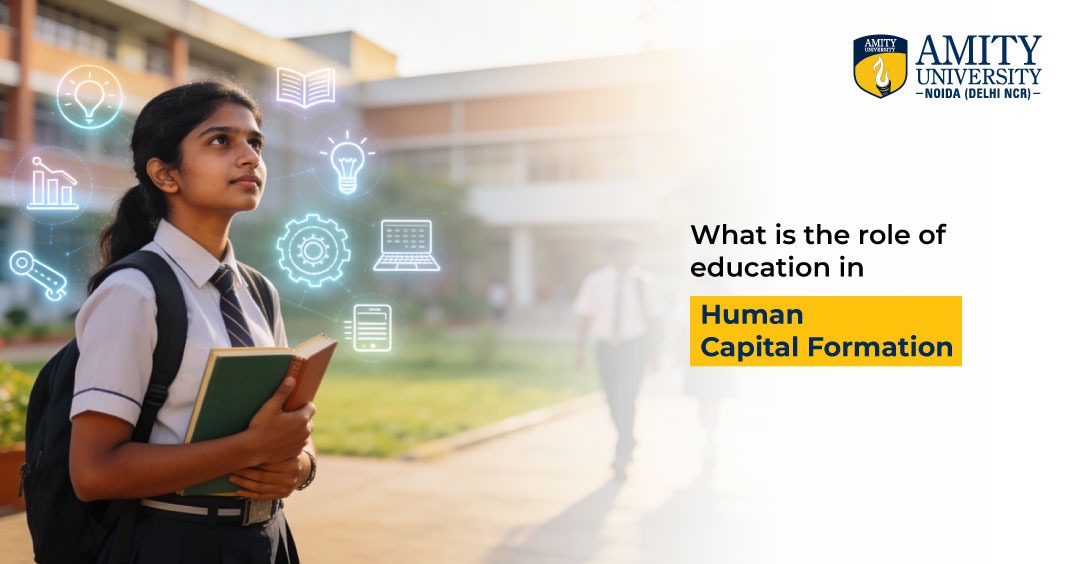
With the advent of the knowledge-based economy in modern times, the most valuable resource of any country is no longer its natural wealth or infrastructure, but people. The skills, knowledge, health, and abilities of individuals constitute human capital as defined by economists. Amongst several elements responsible for the creation of human capital, education holds the greatest significance.
The role of education in human capital formation goes beyond the acquisition of knowledge alone. Through education, individuals gain skills and become productive and more likely to get employed, and ultimately help drive economic and social development. Countries investing significantly in education are seen to be growing economically and socially at a faster rate.
In this blog, the concept of human capital formation and the role of education in its formation are discussed. With the advent of the knowledge-based economy in modern times, the most valuable resource of any country is no longer its natural wealth or infrastructure, but people. The skills, knowledge, health, and abilities of individuals constitute human capital as defined by economists. Amongst several elements responsible for the creation of human capital, education holds the greatest significance.
Human capital formation is all about the process of making people knowledgeable and healthy enough so that they become capable of contributing to the economic processes and development of society.
This concept has become popular owing to the works of certain economists like Theodore Shultz and Gary Becker, who suggested treating education and training as an investment and not just as a cost. Human capital formation may include such elements as:
Education and training
Skills acquisition
Healthcare and nutrition
Research and innovations
Professional experience and learning
Among these components, education plays a fundamental role as other elements are based on it.
Education assists individuals in gaining knowledge, developing skills, and building problem-solving and adaptation capabilities. It makes people ready to work in the market and contribute to economic development. There are several ways in which education facilitates the process of human capital creation.
1. Increases Knowledge and Skills- The main aim of education is to provide people with technical knowledge, cognitive skills, and competencies that will make them efficient and productive. For instance:
Primary education increases literacy and numerical abilities.
Secondary education improves the capacity for analysis and communication.
Higher education and vocational training offer special competencies.
The World Bank suggests that each year of education brings considerable income gains and increases productivity.
2. Increases Productivity and Economic Growth- Educated people are likely to be more productive because they can make effective use of technology, cope with the dynamic work environment, and address difficult situations. The countries that are characterized by high levels of educational attainment usually have:
Greater labour productivity
Higher per capita income
Greater innovativeness and entrepreneurship
Economic competitiveness
For example, there is always a close correlation between the two variables (educational attainment and economic performance) according to the OECD statistics.
3. Enhances Career Prospects and Wages- Education enhances career prospects because it equips individuals with skills to perform in a wide range of careers. The educated people are likely to have:
Greater employment prospects
Greater wage levels
Career mobility
Reduced the chances of being unemployed
It has been found by the ILO that the unemployment rate is lower for educated individuals than for uneducated people.
4. Promotes Innovation and Technological Developments- Innovation is highly dependent on the availability of educated and skilled people who can perform research, develop technology, and improve the current processes. Universities, research facilities, and technical training institutes play a critical role in:
Scientific innovations
Technological innovations
Innovations in products
Development of the entrepreneurship ecosystem
South Korea, Singapore, and Finland are good examples of countries that managed to undergo technological and economic transformation because of investment in education.
5. Promotes Social Development- Education plays not only an economic but also a social role in human capital formation by:
Improving health status
Promoting gender equality
Encouraging civic activities
Creating social inclusion
Reduction of poverty
Educated people are usually well-informed about healthcare, the environment, and civic affairs, which helps them build stronger societies.
6. Encourages Adaptability in a Changing Economy- In the contemporary world, the workforce is changing fast owing to automation, artificial intelligence, and digital transformation. An education enables people to:
Learn about new technologies
Keep reskilling and upskilling throughout their career lives
Keep adapting to new job demands
Engage in new emerging industries
Thus, lifelong learning is becoming a key feature of human capital development in the digital age.
7. Promotes Entrepreneurship and Leadership- Education develops the skill sets such as critical thinking, decision making, and problem-solving skills needed for entrepreneurship and leadership. The entrepreneurs need education to be able to:
Spot opportunities
Run businesses
Know about the financial system
Find innovative solutions
The educational background leads to the building of companies that create jobs and economic growth.
Educational systems are typically considered an investment by economists due to the fact that investments yield profits both at the individual and social levels. A few of the personal benefits are:
Higher salary
Career prospects
High standard of living
Job stability
Social benefits
Economic growth
Productivity
Poverty alleviation
Tax income
Well-developed institutions
Human Capital Index, compiled by The World Bank, emphasizes the point that nations that invest in health and education experience more prosperous economic development.
These countries have proved that proper investments in education bring positive outcomes.
Even though education plays a crucial role in building human capital, some obstacles that hinder the process include:
In the light of growing knowledge-based economies, the educational system is evolving towards:
Digital literacy
Critical thinking
Interdisciplinary approach
Life-long learning
Industry-oriented training
The future of human resource development would depend not only on expanding access to education but also on ensuring the quality of education.
Educational investment as an instrument of building up the stock of human capital is a very important component for success on a personal level as well as on a nationwide level. The process of learning leads to increasing knowledge, acquiring skills, improving labor productivity, developing innovations, and social prosperity.
Continuing to change, the world still provides educational investment as one of the most successful tools for building up human capital.



Amity University Noida's Official Blog: Your Destination for Career Guidance, Course Insights, Rankings, and Expert Tips for a Future Full of Possibilities.
Contact us: admissions@amity.co.in