
The Secret to Career Success: A Step-by-Step Guide to Continuous Learning
31-12-2025

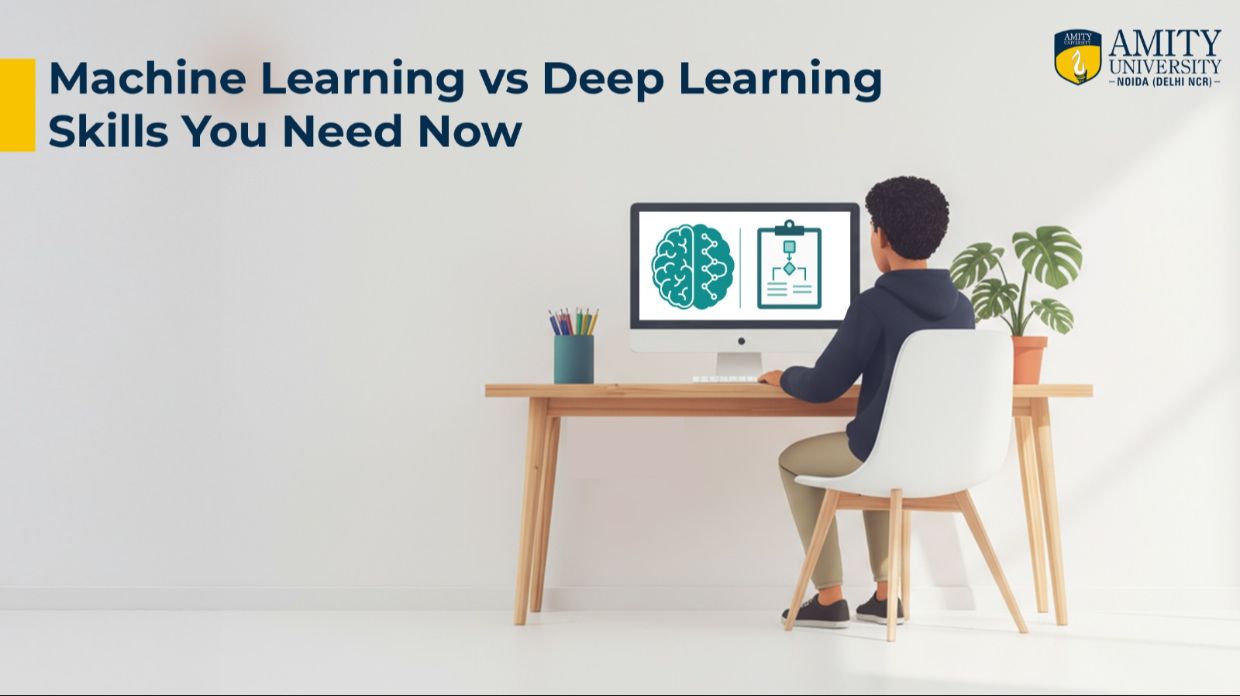
What if the power to predict stock markets, drive cars without drivers, or make machines talk like humans was right at your fingertips? It’s happening. Machine learning and deep learning are the superheroes behind some of the most exciting innovations of our time. From robotics and healthcare to entertainment and e-commerce, these technologies are transforming the way industries function and how jobs evolve.
The numbers prove it. The machine learning market is expected to reach $209.91 billion by 2029, while the broader AI market (which includes ML and DL) may reach $1.59 trillion by 2030. This isn’t just progress. It’s a revolution shaping the future of work.
Machine learning is the science of making machines smarter by feeding them data instead of commands. If you’ve ever wondered what machine learning is, think of it as teaching a computer to recognise faces in a photo album or recommend the next product you might want to buy.
By analysing patterns, spotting trends, and predicting outcomes, ML makes systems more adaptive and intelligent, playing a key role in data science machine learning and modern automation.
In a world overflowing with data, ML helps industries stay afloat instead of sinking. Finance depends on ML for fraud detection and stock predictions. Healthcare uses it for early diagnosis. E-commerce uses it for personalised shopping. Education uses it for smart learning platforms.
McKinsey reports that sales and marketing are the most profitable domains for ML. It’s no surprise that 80% of ML-driven companies prioritise retail and e-commerce. Strong machine learning tools and frameworks make this growth possible.
Cloud computing and Big Data
Strong mathematics and statistics
Programming skills like Python, R, and Java
Knowledge of Natural Language Processing (NLP)
Understanding of AI vs machine learning vs deep learning fundamentals
Machine Learning Engineer: A machine learning engineer builds algorithms to solve real-world problems. They work across industries, handling data pipelines, automation, and model optimisation as part of a fast-growing machine learning career.
Data Scientist: A data scientist cleans, organises, and interprets data. They combine ML algorithms, domain knowledge, and storytelling to turn data into strategy.
AI Research Scientist: These experts explore new algorithms, model architectures, and innovations that push technology forward.
Business Intelligence Developer: BI developers translate large datasets into business strategies, enabling organisations to make informed decisions.
If ML is smart, deep learning is genius. If you’ve ever wondered what is deep learning, think of it as a more advanced version of ML that mimics the way the human brain works. Deep learning uses neural networks to process massive datasets and recognise patterns with incredible accuracy.
DL powers voice assistants, facial recognition, chatbots, and autonomous cars, high-impact deep learning applications that shape modern AI.
Deep learning takes machine intelligence much further by thinking in layers. It:
Detects diseases using medical imaging
Powers autonomous vehicles
Creates advanced recommendation engines
Enables real-time language translation
It doesn’t just learn. It reasons and adapts, making it crucial for future AI systems.
Strong knowledge of AI and applied mathematics
Mastery of DL frameworks like TensorFlow and PyTorch
Data handling and visualisation
Programming expertise for building scalable models
Understanding the relationship between machine learning vs deep learning
Computer Vision Engineer: Teaches machines to understand images and videos.
Deep Learning Engineer: A deep learning engineer designs and maintains advanced neural networks for automation, perception, and prediction.
NLP Engineer: Builds models that help machines understand and generate human language.
Generative AI: Revolutionising creativity through AI-generated content.
Federated Learning: Protects user privacy by training models without sharing raw data.
Explainable AI: Makes model decisions transparent and trustworthy.
At Amity, the future of AI isn’t a distant goal, it’s a lived reality. Students explore hands-on ML and DL projects using cutting-edge infrastructure.
Ticket to the World Stage: Global internships and research projects with leading industry giants across the US, UK, and more.
Toolkit for an AI Hero: Industry-live projects that sharpen problem-solving, communication, and analytical skills.
Innovation Playground: AI labs equipped with globally competitive machines and tools to foster teamwork, leadership, and creativity.
Placements That Speak for Themselves: With multi-crore packages and placements in Fortune 500 companies, Amity sets the bar high year after year.
Machine learning and deep learning aren’t just technologies, they’re catalysts shaping the future of AI. From personalised healthcare to autonomous systems, the impact of ML and DL is limitless. The only question now is simple:
Are you ready to ride the AI wave and shape the future?
Machine learning is a method of teaching computers to learn patterns and make predictions using data instead of explicit instructions.
Deep learning is an advanced form of machine learning that uses neural networks to learn from large datasets. It handles complex tasks like speech recognition and autonomous driving.
Both careers have a strong demand. ML roles are broader across industries, while DL roles specialise in computer vision, NLP, robotics, and large-scale automation.
You need programming skills, mathematics, statistics, cloud computing knowledge, and an understanding of ML tools and data pipelines.
Deep learning powers self-driving cars, medical image analysis, chatbots, virtual assistants, facial recognition, and generative AI models.






Amity University Noida's Official Blog: Your Destination for Career Guidance, Course Insights, Rankings, and Expert Tips for a Future Full of Possibilities.
Contact us: admissions@amity.co.in