
The Secret to Career Success: A Step-by-Step Guide to Continuous Learning
31-12-2025

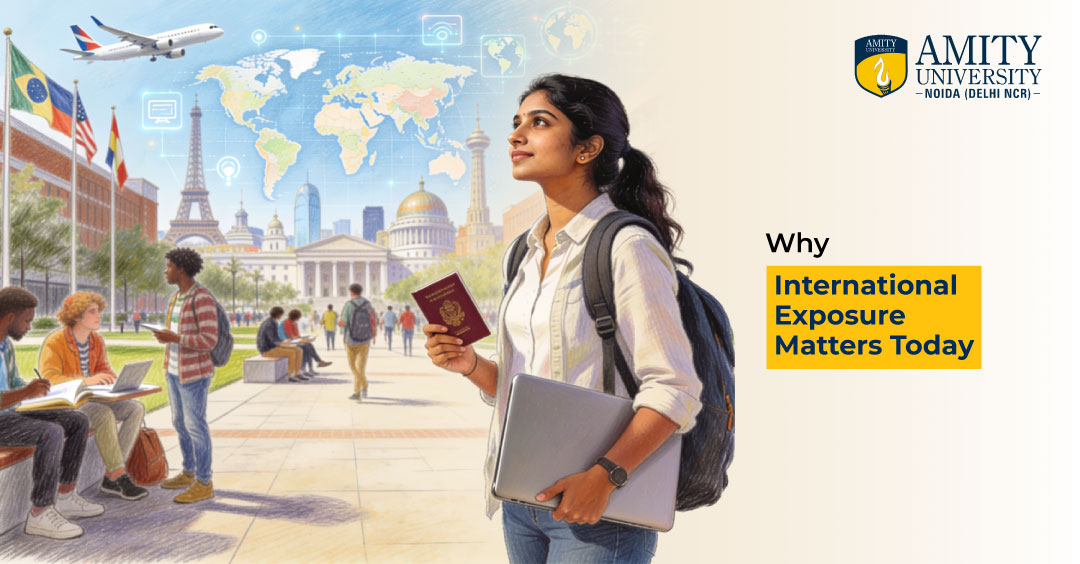
For decades, students thought that studying overseas was the main way to get global exposure, interact with different cultures, and seize international opportunities. Nowadays, though, what it means to learn globally is changing fast.
Thanks to tech advances, more cooperation between schools, and the growing internationalisation of higher education, students can connect with the world in new ways. Because of these changes, you don't need to leave India to get an international education and have those culturally rich experiences anymore.
As our world gets more linked up, it matters less where students study and more whether they can truly engage with ideas, people, and opportunities from around the globe.
Today, international exposure isn't just about getting that passport stamp or spending a few months studying abroad. It's about understanding worldwide trends, working well with people from different cultures, and being open to new ideas. Employers now look for these skills because businesses are global, too. No matter if you work for a big firm, a tech start-up, do research, or run your own biz, you need to connect with people from all over. So, having an international perspective is less about where you've been and more about having that global mindset.
The internationalisation of higher education has accelerated significantly over the past decade. Universities across India are building partnerships with institutions worldwide to create learning opportunities that were once available only through overseas study. These collaborations often include:
Student exchange programmes
Semester-abroad opportunities
Joint research projects
International conferences and workshops
Collaborative learning initiatives
Visiting international faculty
Global immersion programmes
Dual-degree and pathway programmes
Such initiatives enable students to gain international perspectives while remaining enrolled in their home institution. The result is a learning experience that combines local relevance with global understanding.
Access to diverse academic viewpoints is super valuable in international education. Nowadays, universities often bring in guests like professors, researchers, and industry leaders from all over. They share their knowledge through talks, workshops, and project collaborations.
Students pick up info on top global practices, tech, and career trends this way. These exchanges show how issues get tackled worldwide, pushing learners to consider things globally, not just locally. Also, being exposed to different ideas builds key skills for the future workplace, like better thinking, creativity, and solving problems.
Research is pushing international academic involvement like never before. Universities collaborate on big projects with places all around the world. Postgrads and students doing research tackle huge global issues too, from climate change to AI. Working on these projects exposes them to different methods and ways of thinking from various disciplines.
This experience is super valuable for future researchers and innovators. In many cases, it's just as good as studying abroad.
Tech has totally changed how students learn and work together. Virtual exchange programs, webinars, online research projects, and global classrooms let students chat with classmates and teachers from all over the world right from their school. They can swap cultures, study together, and connect professionally like never before.
These experiences often give exposure to what happens in today's workplaces, where teams usually span different countries and time zones. Since remote work is getting more common, students who do this stuff while studying often come out super prepared for their careers.
Organizations today operate in an environment where markets, customers, technologies, and talent pools are interconnected.
As a result, employers are looking for graduates who demonstrate:
Cross-cultural communication skills
Global awareness
Adaptability and openness to diverse perspectives
International business understanding
Collaborative problem-solving abilities
Confidence in multicultural environments
International exposure helps students develop these competencies regardless of whether they have studied overseas. What matters most is the ability to think globally while acting effectively in local and international contexts.
Indian universities are becoming popular global learning destinations. Through international partnerships, student exchange programs, joint research, and other global academic efforts, institutions are letting students get international exposure without leaving India.
Take Amity University Noida, for instance. They've woven international collaborations into their academic setup. It links up with universities in places like the US, UK, Australia, France, Germany, and Singapore. Because of this, they offer student exchange programs, study-abroad chances, joint research projects, immersion programs, and talks with global experts.
The real perk? Students get exposed to international conferences, guest lecturers, and cross-cultural learning. This makes global education an everyday part of their academic lives, rather than a separate opportunity available only to a select few.
This shows a bigger change happening in higher education. Schools are making international experiences easier to reach, more inclusive, and a regular part of what students do.
The future of higher education isn't just about mobility; it's about being connected. As colleges boost their international teamwork and use tech for learning, students can interact with the world right from their school. Learning from top experts globally, joining worldwide projects, and contributing to joint research is getting easier.
While studying overseas is still very worthwhile for many, it's not the only way now to get that global experience. In today's scene, these kinds of opportunities are coming straight to students' hometowns. By taking part in these programs, students can pick up the know-how and views they need to do well in our interconnected globe without moving out of their countries.


Amity University Noida's Official Blog: Your Destination for Career Guidance, Course Insights, Rankings, and Expert Tips for a Future Full of Possibilities.
Contact us: admissions@amity.co.in