
The Secret to Career Success: A Step-by-Step Guide to Continuous Learning
31-12-2025

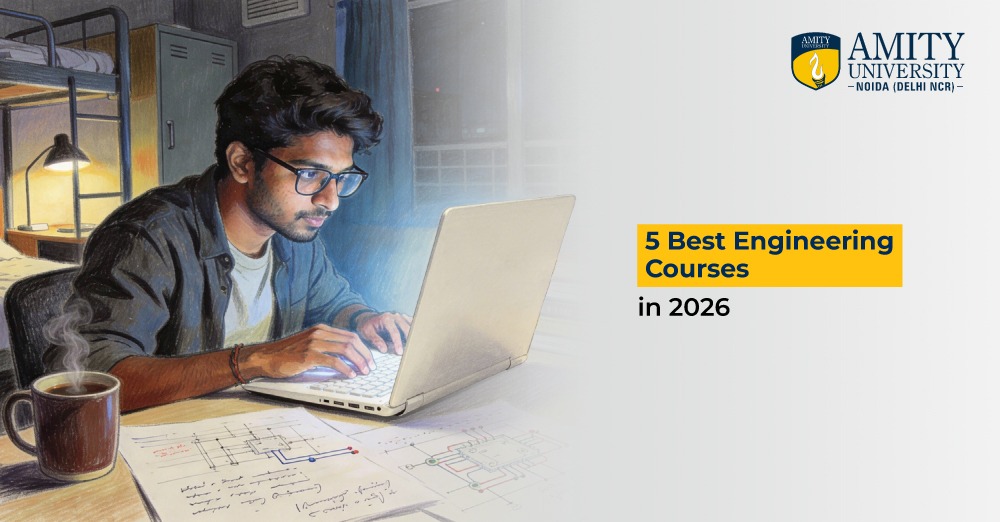
Just passed out from 12th and now want to pursue a career in Engineering? Before you apply its important to know which are the best Engineering courses that will help in your career and fit in this fast-paced transformation era.
Thousands of students wish to take up engineering as their career because of a better package. Engineering courses include Computer Science & Engineering, Aerospace Engineering, Aeronautical Engineering, Artificial Intelligence, etc., which are known to offer a higher salary in top companies.
Choosing the right career in Engineering is important to shape a better tomorrow. To assist you with your career, below we have given a detailed breakdown of the top engineering courses that are also going to stay in the long run, along with the expected salary package when you join any organization.
The latest one with a new and advanced course is Computer Science & Engineering. Though the traditional software development is still in the curriculum, the future of CSE revolves around scalable distributed architectures, cloud computing frameworks, cybersecurity paradigms, and quantum computing. The curriculum instructs students in advanced data structures, operating systems design, full-stack architecture, and decentralized cryptography, keeping it indispensable across every global economic vertical.
Aerospace Engineering studies are all about designing, developing, and manufacturing aircraft and spacecraft. Divided into two parts: Aeronautical Engineering and Astronautical Engineering. Major focus lies on Commercial airplanes, helicopters, gliders, drones, fighter jets, rockets, satellites, space probes, space stations, and lunar landers. With the exponential rise of commercial space travel, satellite communications networks, and deep-space planetary exploration, aerospace engineering has rapidly become one of the most intellectually prestigious and high-growth sectors worldwide.
Artificial Intelligence one of the most popular terms used in today's modern times. This course is needed in every field, as AI is everywhere. This course focuses on building computational models that mimic human intelligence, enabling machines to learn, reason, perceive, and make decisions autonomously. You will learn about advanced mathematics, neural networks, deep learning algorithms, natural language processing (NLP), and computer vision with an in-depth knowledge. As industries automate at scale, AI engineers are foundational in building predictive frameworks, medical diagnostic software, and autonomous operational pipelines.
Traditional civil engineering is getting a major high-tech makeover. It's no longer just about concrete and steel; the focus has shifted to building smart cities, weather-proofing infrastructure against climate change, and managing resources sustainably. Today's engineers are working with self-healing materials and BIM (Building Information Modeling) platforms to design zero-emission transit networks. As cities continue to grow globally, the demand for planners who can balance structural integrity with environmental impact is at an all-time high.
This is where mechanical design, electronics, and software collide to drive the next industrial revolution. Robotics engineers spend their time perfecting sensory feedback, industrial kinematics, and human-robot collaboration. You’ll find their work everywhere from precision surgical robots in hospitals to the autonomous systems powering massive factories. They are essentially building the physical "muscles" of the modern world.
The hiring market for AI graduates is currently at a fever pitch. Most people start out as ML Engineers or Data Scientists, but the career progression is remarkably fast. If you have the right technical depth, moving into a Lead Architect role or even a CTO position can happen much sooner than in traditional tech sectors.
● Salary: Beginners usually land between ₹8L and ₹15L LPA. For those with a few years of solid experience under their belt, packages routinely climb past ₹45L LPA.
A CS degree can boost your engineering career. Its real value lies in how easily you can pivot. Whether you want to focus on Cloud Architecture, jump into Cybersecurity, or build products as a Full-Stack Developer, the demand remains stable even when the broader economy gets shaky.
● Salary: Standard entry-level offers range from ₹5L to ₹12L LPA. That said, product-heavy giants frequently go much higher, offering specialized talent anywhere from ₹25L to ₹50L LPA.
This is a high-stakes field where you are literally working on the future of flight and space exploration. You might find yourself working on propulsion systems for ISRO or designing avionics for private firms like SpaceX. It is a blend of intense physics and cutting-edge tech.
● Salary: Freshers typically start between ₹7L and ₹12L LPA. Senior engineers in defense or high-end private space tech can expect to reach the ₹30L LPA mark.
While Aerospace looks at the stars, Aeronautical engineering is the backbone of everything moving within our atmosphere. With the drone industry exploding and commercial aviation evolving, there is a massive need for experts in aircraft design and MRO leadership.
● Salary: New graduates generally see offers between ₹6L to ₹10L LPA. Seasoned aviation consultants often pull in more than ₹25L LPA.
Civil engineering has moved far beyond just pouring concrete. The most exciting roles today are in smart-city planning, green building consultancy, and renewable energy infrastructure. You are more likely to be a BIM Manager or a Sustainability Engineer than a traditional site supervisor.
● Salary: Starting pay sits between ₹4.5L and ₹8L LPA. However, if you become a specialized infrastructure consultant or a project lead, your earning potential scales toward the ₹20L to ₹35L LPA range.
|
Engineering Course |
Core Specialization Areas |
Key Job Roles Offered |
|
Artificial Intelligence |
Neural Networks, Deep Learning, Natural Language Processing, Computer Vision |
AI Engineer, Data Scientist, Machine Learning Researcher, NLP Architect |
|
Computer Science |
Distributed Cloud Systems, Cyber Security, Full-Stack Architecture, Cryptography |
Cloud Architect, Software Engineer, Security Analyst, DevOps Specialist |
|
Aerospace Engineering |
Orbital Dynamics, Celestial Propulsion, Rocketry Design, Structural Analysis |
Propulsion Engineer, Satellite Systems Designer, Mission Control Specialist |
|
Aeronautical Engineering |
Atmospheric Fluid Dynamics, Avionics, Sustainable Aviation, UAV/Drone Tech |
Aerodynamicist, Flight Test Engineer, Aircraft Design Consultant, MRO Analyst |
|
Civil Engineering |
Building Information Modeling (BIM), Smart Cities, Geotechnical Engineering |
Smart City Infrastructure Planner, BIM Manager, Sustainability Consultant |
|
Robotics Engineering |
Industrial Mechatronics, Kinematics, Control Systems, Computer Vision Systems |
Robotics Software Engineer, Automation Specialist, Mechatronics Analyst |
When it comes to choosing future-ready courses, Amity University Noida stands out for offering the top-rated Engineering Courses in 2026. Their education is not just limited to theoretical, but it's beyond the classroom. There are multiple specializations that students can choose from, like Computer Science & Engineering, Aerospace Engineering, Aeronautical Engineering, Artificial Intelligence, Automobile Engineering, Civil Engineering, CSE (IoT, Cyber Security, including Blockchain Technologies), and more. What makes this different from any other university is the learning application of AI, Live projects, and 25+ certification programs.





Amity University Noida's Official Blog: Your Destination for Career Guidance, Course Insights, Rankings, and Expert Tips for a Future Full of Possibilities.
Contact us: admissions@amity.co.in