Internships at Amity University Noida: Where Students Train, Stipends & Industry Exposure
30-10-2026

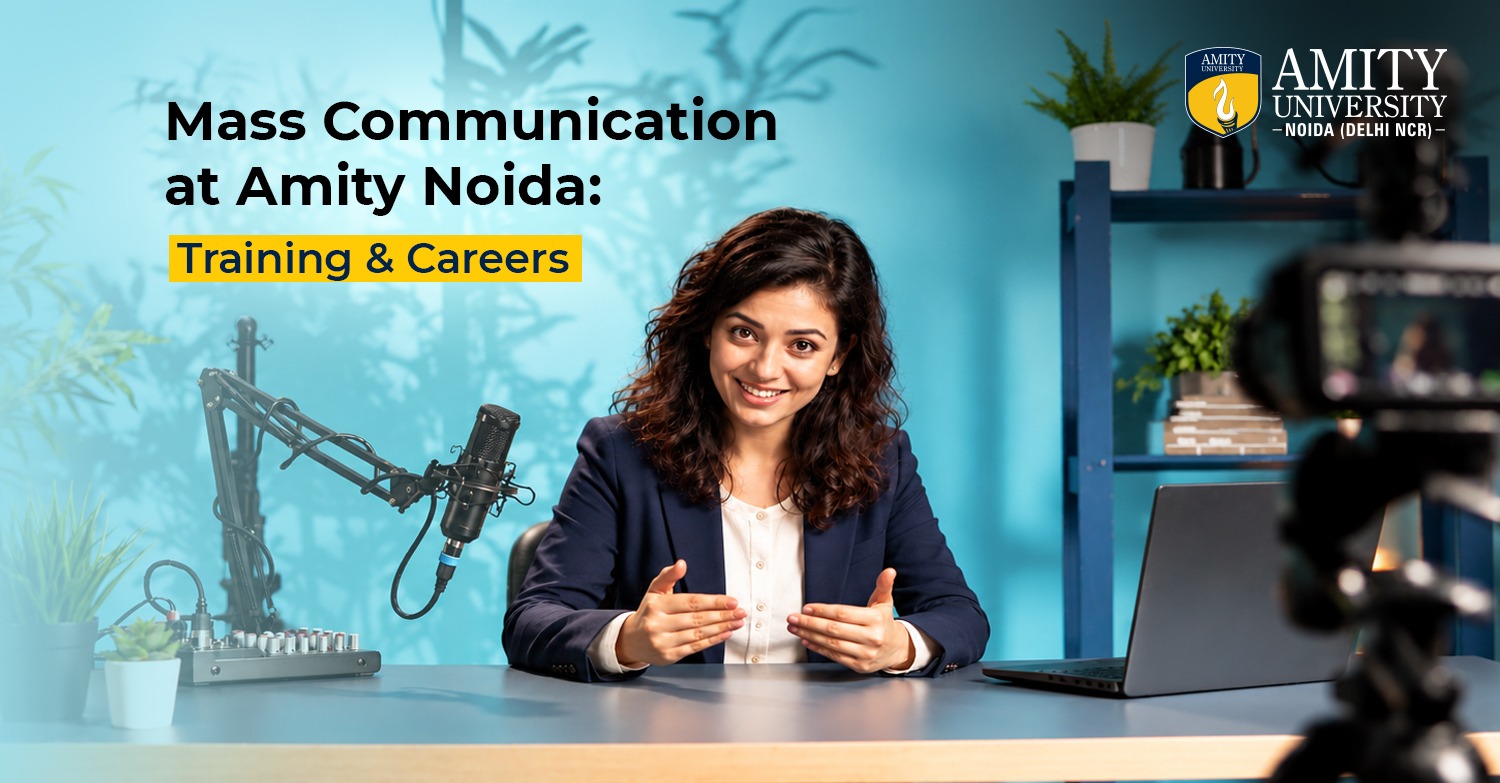
The world of mass communication has changed greatly from the era of television and print journalism. It now encompasses podcasts, filmmaking, digital newsrooms, social media, and public relations, among other aspects of the media industry, providing students with many different career possibilities depending on their interest in creative media communication.
Students who are interested in learning more about Mass Communication at Amity University Noida have the option of pursuing a Bachelor of Arts in Journalism and Mass Communication (BAJMC), which enables them to study journalism, broadcasting, digital media, advertising, and public relations. They can also pursue the Bachelor of Arts in Journalism and Mass Communication (Honours/Honours with Research) program and the three-continent program.
The importance of media education lies in the ability to transition from the theoretical understanding of communication concepts to practical application of knowledge through the processes of reporting, production, writing, and multimedia storytelling. Learn more about the educational process, industry exposure, internship programs, and career opportunities available at Amity University Noida below.
Mass Communication is ideal for those students who would like to learn about story creation, information dissemination, and how people interact with various types of media. An undergraduate degree in Journalism and Mass Communication helps students build up their editorial sense and communication skills.
At Amity University Noida, the Amity School of Communication offers a campus built around Media Studies and experiential learning. Amity University stresses hands-on activities, industry interaction, media house visits, and specialized production infrastructure as key parts of its media education. The following are some of the fields that students can look into:
Journalism, news writing, and reporting
Television and broadcasting journalism
Radio production and podcasting
Film and video production
Photography and visual communication
Advertising, branding, and public relations
Digital journalism and social media content creation
Multimedia storytelling and content creation
This scope is important since nowadays media occupations require knowledge of several types of media. A journalist needs to create a video story, while a digital content creator should be capable of writing, researching, editing, and engaging audiences.
Media education takes on its true meaning as students gain knowledge about the development, production, editing, and presentation of ideas to the audiences. Practical assignments make it possible to link the theoretical knowledge gained in class to the obligations of producing media materials professionally.
The facilities provided by Amity University Noida include student projects, community radio projects, media production resources, and other activity-based media programs that allow practical training.
According to the university, the infrastructure of its School of Communication comprises a news studio and a film studio, a professional newsroom setting, community radio station facilities, a production control room, a photo lab and editing bays, as well as broadcasting equipment and production technology.
These facilities provide an opportunity for the students to familiarize themselves with various aspects of media production.
Film-making and the production of audio visual content go beyond simply running a camera. It is important that students learn about story structure, scene planning, sound and vision coordination and editing among other skills.
Some of the tasks that students can engage in to practically learn the skills in media courses include:
Script writing: Creating and developing ideas, structuring a story, developing dialogue and preparing scripts.
Film making: Learning about story boarding, shot composition, shooting techniques and production planning.
Recording: Basic knowledge about audio recording, voice recording.
Video editing: Editing video footage, creating a story from the footage.
News production: Learning about reporting, news delivery, coordination within the newsroom and preparation of news packages.
Photography: Visual story-telling, picture composition and creation.
The actual tasks undertaken by the students will vary depending on the curriculum and the academic work.
However, when writing a news story for a television bulletin, the approach taken might be very different from one that would have been adopted in a podcast piece or video. The knowledge of how to do this is very helpful for students right from the onset of their studies.
This way, they will learn how to tailor their writing and presentation to suit their target media type. This is necessary in today’s media environment where organizations are communicating using various platforms including websites, social media, streaming services, radio and television.
Podcasts have proved to be an essential medium for interviews, conversation, storytelling, and sharing experience in their profession.
Students of Amity University Noida who are keen on learning about audio and video stories can visit the media-learning campus of Amity University Noida, which includes a community radio studio and Podcast and Vodcast certification program that is mentioned in the prospectus of 2026 of Amity University Noida.
Podcast interviews conducted by alumni and current students could be used as a platform for discussing various experiences related to education, creative works, career paths and development in general. The interviews would allow the prospective students to get an understanding of various opportunities available to them in media and communications.
From the perspective of students who study podcasting, such kind of interviews can also give them practice in:
Interview guest research and interview question creation.
Episode outline and introduction writing.
Interview recording and sound management.
Episode editing and narrative building.
Promotional material creation for online distribution.
Are there any podcasts involving Amity alumni and current students produced on a regular basis? While there is information regarding podcasting and vodcasting offered by Amity University academically, there is no confirmation of any regular schedule or existing podcast series with interviews of alumni and current students.
Knowledge about the functioning of the newsroom is one of the key elements of journalism training. Students should learn about reporting deadlines, editorial decisions, news delivery, production coordination, and the technical process of preparation of material for broadcasting.
Interaction with the industry, media house visits, and newspaper publishing are among the specializations offered by Amity University, Noida through its School of Communication. The University further mentions that its students have managed to secure placements in TV channels, media houses and PR agencies.
Professional exposure in a newsroom will assist the student in comprehending how information is transferred from a developing story into a news bulletin. Students are able to learn about the various roles involved in researching, validating, writing, presenting, and producing the news.
In a studio environment, the following could be taught to the students:
Newsroom processes and editorial coordination.
Presentation in front of the camera and broadcast communication.
News scripting and news bulletin production.
Production control and audio visual production equipment.
Interviewing and reporting skills.
Visits to a media house will assist in supplementing the above learning.
BAJMC Programme at the University is noted for its emphasis on interactions with media organizations, exposure, and placements through television channels, print, and PR firms. But the publicly available information referred to above does not give a definite, up-to-date list of tie-ups between news channels for the programme.
Prospective students need to know that there are various ways of exposure and they should differentiate between institutional collaborations, sessions by industry experts, visits, internships, and recruitment partnerships.
There are many changes happening in the areas of media trends, production, and audience preference. Students learning from experts will get an understanding of how all these changes affect their work in fields such as journalism, advertising, and broadcasting.
At Amity University Noida, the significance of industry interaction is evident in the form of master classes, webinars, guest lectures, and industrial visits, which have included over 100 interactive sessions with people in the fields of journalism, advertising, and public relations.
The industry session can expose students to the standards that exist in the profession and are not limited to classroom work alone. The journalist can enlighten them on the need for verification and accuracy, while the advertising expert can tell them how creative ideas are modified for particular audiences.
Industry exposure can assist students to:
Comprehend the various expectations from media professionals.
Know about the new media formats and audience behavior.
Acquire professional communication and presentation skills.
Explore various specializations before deciding on a career path.
Get knowledge about portfolios, internships, and entry-level jobs.
It is important for the students to take advantage of these sessions in order to derive the most from their experiences.
The internship program helps the students to familiarize themselves with the speed and collaboration of a professional work environment. They also provide an opportunity to gain hands-on experience and understand where their skills and interests lie.
Amity University Noida makes note of the summer internship programs, alumni forums, mentoring program, industrial visits and career readiness programs through the CRC and BAJMC Program Information. It even points out some TV channels, media houses, magazines, and PR agencies where the students have got placement opportunities.
According to their interest and skill, and based on the availability of such programs, the students may pursue internships at:
News channels and digital news platforms.
Newspapers and online news media.
Advertising and creative agencies.
Public relations and corporate communications firms.
Film production studios, TV and video production studios.
Digital marketing and social media teams.
Podcasting and content production organizations.
Internship jobs can consist of researching, writing, reportage support, social media content creation, production coordination, editing, or even campaign management. Each job and each company will have its own duties.
The students can create their portfolio through internships wherever allowed. Written articles, edited videos, scripts, campaign ideas, and many more such things can be included in the portfolio.
The Corporate Resource Centre of Amity University, Noida is a facilitator for placement and internship services, career guidance and development and corporate interaction. The general career preparation activities include industry sessions and preparation for the recruitment process.
In the case of media studies, the importance of the program will depend on the job, needs of the employer and level of preparation of the student. Good portfolio, good communication skills, research skills, work experience and media ethics can make one’s profile competitive.
Note: University-wide placement information must not be taken to guarantee placements for BAJMC students. The number of placements and internship opportunities for this program needs to be confirmed by the university.
There are several career paths that may be chosen by a student with a degree in journalism and mass communication. The career paths will largely depend on the specialization, skills and work experience of the particular student.
The following are some of the career options for those who have completed their degree course.
Journalist/News Reporter- Carry out research, conduct interviews, gather information and provide reports for print, television or online media.
News Anchor/Presenter- Announce the news, conduct interviews and convey information to the audience effectively through television and online media.
Video Producer/Assistant Director- Assist in production processes, plan video shoots and aid in the creation of audio-visuals from the script.
Digital Content Creator- Create articles, videos, short content pieces, and multimedia stories for websites, social media sites, and digital publishing houses.
Public Relations Officer- Assist in managing media relations, creating communication material, running campaigns, and maintaining the public image of an organisation.
Copywriter/Advertising Officer- Develop ideas and copy for campaigns, advertisements, and communications.
Podcast/Audio Content Creator- Conduct research on topics, create script, conduct recordings, and edit audio/video segments.
Other possible jobs include social media executive, video editor, script writer, media researcher, communication coordinator, and corporate communication officer.
Further, students can think about doing a master’s course in journalism, mass communication, advertising, public relations, or media management.
While the degree serves as the foundation of knowledge, a portfolio proves the practical creation abilities. It will be beneficial for students who start compiling their portfolios at college to be able to show the skills before the internship application.
Here is how you can start:
Create original content: Write news stories, write short scripts, make videos or podcasts as part of individual and academic projects.
Try different types of content: See what type of content suits you by trying writing articles, conducting interviews, taking pictures, recording audio, and short videos.
Practice doing research and verifying information.
Get feedback: Use professors’ recommendations, peer reviews, and the chance to communicate with media specialists to refine your content.
Search and apply for suitable internships.
Document the content: Compile the portfolio of your published works and approved projects.
The ethics of judgment plays a vital role in media.
Students interested in media careers can explore the programmes offered by Amity University's School of Communication, depending on their academic background and long-term goals.
|
Programme |
Suitable for students interested in |
|
B.A. Journalism & Mass Communication |
Journalism, reporting and broader media careers |
|
B.A. Journalism & Mass Communication (Honours/Honours with Research) |
Journalism and communication, with an extended academic or research pathway |
|
B.A. Journalism & Mass Communication (3-Continent) |
Media education with an international study component |
Before choosing a programme, review its current curriculum, eligibility requirements, duration, fees, and practical components. Students should also enquire about the latest internship arrangements, current industry partnerships and programme-specific placement outcomes.
For official programme information, visit Amity University Noida.
Mass communication is a discipline where storytelling, technology, research, and audiences merge. Whether it be creating a podcast or writing a news article, creating an advertisement campaign or supporting in the creation of a film, there are various professional pathways that one may pursue as a student.
In case of Amity University Noida, School of Communication emphasizes practical media resources, industrial interface, media visits, and career-related activities that might assist students in gaining an idea about the professional world. To benefit from all these, consistency, curiosity, ethical judgment and learning from diverse formats are important.
For students who aspire to become journalists, broadcasters, filmmakers, advertisers or digital communicators, it may serve well to look into the possibilities offered by the BA Journalism and Mass Communication courses at Amity University Noida.

Amity University Noida's Official Blog: Your Destination for Career Guidance, Course Insights, Rankings, and Expert Tips for a Future Full of Possibilities.
Contact us: admissions@amity.co.in