BBA After 12th: Benefits of Studying BBA and Top Reasons to Choose This Career-Ready Course
30-11-2025

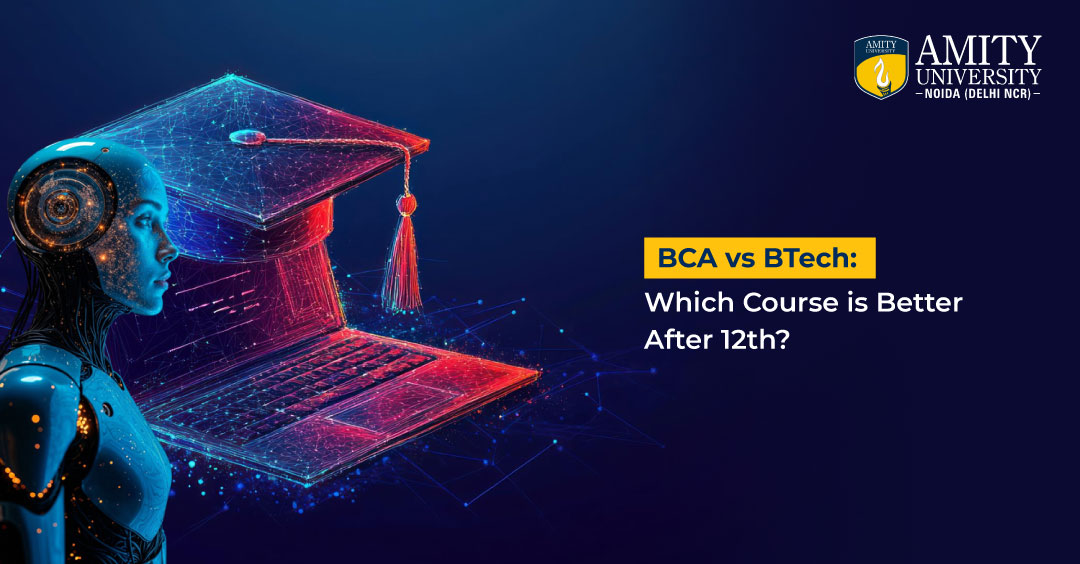
Selecting the right course after class 12 can affect your career in the long run. In a scenario where the technology sector in India is growing in 2026, students have become curious to compare BCA vs. BTech to select the right choice according to their aspirations.
Both courses provide an entry into the field of technology, yet are quite different in terms of curriculum, duration, mode of education, admission, and job prospects. Whereas one deals with software and programming, the other covers engineering basics, including hardware and electronics, along with computer science.
When it comes to selecting the right course after class 12, this article provides a detailed comparison between BCA and BTech to help you make an informed decision.
Bachelor of Computer Applications (BCA) is a three-year undergraduate course that is aimed at individuals who have an interest in software development, programming, database management, cloud computing, cyber security, and web development.
The course is highly practical in nature and caters to the IT industry by preparing individuals for working in the field without any requirement for engineering education. Individuals opting for BCA usually take up courses like:
Programming Languages (Python, Java, C++)
Data Structures
Database Management Systems
Web Development
Operating Systems
Software Engineering
Fundamentals of Artificial Intelligence
Cloud Computing
Presently, most universities include industry certifications and internship programs as well in the syllabus.
BTech Course is an undergraduate four-year engineering course that blends theory and engineering practice. Computer Science Engineering (CSE) continues to be among the most popular specializations; however, candidates have the option of specializing in subjects such as Artificial Intelligence, Data Science, Information Technology, Electronics, Mechanical Engineering, Civil Engineering, Biotechnology, and many more.
BTech course provides analytical thinking and engineering principles, design, and engineering problem-solving. Some of the subjects taught during the course include:
Engineering Mathematics
Computer Programming
Data Structures and Algorithms
Computer Networks
Operating Systems
Artificial Intelligence
Machine Learning
Cloud Computing
Internet of Things
Software Engineering
Design Projects in Engineering
Due to its engineering nature, BTech courses include laboratory work and research, internship, and much more.
Although both programmes can lead to rewarding technology careers, there are several important distinctions.
|
Feature |
BCA |
BTech |
|
Full Form |
Bachelor of Computer Applications |
Bachelor of Technology |
|
Duration |
3 Years |
4 Years |
|
Focus |
Software applications and programming |
Engineering, computing, hardware & software |
|
Eligibility |
Class 12 from a recognised board (varies by university) |
Class 12 with PCM for most engineering programmes |
|
Curriculum |
Computer applications and software |
Engineering principles and advanced technology |
|
Career Roles |
Software Developer, Web Developer, Data Analyst |
Software Engineer, AI Engineer, Systems Engineer, Product Engineer |
|
Higher Education |
MCA, MBA, MSc |
MTech, MBA, MS |
One of the most common queries that students have is whether BCA or BTech provides better employment opportunities. This decision actually depends upon your personal preferences and career objectives rather than which course to take.
Opt for BCA when:
You like programming and application development.
You want to get into IT early in your career.
You prefer software-centric education.
You plan to join MCA in the future.
You wish to gain flexibility in exploring new technologies by getting certifications.
Opt for BTech if:
You like Mathematics and Engineering.
You need a solid technical base.
You are interested in research, product engineering, or AI.
You want to work with multinational technology firms.
Both BCA and BTech today provide opportunities in some high-growth areas, including Artificial Intelligence, Cybersecurity, Cloud Computing, Data Science, and Software Development.
The admission procedure for BCA varies from one college to another. The following are generally taken into consideration:
Marks obtained in Class 12
Examination for entrance (as the case may be)
Interviews for certain colleges
A few colleges provide admissions based on merit alone, while some colleges conduct both academic and aptitude tests for admission. Candidates from Science, Commerce, or Humanities streams could be eligible for BCA as per the selection criteria of individual colleges. Before application, candidates should study:
Eligibility Criteria
Deadline for Admission
Criteria for Entrance Examination
Scholarships
Internship & Placement Assistance
Admission to a BTech program is normally through:
Class 12 with Physics, Chemistry, and Mathematics
National or university entrance examination
Counselling and allocation of seats
A number of universities also organize their own entrance test or admission procedure. Students should evaluate the universities based on:
Course content
Laboratory facilities
Industrial linkages
Research facilities
Placements
International exposure
The salary is determined by various factors, such as skills, internships, certification, location, and company. In general:
BCA students start working in areas like software development, web development, technical support, testing, and data analytics.
Students from BTech have access to a larger number of job opportunities in engineering and product development areas, especially software engineering, artificial intelligence, cloud computing, semiconductors, and research-based companies.
With experience and specialized certification, the salary becomes more dependent on expertise than the qualification itself.
Reflect upon the questions below:
• Do you like the ideas of engineering or software engineering?
• Are you at ease in handling higher mathematics?
• Would you prefer to go for a three-year or a four-year bachelor’s degree program?
• Are you looking forward to pursuing further studies?
• What kind of technology-oriented career fascinates you?
There is no concept of what is best suited to all. It depends upon your choice.
Selecting a suitable university is as essential as selecting a suitable program. At Amity University Noida, the students who enroll for BCA and B.Tech. enjoy an academic environment that not only provides theoretical knowledge but also practical exposure.
A few of the major advantages can be highlighted as follows:
Curriculum oriented towards industry with the latest technologies incorporated.
Up-to-date labs and modern computer centers.
Live project work, internships, and research experience.
Experienced faculty having academic as well as industrial exposure.
Industrial interaction through workshops, seminars, and innovative projects.
Preparation for placements, career counseling, and entrepreneurship.
Collaboration with international universities and interdisciplinary education.
No matter whether students opt for BCA or BTech, it is all about acquiring the technical and professional skills demanded by the fast-changing technological scenario.
The discussion of which course is better between BCA and BTech does not have an absolute answer. The two courses are promising for those who want to venture into the dynamic field of technology; however, each suits someone with a different interest.
For example, if your area of interest is software engineering and application programming, then BCA is the right choice because of its shorter duration compared to BTech. However, if you would like to learn engineering, technology, and research skills, then BTech will suit you.
Before choosing your course, think about your talents, career interests, study preferences, and the institution that you want to enroll in. Choosing the correct program will help you build a successful future in the world of technology.





Amity University Noida's Official Blog: Your Destination for Career Guidance, Course Insights, Rankings, and Expert Tips for a Future Full of Possibilities.
Contact us: admissions@amity.co.in