
The Secret to Career Success: A Step-by-Step Guide to Continuous Learning
31-12-2025

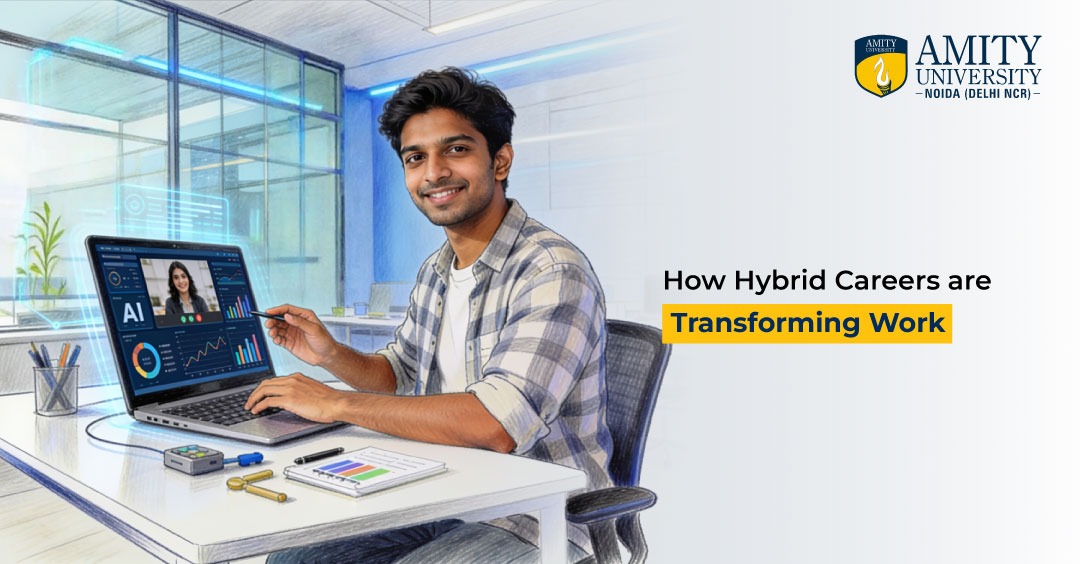
In the past, people's professions were quite predictable – engineers would be engineers, writers would write, and doctors would continue practicing their profession without stepping outside its boundaries. Today, things change. Now more and more companies look for specialists capable of applying expertise in many areas, of being able to evolve in response to technological changes, and of being flexible enough to occupy various positions. The advent of Hybrid Careers is not just an employment trend but something that also influences higher education and the training of personnel.
Hybrid Careers become popular because of the way the economy evolves. The development of artificial intelligence, automation, sustainability, digitalization, and the changing expectations of consumers make it necessary to create new jobs and new job descriptions. For example, today, marketing specialists might have to know some data analytics. In addition, architecture requires a combination of expertise in natural sciences, and the healthcare field cannot function without working alongside IT professionals. The most important specialists today are those who are capable of establishing connections between domains.
These facts have been recently revealed in the latest global statistics. According to the World Economic Forum’s Future of Jobs Report 2025, more than 1,000 employers that employ over 14 million people across 55 economies view technological changes as having a significant impact on jobs between now and 2030. The report notes that 59% of employees will need training or reskilling over the next decade, while 85% of employers expect upskilling to be a priority for their workforce. Skill shortages become the number one obstacle to business transformation according to 63% of the organizations surveyed. This shows that learning should not end when one graduates; it should extend beyond graduation into the entire career.
The moment defining the hybrid career mix is the technical competencies combined with deep cognitive soft skills. Digital literacy, predictive analytics, and algorithmic programming dominate modern workforce demands, and global employers place an equal weight on analytical thinking, strategic creativity, and adaptive resilience. Consequently, the future of work and education dictates that technology will not replace humanity; humanity will utilize technology to amplify its own potential.
This phenomenon can be witnessed everywhere. Financial services firms recruit behavioral economists to supplement their data scientists, media firms recruit coders and analysts, manufacturing firms are hiring engineers and sustainability experts, and even those working in design should be knowledgeable in user behavior, digital platforms, and new technology, in addition to aesthetics.
Similarly, the notion of a linear career is also no longer valid. LinkedIn has described the contemporary career path as a climbing wall rather than a ladder, whereby progress will be made by moving sideways, engaging in diverse activities, and learning multiple skills along the way. In this context, success in one's professional life will be less about job titles and more about lifelong learning.
Indeed, educational institutions around the world are adapting accordingly. The Organisation for Economic Co-operation and Development has made it a point to highlight the need for a new approach to education, given technological advances and changing needs in the labour market. University curricula around the world are incorporating interdisciplinary approaches, practical experience, digital literacy, entrepreneurship, and research.
There are numerous examples of such cases, and India seems particularly interesting. Possessing one of the youngest workforces in the world and developing its digital economy rapidly, India sits right at the junction of global talent transformation. Innovations in start-ups, technology industries, finance, medicine, sustainable development, and other areas create a need for professionals capable of working across multiple functions. Employers look for applicants with a combination of specialized skills, innovative mindset, leadership qualities, and technological proficiency.
At the same time, students expect to be able to develop their own capabilities according to similar criteria. Instead of simply getting another degree, modern learners tend to pursue programs providing opportunities for diversification, research, innovations, and practical experience in solving various problems. In essence, modern campuses go far beyond academic functions and serve as platforms for the exchange of ideas between different fields.
In this regard, leading universities all around the world focus on making their curricula flexible and creative. Nowadays, many institutions introduce interdisciplinary learning and integrate innovation centres, research labs, business incubators, and other elements into educational processes. Such institutions emphasize the need to use the gained knowledge and apply it practically by collaborating within teams and engaging in innovation processes.
The above can also be understood by the approach of learning adopted in places like Amity University Noida, where there is stress on multidisciplinary exposure, research, industrial exposure, sports, innovation spaces, and collaboration spaces. All these are ways in which the importance of being able to thrive in several different worlds at the same time can be understood.
In summary, the discourse on Hybrid Careers is all about possibilities. There is a recognition that it is no longer feasible to think of oneself as an expert limited to a certain discipline. This is due to the fact that some of the most pressing challenges facing the globe today, including climate change, healthcare access, digitization, and economic development, can be addressed only with the help of hybrid professionals.
In today's ever-changing environment, organizations have been forced to transform themselves, making the requirement for hybrid professionals more important than ever before. To put it another way, the Future of Work and Education lies with people who possess a blend of inquisitiveness, capability, and knowledge.
Another aspect of Hybrid Careers is the effect that these careers have on leadership. Traditionally, the hierarchical structure was built on specialization, where departments worked in isolation, and skills remained compartmentalized. Now, however, leaders need to understand technology, business, people, sustainability, and communication at the same time. Organizations are moving towards executives that are capable of doing just that, which influences recruitment trends in multinationals and start-ups alike. It seems that research and reports show an ever-growing tendency that organizations with the ability to form interdisciplinary teams have an advantage. Now that artificial intelligence has entered everyday work processes, specialists who have the potential to make use of complex and sophisticated knowledge to help people, organizations, and society are more valuable. This is precisely why more effort is being put into interdisciplinary learning systems by the academic community, potential employers, and policy makers. The upcoming workforce may very well be characterized by the cooperation of specialists with multidimensional views of issues, as opposed to experts with unidirectional knowledge systems. The point for current students going into higher education is that, aside from having the requisite knowledge, their ability to relate one type of knowledge with another and operate in cross-cultural settings is crucial.
What this means is that the concept of Hybrid Careers does not imply merely a temporary change to a disrupted knowledge ecosystem. Hybrid Careers signify the emergence of a fundamentally new way of thinking about expertise and its application within society as a whole.

Amity University Noida's Official Blog: Your Destination for Career Guidance, Course Insights, Rankings, and Expert Tips for a Future Full of Possibilities.
Contact us: admissions@amity.co.in