
From Script to Screen: How Film Students Bring Stories to Life
31-03-2026

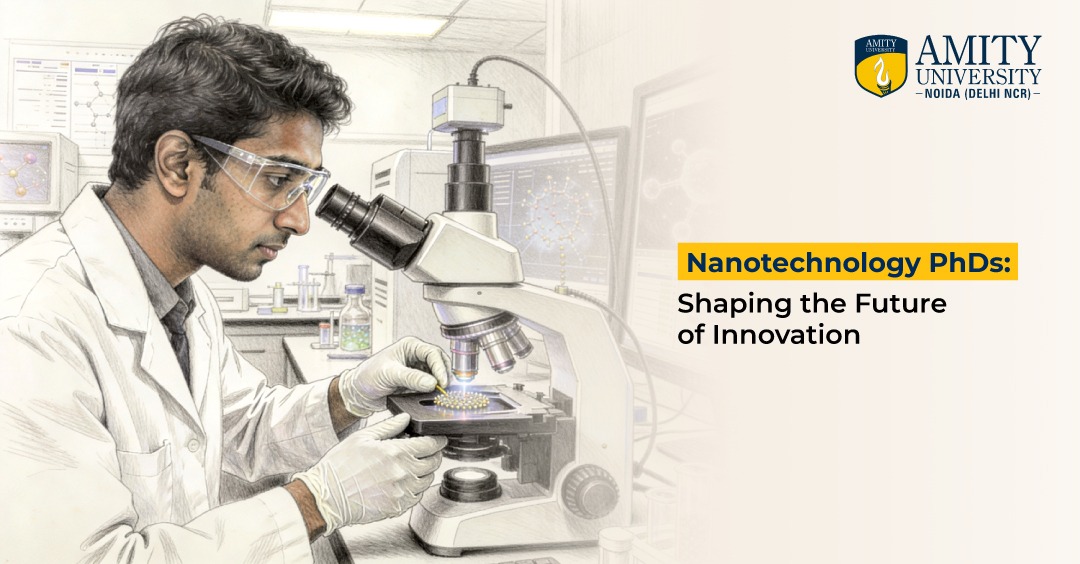
This year the University of California reported a ground-breaking innovation in sustainable energy. The researchers converted carbon dioxide into methanol using a single atom catalyst. Across the globe, Sweden’s ChemoTech AB company is making lipid based nanoparticles encapsulate chemotherapy drugs. They travel through the bloodstream to the tumor site and attack the cancerous cells. Thus, there’s minimal damage to healthier cells –making precision medicine the NextGen frontier of treatment. That’s the magic of Nanoscience and Nanotechnology which is redefining solar cell usage, electronics and also sustainable energy. A PhD in this discipline opens doors to innovations and interesting roles, that have fantastic future potential.
The Amity Institute of Nanotechnology (AINT) offers advanced research opportunities in the cutting-edge field of nanotechnology. This program focuses on the development and application of nanoscale materials and systems, preparing students for impactful careers in nanotechnology, including roles in research, academia, pharmaceuticals, and industrial innovation.
Core Areas: Principles and Practices, comprehensive examination - S&T
quantitative techniques Sc. and Tech, research and publication ethics, research methodology Sc. and Tech.
Eligibility: M.Sc. in Physics/ Chemistry/ Bioscience/ Nanoscience/ Forensic Science/ Biochemistry/ Material Science/ Electronic Science/ Environmental Science or equivalent with 55% marks in aggregate OR M.Tech in Nanotechnology/Biotechnology/Materials/Instrumentation / Electronics/ Food Technology/ Pharmacy/ Chemical Engineering./ Biomedical Engineering, or equivalent with 55% marks in aggregate.
Or
B.Tech in the relevant areas with minimum 75% / 7.5 CGPA is eligible to directly apply for Ph.D programs.
1. Green Nanotechnology- Is reducing environmental impact by developing and using environmentally friendly nanomaterials like plant extracts.
2. Advanced Nanomaterials- Are highly flexible, good conductors and advanced strength and are powering sectors like aerospace, construction and others. Examples-nanotubes, graphene.
3. Nano Biosensors- These are used for medicine, forensics, environmental monitoring by deploying devices and biological components that can be identified.
4. Nanomedicine- Is driving precision diagnostics and drug delivery.
1. Nano Safety and Regulatory Expert: Is responsible for regulatory compliance and ethical practices.
2. Nano Materials Scientist: Develops new materials like graphene for diverse usage and applications.
3. Nanotechnologist: Is adept at innovations—like materials, devices and others-- through molecular manipulation.
4. Nanomedical Engineer: Uses his expertise to create medical solutions like targeted medicine.
5. Research Scientist: Investigates and experiments with various processes for technological advancement.
Today, nanotechnology and nanoscience are converting science fiction into real life, one atom at a time.






Amity University Noida's Official Blog: Your Destination for Career Guidance, Course Insights, Rankings, and Expert Tips for a Future Full of Possibilities.
Contact us: admissions@amity.co.in