
From Script to Screen: How Film Students Bring Stories to Life
31-03-2026

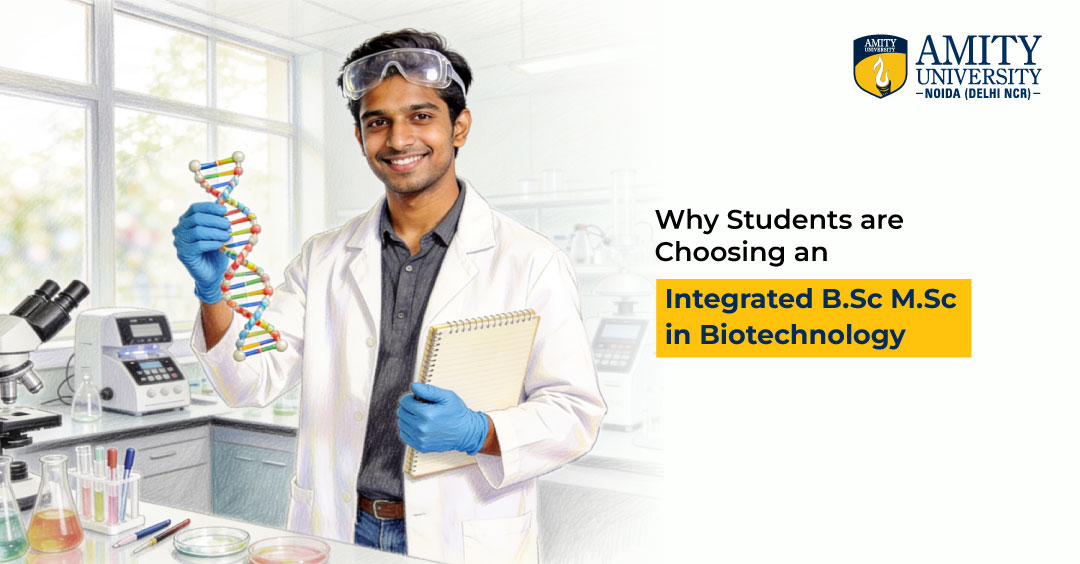
Biotechnology has become one of the most progressive sciences, affecting industries such as healthcare, pharmaceuticals, agriculture, environmental conservation, and food technology. With the progress in scientific inventions and developments, there is a rising need for individuals who have extensive knowledge and research abilities in biotechnology.
To keep up with the rapid pace of development of the field of biotechnology, many students today are choosing an integrated BSc MSc in Biotechnology program rather than studying separately undergraduate and graduate programs in biotechnology. In this five-year program, students have an opportunity to acquire deep knowledge in the subject, research experience, and professional skills without separate admissions after completing their studies.
Then, why is the integrated program becoming more and more attractive for students after Class XII?
A combined BSc & MSc in Biotechnology is a five-year programme in which the undergraduate and postgraduate levels of study come together in a joint programme. The programme aims to ensure that:
There are robust foundations of biological sciences and biotechnology.
There is a deeper understanding of molecular biology, genetics, microbiology, and bioinformatics.
Laboratory skills have been gained through hands-on experience.
Industrial skills have also been acquired.
Thus, the student comes out of this programme with both academic knowledge and a practical skill set and becomes highly employable.
1. Time-Efficient Academic Experience- One of the biggest benefits of an integrated programme is that it ensures continuity. There is no need for the students to follow different procedures for application to a master's programme, appearing in entrance examinations, or transferring to another institute during the course of study.
The five-year programme enables them to concentrate on gaining expertise right from the start.
2. Good Research Experience- The field of biotechnology is highly research-oriented. Some of the research-related elements in such programmes are as follows.
Laboratory projects
Dissertation work
Methodology of research
Familiarity with advanced scientific equipment.
3. Better Career Prospects- Biotechnology-based companies today are looking for people with advanced degrees and knowledge in specific areas. The integrated course provides that advantage since graduates of such courses are knowledgeable in both the undergrad and postgrad levels. Career prospects are:
Biotechnology Research Scientist
Clinical Research Associate
Genetic Analyst
Bioprocess Engineer
Bioinformatics Analyst
Quality Control Analyst
Regulatory Affairs Specialist
The course is also great preparation for future PhD study and research.
4. Skill development for industrial application- Today’s biotechnology is very interdisciplinary. Knowledge in data analysis, lab work, science writing, and other technologies is needed by the students. An integrated program will offer:
Technical lab skills
Computational biology experience
Science writing and presentation skills
Project and team working skills
This makes the graduates job ready and well-equipped academically.
5. Healthcare and Diagnostics- There is a need for people skilled in molecular biology and genetics within diagnostic labs and health care firms.
6. Food and Agriculture Sectors- Biotechnology is now being widely used for increasing crop yield and food security.
7. Academia and Research- Individuals can join PhD programs and earn money through teaching and research.
8. Skills Developed by Students in the Program- The integrated BSc MSc program in biotechnology enables the development of many critical skills in students, such as:
Research and analytical skills
Technical skills in the laboratory
Interpretation of data
Problem-solving skills
Scientific communication
Critical and innovative thinking
Admission into dual degree programmes has become more popular due to the increasing recognition among the youth and their parents of the importance of specialisation and strategic planning for the future. Some of the main reasons behind this trend are:
An organized way of learning
Less uncertainty about future admission into postgraduate programs
More chances for research work
Well-preparedness for the professional field
Getting an opportunity to specialize in any subject
With the rise of knowledge-based sectors, dual degree programmes provide a strategic edge to the students through specialization.
There is an Integrated BSc-MSc Biotechnology course offered by Amity University Noida, which aims at integrating both theoretical and practical aspects of learning through research.
Key elements of this course include:
Knowledge in biotechnology and life sciences in general.
Practical exposure through laboratory and projects.
Exposure to newer concepts such as molecular biology, genetics, microbiology, and bioinformatics.
Mentorship provided by experienced faculty and opportunities for learning through research.
Moreover, there is an ecosystem created at the university where students can innovate, learn, and interact with industry experts.
Those students who are interested in scientific research and discoveries, love laboratory experiments, and would like to make their contribution to healthcare, environment, and technology development should consider biotechnology as their specialization. An integrated course will include the following benefits:
Continuity in academic education
In-depth knowledge in the subject
Opportunities for research
Good career perspectives
Education for further study and work
Considering that biotechnology is going to play an increasingly important role in the future of science and industries, taking an integrated BSc MSc course in Biotechnology will allow students to acquire the necessary skills and become successful professionals in one of the most rapidly developing scientific fields.






Amity University Noida's Official Blog: Your Destination for Career Guidance, Course Insights, Rankings, and Expert Tips for a Future Full of Possibilities.
Contact us: admissions@amity.co.in