From Script to Screen: How Film Students Bring Stories to Life
31-03-2026

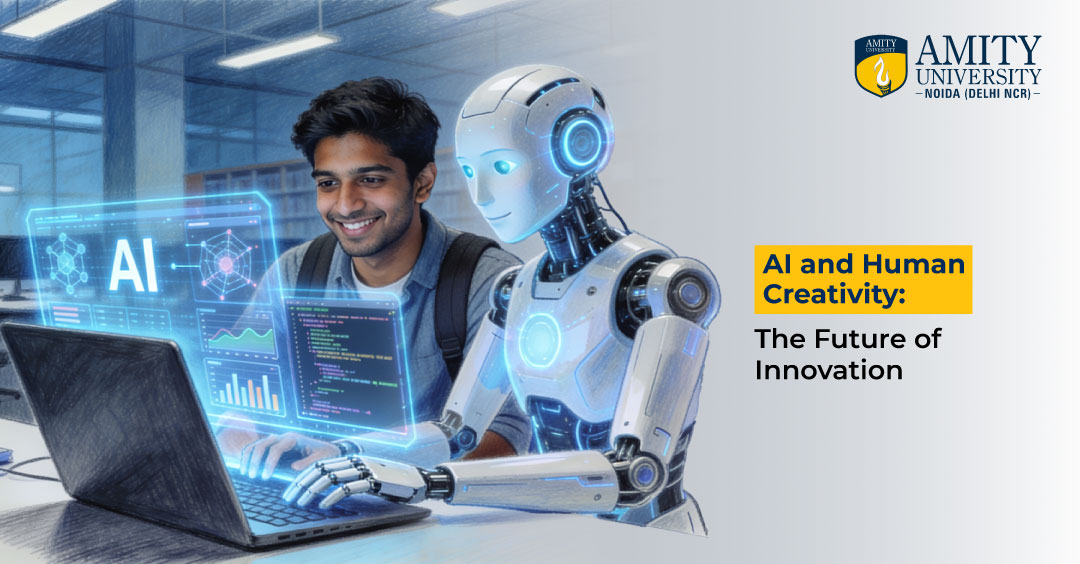
The history of human achievements can be traced back to one particular driving force that made everything possible: imagination. All the greatest inventions, from the wheel and the printing press through the internet and up to exploring outer space, started as ideas. Now the world has reached yet another important juncture. Artificial Intelligence revolutionizes businesses, societies, and economies worldwide; however, it should be noted that the core power of this technology does not lie in replacement but in augmentation of human capabilities.
The convergence of computation and creativity has changed education to some extent and is now making its way into academic curricula. In case you have considered pursuing B.Tech. Artificial Intelligence education, you may notice that this field used to be regarded as a rather narrow and specialized area within Computer Science, and has evolved into one of the most versatile areas of scientific inquiry.
The potential of AI extends far beyond research labs and tech companies. It influences the way physicians treat their patients, the methods farmers use in agriculture, the way banking and finance detect fraudulent activity, movie special effects, pharmaceutical research, and more and more aspects of daily lives.
The International Monetary Fund claims that close to 40 percent of employment opportunities worldwide may be disrupted in one way or another by artificial intelligence. Instead of eradicating job opportunities, artificial intelligence promises to change processes, skills, and tasks. In light of this, a growing demand emerges for specialists who will help to implement intelligent systems correctly.
When discussing the subject, most people concentrate on algorithms and automated processes that use machine learning techniques to achieve something. But one should also remember that much of the progress in this sphere comes from imaginative thinking. Generative AI technology used to create artworks, write code, design objects, and assist scientists with their research is just one example of the potential of such technologies. As one can see, they need to be developed by specialists with the necessary technical skills, but also imagination, ethics, creativity, and critical thinking.
A BTech Artificial Intelligence programme can provide students with an excellent opportunity to develop these competencies since it allows one to master the fundamentals of machine learning, data science, computer vision, neural networks, robotics, and natural language processing.
The investment and innovation that is happening in the field of AI globally are huge. In the findings published by PwC, it was revealed that by the year 2030, artificial intelligence can add a total value of $15.7 trillion to the GDP. Out of these gains, roughly $6.6 trillion would be because of enhanced productivity, and $9.1 trillion would be due to the increase in consumer spending and demand.
There are many consequences of this trend on the education sector. Students today are preparing themselves for a future where they are going to create and control such technology. It needs to combine both their technical skillset as well as humanity.
In this respect, India is an outlier. The young population that exists in India and its growing digital economy make it a major player in the field of global AI innovation.
In turn, the National Association of Software and Service Companies (NASSCOM) has pointed to the increasing importance of India in the sphere of artificial intelligence, as the adoption of AI solutions is rapidly increasing in fields such as healthcare, manufacturing, banking, education, agriculture, and logistics. As more and more businesses implement AI, there is a great need for individuals capable of bridging technology and business.
This brings us to the issue of AI Career Opportunities, which have grown immensely diverse. People may think that when it comes to AI-related jobs, one must be a data scientist or a machine learning engineer; however, nowadays, organizations search for AI researchers, business analysts, product managers, AI consultants, robotics engineers, prompt engineers, computer vision specialists, data architects, and experts on AI ethics.
AI ethics specialists should definitely be considered separately because as the influence of intelligent algorithms in decision-making grows in hiring, healthcare advice, finance, and government regulation, it becomes necessary to ask ethical questions regarding the implications of algorithms' decisions. Thus, future AI professionals need to take into account not only technical aspects but social as well.
In institutions like Amity University Noida, this changing approach is seen in the importance of research-based learning, innovation hubs, industrial collaboration, and multidisciplinary approaches. Such opportunities could enable them to gain the flexibility needed to succeed in an area that is constantly and consistently changing.
The most interesting thing about artificial intelligence is that its future is yet to be determined. Contrary to other professions that have been around for quite some time, artificial intelligence is a relatively new area of study. In other words, there is always something new to learn every day. This makes sure that when the learners graduate from college, they will work in a profession where continuous learning cannot be avoided.
This uncertainty is also the same thing that makes this profession appealing. While their parents learned how to interact with computers, the present generation is expected to determine how intelligent machines are going to be incorporated into the various aspects of society. This gives them the chance to participate in solving problems that go beyond technology itself.
Although the Future of Work increasingly relies on intelligent systems, the future of innovation continues to lie within the realm of humanity. Machine learning enables information processing with astonishing speed, pattern recognition, and automated routines of work. The thing machines cannot replace is the power of imagination that makes us question the conventional and see beyond what currently exists.
Therefore, when discussing artificial intelligence, it would be wrong to oppose people and machines. The relevant discussion should focus on ways to integrate humans and intelligent systems to resolve issues that could not have been tackled otherwise.
For prospective BTech Artificial Intelligence program students, this approach can shed light on the real meaning of the chosen educational track. Instead of simply focusing on studying innovative technology, learners will gain valuable insight into its ability to enhance human potential and open opportunities that were unthinkable before.
In other words, an encounter between the human imagination and artificial intelligence promises incredible results. For young learners eager to explore the subject further, this is likely to be an area to pursue a career.




Amity University Noida's Official Blog: Your Destination for Career Guidance, Course Insights, Rankings, and Expert Tips for a Future Full of Possibilities.
Contact us: admissions@amity.co.in