
From Script to Screen: How Film Students Bring Stories to Life
31-03-2026

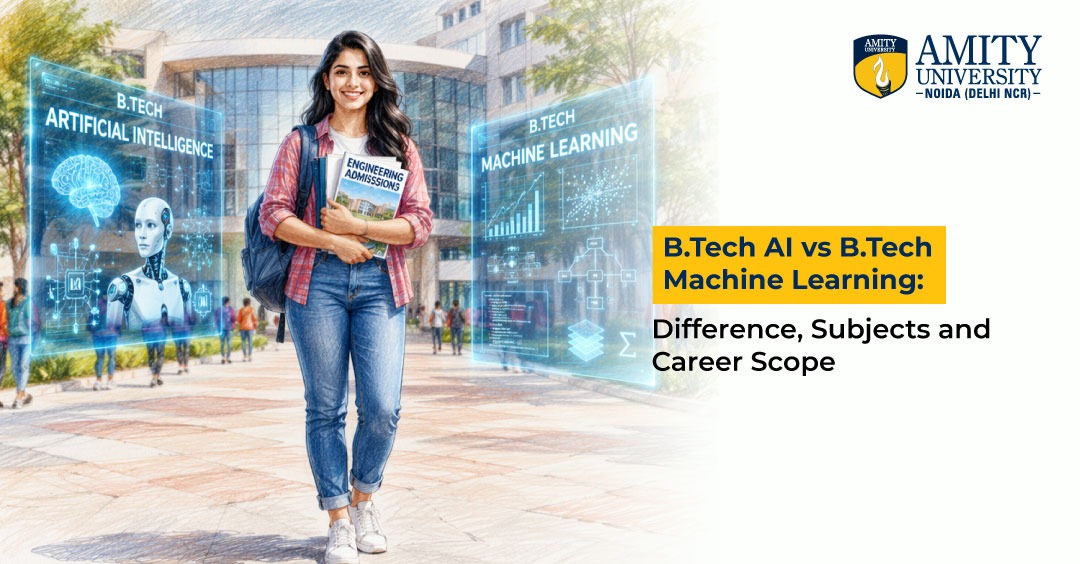
B.Tech AI and B.Tech Machine Learning sound like the same thing. And most students assume they are, although they are not.
Yes, broadly, artificial intelligence and machine learning are related. But as undergraduate engineering programmes, they build different skills, attract different kinds of students, and lead to different career trajectories. Yet, picking the wrong course doesn't ruin anything permanently. But it does mean spending four years going deep in a direction that did not suit you from the start.
The BTech AI vs BTech Machine Learning question is bothering many students. Hence, it deserves a proper and detailed answer. Here it is.
In simple words, AI is the larger umbrella. Machine learning sits under it. A B.Tech AI programme touches ML as one of several components. A B.Tech ML programme makes ML the entire focus.
|
Parameter |
B.Tech Artificial Intelligence |
B.Tech Machine Learning |
|
Scope |
Broad: intelligence systems, applications, behaviour |
Narrow and deep: data models, algorithms, learning systems |
|
Foundation |
Programming, AI Logic, system design |
Mathematics, statistics, probability, data modelling |
|
Key Subjects |
NLP, Computer Vision, Robotics, AI Ethics, Deep Learning |
Linear Algebra, Statistical Learning, Model Optimisation, Data Engineering |
|
Best Suited For |
Students who want to build complete intelligent applications |
Students who enjoy maths, data, and model-driven problem-solving |
|
Career Direction |
AI Engineer, Robotics Engineer, AI Application Developer |
ML Engineer, Data Scientist, Research Engineer |
B.Tech AI is a broad engineering degree. It is built around the idea of creating systems that behave intelligently. A voice assistant, a self-driving navigation system, a recommendation engine, or a medical diagnostic tool. Typical subjects across four years include:
AI fundamentals and knowledge representation
Machine learning and deep learning principles
Natural language processing and text analytics
Computer vision and image recognition
Robotics and autonomous systems
AI ethics, governance, and responsible design
Data structures, algorithms, and software engineering
BTech AI scope spans a wide range of industries. Graduates enter roles in AI product development, intelligent application design, robotics engineering, and software development with an AI specialisation. The breadth of the programme means graduates are not locked into one narrow function. That flexibility is a genuine advantage in a field that's still evolving fast.
The ML engineering course is heavier on mathematics from day one. Students who underestimate this find year one significantly harder than expected.
Core areas of focus include:
Probability theory and statistical inference
Linear algebra and calculus applied to learning systems
Supervised, unsupervised, and reinforcement learning
Algorithm design and model optimisation
Data preprocessing, feature engineering, and model validation
Deep learning architectures and neural network design
Research methodology and performance benchmarking
This is a specialist degree. It does not try to cover all of AI. It goes very deep into the models and mathematics that make intelligent systems actually work under the surface.
|
Subject Area |
B.Tech AI |
B.Tech ML |
|
Core Mathematics Load |
Moderate |
Heavy |
|
Programming Emphasis |
Moderate to High |
High |
|
NLP and Computer Vision |
Yes, covered directly |
Covered as ML applications |
|
Robotics and Autonomous Systems |
Yes |
Not typically core |
|
Statistical Modelling |
Introductory |
Advanced and central |
|
Research and Model Building |
Partial |
Primary Focus |
Neither of the courses is objectively better. This is genuinely a question of the fit and interest of the students.
Choose B.Tech AI if:
You want a wider technology degree with flexibility across applications
Robotics, NLP, computer vision, and intelligent system design interest you equally
You'd rather understand how AI systems work broadly than specialise in modelling
Maximum career flexibility across AI-adjacent roles is the goal
Choose B.Tech ML if:
You enjoy mathematics, statistics, and data-driven problem-solving
Model building and algorithm optimisation genuinely appeal to you
You want to work as a data scientist, research engineer, or ML specialist
Deep technical specialisation matters more to you than breadth
For most students, yes. The mathematical load in ML is heavier and more sustained. Probability, statistics, and linear algebra aren't occasional topics. They're foundational to almost every ML subject across all four years.
B.Tech AI can feel more accessible initially. Because it includes broader, application-oriented content alongside technical subjects. It still becomes deeply technical in advanced areas like deep learning, NLP, and computer vision. Neither programme is easy. ML just demands quantitative strength earlier and more consistently throughout.
At Amity University Noida, both B.Tech AI and B.Tech Machine Learning courses are offered with structured curricula. They also offer strong lab components, industry-aligned projects, and placement exposure to companies actively hiring in AI and data science. In both fields, a portfolio of real projects carries significant weight in technical hiring rounds, sometimes more than academic marks alone.





Amity University Noida's Official Blog: Your Destination for Career Guidance, Course Insights, Rankings, and Expert Tips for a Future Full of Possibilities.
Contact us: admissions@amity.co.in