
From Script to Screen: How Film Students Bring Stories to Life
31-03-2026

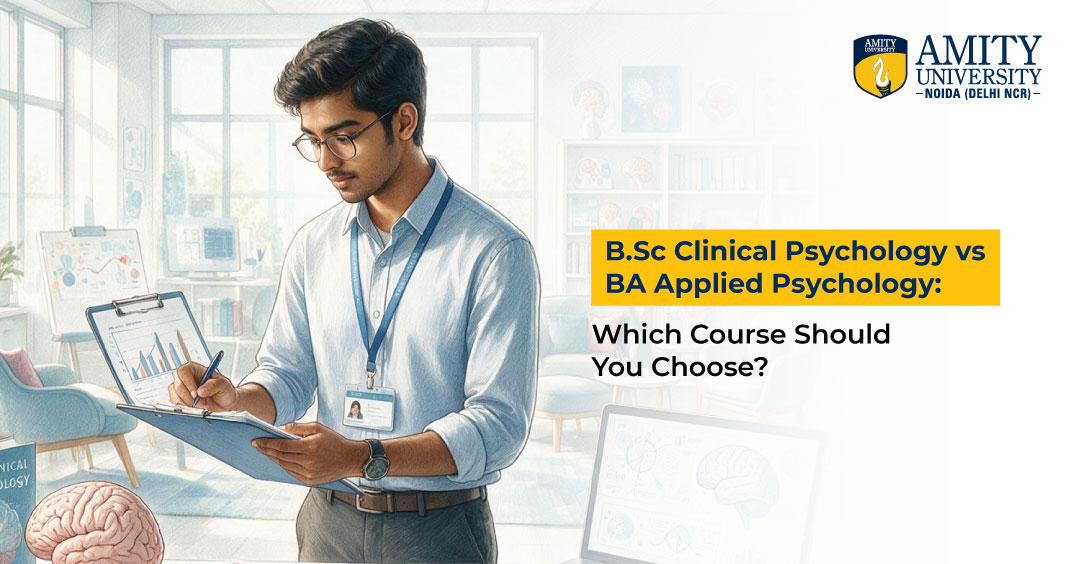
Psychology has become more relevant over the last few decades. Mental health awareness is growing every day. Career demand is rising simultaneously. And yet, most students opting for psychology are still confused by BSc Clinical Psychology vs BA Applied Psychology.
The answer is that the two programmes attract different kinds of students, the subject combinations change, career paths are different, and the scope of job opportunities is different. Getting clarity here before you enrol matters more than most counselors will tell you.
The science versus arts classification is not just administrative. It shapes the entire nature of how you study psychology at the undergraduate level.
|
Parameter |
||
|
Degree Type |
Science-based undergraduate degree |
Arts-based undergraduate degree |
|
Core Focus |
Diagnosing and treating psychological disorders |
Applying psychology to real-world settings: organisations, education, counselling |
|
Key Subjects |
Abnormal Psychology, Psychopathology, Neuropsychology, Clinical Assessment |
Organisational Psychology, Social Psychology, Counselling Theory, Departmental Psychology |
|
Primary Career Direction |
Clinical practice, mental health services, therapy |
HR, counselling, education, corporate wellness, social work |
|
Post graduate Pathway |
M.Sc Clinical Psychology, RCI- recognised programmes |
MA/ M.Sc Applied or Counselling Psychology |
This is a science degree first. Hence, the approach towards psychological disorders is to go ahead with biological and neurological frameworks alongside psychological ones. The curriculum goes deeper into diagnostic systems, research methodology, and clinical assessment. Core areas usually covered include:
Psychopathology and abnormal psychology
Psychological assessment and diagnostic tools
Neuropsychology and brain-behaviour relationships
Counselling and psychotherapeutic techniques
Research methods and psychological statistics
BSc psychology scope through the clinical route is most relevant for students who want to work directly with individuals experiencing mental health conditions. Think therapy, rehabilitation, psychiatric support, and clinical research. It's a demanding programme. The science foundation requires comfort with biological sciences and research design, not just an interest in human behaviour.
It also leads more directly to RCI (Rehabilitation Council of India)-recognised postgraduate programmes, which are essential for practising as a licensed clinical psychologist in India.
Applied psychology casts a wider net. It takes psychological theories and asks: where else does this matter? The workplace. Schools. Communities. Public policy. Sports teams. The BA programme typically covers:
Organisational and industrial psychology
Social and developmental psychology
Counselling theory and communication
Educational psychology
Consumer behaviour and human factors
Clinical psychology vs applied psychology diverge most clearly here. Applied psychology does not train students to diagnose or treat clinical disorders. It trains them to understand human behaviour in context. They are trained to apply that understanding professionally across diverse settings.
Many applied psychology graduates find their way into HR management, corporate L&D, educational counselling, NGO work, and community mental health. Some go on to postgraduate programmes in counselling psychology or organisational behaviour.
|
Career Area |
B.Sc Clinical Psychology |
BA Applied Psychology |
|
Clinical Practice/Therapy |
Yes, with RCI- Recognised PG |
Limited without clinical PG |
|
HR & Organisational Development |
Less Common |
Strong Pathway |
|
School & Educational Counselling |
Possible |
Common entry Point |
|
Psychiatric Hospital & Rehab Centres |
Strong Fit |
Less Direct |
|
Corporate Wellness & EAP Roles |
Possible |
Growing Pathway |
|
NGO & Social Work |
Possible |
Very Common |
Psychology in a B.Sc or BA course is a choice that students have to decide for themself. Here is a practical way to think it through.
Choose B.Sc Clinical Psychology if:
You want to work directly with mental health conditions
You're comfortable with science-based study and research methods
Your long-term goal involves clinical practice or psychiatric support
You're prepared to invest in an RCI-recognised postgraduate programme after graduation
Choose BA Applied Psychology if:
You're drawn to understanding human behaviour in workplaces, schools, or communities
You want flexibility across multiple career directions
You'd like to enter HR, counselling, education, or social development roles
You're not yet certain about clinical practice specifically
Neither is a weaker option. They serve different goals.
The short answer is yes, but there are conditions. With a BA Applied Psychology graduate degree, you cannot practise as a clinical psychologist. You will need an RCI-recognised postgraduate qualification. The BA degree opens a strong route into counselling, organisational, and educational psychology roles. A postgraduate degree can easily bridge the gap for those who choose clinical practice late.
At Amity University Noida, both BSc and BA programmes are designed to include practical training, research projects, and exposure to real-world applications. Students get the opportunity through internships and collaborative work. In psychology, practical hours matter more. While academic knowledge gets you shortlisted. Supervised practical experience is what distinguishes candidates when placements and postgraduate admissions come around.





Amity University Noida's Official Blog: Your Destination for Career Guidance, Course Insights, Rankings, and Expert Tips for a Future Full of Possibilities.
Contact us: admissions@amity.co.in