
From Script to Screen: How Film Students Bring Stories to Life
31-03-2026

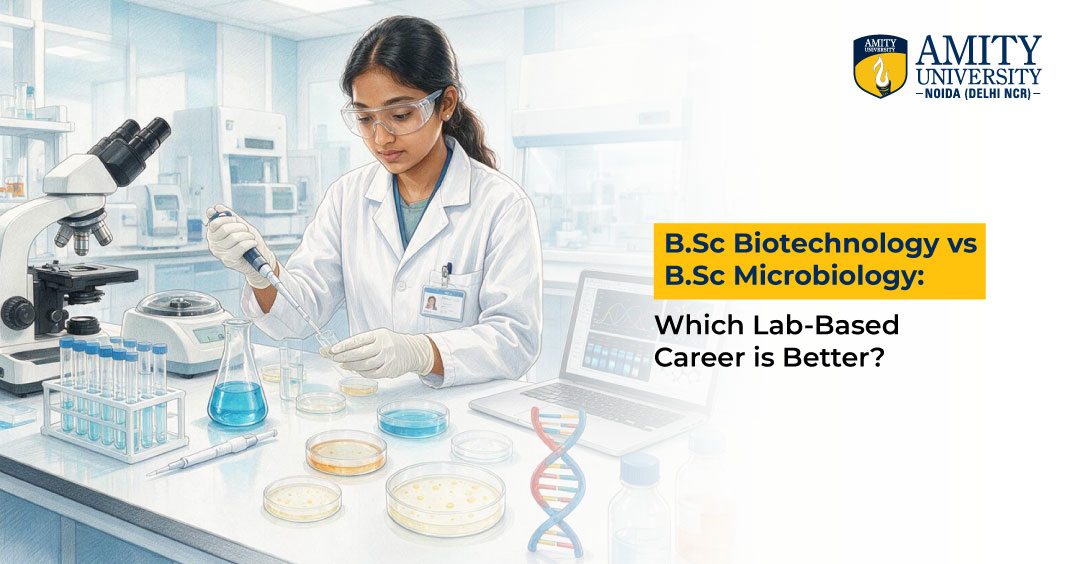
Choosing between BSc Biotechnology vs BSc Microbiology is not a straightforward choice. A common misconception among most students is that the two courses are nearly identical. Although they're not.
Yes, both subjects involve labs. They sit under the biological sciences. Both attract students who did well in Class 12 with the Biology subject. But its curriculum, approach, training process, and career paths are different. Hence, getting it wrong costs 2 to 3 years of your academic and professional career.
The BSc Biotechnology vs BSc Microbiology question is a genuine one. Students in a dilemma deserve a proper answer. Let's dive into the details.
Early semesters overlap for both courses. Both cover biochemistry and cell biology. By year two, they split sharply. Biotech moves toward molecular engineering. Microbiology moves toward understanding and classifying microscopic life.
|
Parameter |
B.Sc Biotechnology |
B.Sc Microbiology |
|
Core Focus |
Manipulating biological systems for industrial, medical, or agricultural use |
Studying microorganisms like bacteria, viruses, fungi and protozoa |
|
Key Subjects |
Genetics, Cell Biology, Bioinformatics, Genetics Engineering, Biochemistry |
Bacteriology, Virology, Immunology, Clinical Microbiology, Medical Microbiology |
|
Primary Application Areas |
Pharmaceuticals, agriculture, biotech industry, diagnostics |
Hospitals, F&B, environmental science, research labs |
|
Lab Emphasis |
Molecular biology techniques, cell culture techniques, PCR, gene editing |
Culturing, microorganisms, staining, microscopy, and sensitivity testing |
Biotechnology doesn't study biology alone. It uses it. Students learn to manipulate biological systems. This knowledge is used to build things such as drugs, diagnostic kits, genetically modified crops, and fermentation products.
The curriculum typically covers:
Genetic engineering and recombinant DNA technology
Bioinformatics and computational biology tools
Cell culture and tissue engineering techniques
Bioprocessing and fermentation technology
Immunology and vaccine development principles
Pharmaceutical companies, diagnostics startups, agri-biotech firms, and genomics research labs all recruit B.Sc Biotechnology passouts. Students who enjoy working across data and wet lab environments will find this programme engaging in a way that pure biology courses aren't.
It's demanding, though. The quantitative load is heavier than most students expect coming from a Class 12 biology background.
Microbiology is more foundational, as it asks a different question. What are these organisms? How do they behave? What happens when they interact with us? Core areas of study usually include:
Medical and clinical microbiology
Bacteriology, virology, and mycology
Immunology and infectious disease
Industrial microbiology and fermentation
Environmental microbiology and water testing
BSc microbiology jobs are available almost immediately after graduation. That's not true of every science degree. Hospitals and diagnostic labs hire fresh graduates. So do food companies, pharma quality teams, and environmental testing agencies.
|
Employer Type |
Typical Role |
Sector |
|
Hospitals & Diagnostic Labs |
Microbiologist, Lab Technician |
Healthcare |
|
Food & Beverage Industry |
Quality Control Analyst |
Food Safety |
|
Pharmaceutical Companies |
QA/QC Microbiologist |
Pharma |
|
Environmental Agencies |
Environment Analyst |
Public Sector |
|
Research Institutes |
Research Assistant |
Academia/Government |
Clinical microbiology is a particularly stable pathway. Demand doesn't fluctuate with the startup ecosystem. Hospitals always need diagnostic microbiologists. That kind of consistency matters.
Postgraduate options diverge here.
Biotechnology graduates typically prefer to go into M.Sc Biotechnology, Bioinformatics, or Genetic Engineering. Many students attempt JAM for IIT or central university admissions. High performers often end up in pharmaceutical R&D, genomics, or synthetic biology research.
Microbiology graduates, like M.Sc Microbiology, Medical Microbiology, or Immunology. Strong entry into clinical research and hospital diagnostics. Some pivot into regulatory affairs or quality assurance in pharma.
Neither path is limited. Both reward postgraduate investment.
Honestly? Neither wins the debate definitely. The answer is personal.
Students pulled toward genetic engineering, molecular diagnostics, and building biological tools find biotechnology vs microbiology a clear choice in biotech's favour. Microbiology is a more suitable option for students who want to work in clinical settings, understand infectious diseases, or contribute to food and environmental safety.
There's another angle worth considering. A genuinely engaged microbiology student with a serious approach who works hard in the lab will shine over a non-serious biotechnology student almost every time. Because subject fit matters more than the perceived idea of prestige.
Both programmes are offered by Amity University, Noida, under the Faculty of Applied Sciences department. Laboratories are well-equipped. Faculty bring industry and research exposure opportunities for students. Internship structures are built into the programme seamlessly. Practical training is not a minor detail. In biological sciences, employers screen heavily for hands-on skills. Classroom knowledge gets you an interview. Lab competence gets you the job.







Amity University Noida's Official Blog: Your Destination for Career Guidance, Course Insights, Rankings, and Expert Tips for a Future Full of Possibilities.
Contact us: admissions@amity.co.in