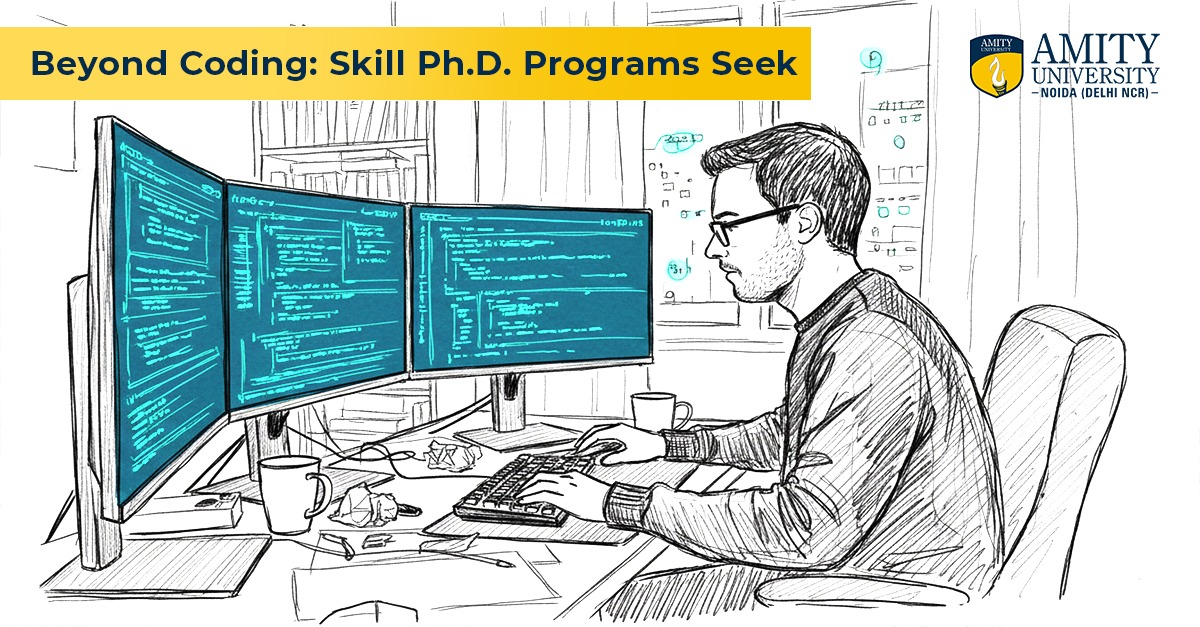
PhD programs today are no longer searching for exceptional coders alone. They are looking for innovators, original thinkers, and future research leaders.
Across Indian and global universities, admission committees increasingly prioritise candidates who demonstrate hands-on research experience, interdisciplinary thinking, and the ability to translate ideas into real-world impact. Technical proficiency still matters, but it is no longer the primary differentiator.
Recent studies indicate that qualities such as resilience, perseverance, collaboration, and adaptability are now ranked as highly as technical skills in doctoral admissions.
In an era where human ingenuity intersects with advanced technology, being an algorithm expert is no longer enough. What sets candidates apart in competitive
PhD programs is a strong body of work, intellectual curiosity, and the capacity to push research boundaries. While core eligibility criteria remain unchanged, rising competition has shifted PhD admissions toward a more holistic evaluation, with greater emphasis on prior publications, research projects, and applied problem-solving skills.
Doctoral candidates are expected not just to execute research, but to lead inquiry and drive innovation forward.
Insights from PhD Admission Committees
Authenticity and Original Thinking
Admission panels value curiosity, independent thought, and the ability to take calculated risks. Skills such as designing, leading, and executing research projects carry significant weight. Conference presentations, peer-reviewed papers, and publications reflect academic seriousness, while contributions to open-source platforms demonstrate real-world application and collaborative ability.
Persistence Through Challenges
The ability to navigate setbacks and remain committed to long-term research goals is a strong indicator of doctoral readiness. Candidates who demonstrate perseverance often stand out as researchers capable of sustaining rigorous inquiry.
Adaptability and Interdisciplinary Collaboration
Managing diverse teams, feedback, ideas, and methodologies, particularly within interdisciplinary research, reflects intellectual maturity, flexibility, and leadership under pressure.
Must-Haves for the Future Researcher
While motivation, discipline, and strong letters of recommendation remain essential, successful PhD candidates bring far more to the table. Studies suggest that prior mentoring experience can improve PhD admission prospects by up to 55 percent, highlighting the importance of collaborative and leadership exposure.
Ethical Awareness
Future researchers must understand the distinction between innovation and responsible innovation. Awareness of research ethics, data privacy, and ethical decision-making is now a non-negotiable expectation.
Interdisciplinary Knowledge
Coders who understand domains beyond technology, such as social sciences, life sciences, linguistics, consumer behaviour, and market dynamics, are increasingly favoured. Research indicates that candidates with interdisciplinary exposure show up to 60 percent higher admission success rates.
Research Experience
A candidate’s seriousness is reflected in prior research engagement, whether through academic projects, industry work, or published papers. Familiarity with reproducible workflows, programming languages like Python, and research methodologies strengthens applications. Advanced specialisations in Data Science and STEM fields are viewed positively, as they signal a proactive and research-oriented mindset.
Communication Skills
Doctoral research depends heavily on clear and persuasive writing. Candidates must be able to explain complex ideas to both technical and non-technical audiences, which is essential for proposals, publications, and collaborative research.
Problem-Solving Ability
Strong researchers can identify gaps, frame hypotheses, and develop innovative solutions. Evidence of solving complex challenges, whether through projects, recommendations, or research work, adds significant value. Coding may be the tool, but problem-solving remains the core research skill.
A 2024 study by Nature reports that researchers with strong collaboration and communication skills produce 37% more high-impact publications than those working in isolation.
The future of doctoral research belongs not to those who merely write code or speak the language of machines, but to those who drive discovery, lead innovation, and pioneer meaningful breakthroughs.
FAQs
1. Do PhD programs value coding skills most?
No, they prioritise research, innovation, and problem-solving more.
2. What helps candidates stand out?
Research experience, originality, and resilience.
3. Is prior research important?
Yes, projects and publications strongly improve admission chances.
4. Why are communication skills needed?
They are essential for proposals, papers, and collaboration.
5. What is the last date to apply for the PET test?
The last date to apply for the PET test is 30 April.
6. When will the PET test exam be conducted?
The exam will be conducted on 11 May or 12 May.