
From Script to Screen: How Film Students Bring Stories to Life
31-03-2026

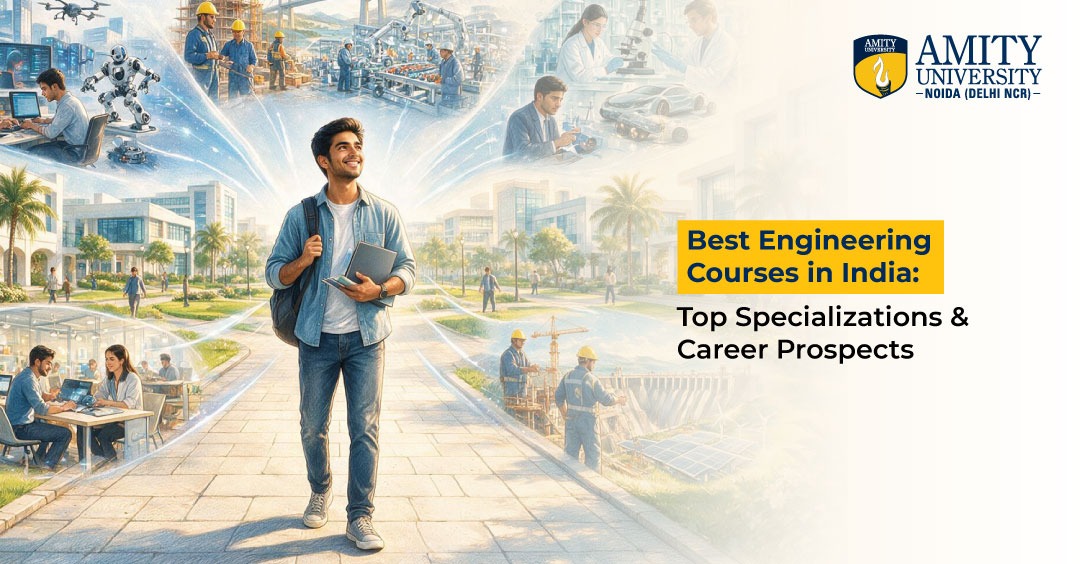
Despite that, engineering remains one of the most preferred career options for students post-Class 12. But there have been some drastic changes in the field during the last decade. Besides conventional areas like Civil and Mechanical Engineering, the newer fields of study like Artificial Intelligence, Robotics, Data Science, Cyber Security, and Biotechnology have created some new career avenues.
Students today do not base their decisions on the popularity of engineering anymore; instead, they consider various factors including industry demands, innovation, research, international exposure, and career growth before choosing a particular field.
As you look for engineering courses in the future, this guide will provide you with all the information that you might require, from the list of engineering courses to the best engineering courses of 2026.
Engineers work towards providing technological solutions to problems that exist in the real world. Engineers provide their expertise in fields such as health care, manufacturing, aerospace, finance, renewable energy, and information technology.
The reasons behind the popularity of engineering as a career are as follows:
Wide variety of career options
High demand for professionals
Research and innovation
High salaries
International career opportunities
Opportunities for entrepreneurship
Access to the latest technology like AI, IoT, and automation
With the increasing adoption of digital transformation in various industries, the demand for multi-disciplinary engineers is anticipated to increase further.
Majority of the bachelor’s degree courses in engineering demand that:
Candidates must pass the Class 12 examination with PCM (Physics, Chemistry, and Mathematics)
The qualifying marks must meet the criteria of the university/institute concerned
Entrance exam marks should be valid when required (like JEE Main or university entrance exams)
Admission in certain universities is also possible on the basis of merit.
|
Programme |
Duration |
|
B.Tech |
4 Years |
|
B.E |
4 Years |
|
Integrated B.Tech + M.Tech |
5 Years |
|
Diploma in Engineering |
3 Years |
|
M.Tech |
2 Years |
The engineering field offers numerous specializations to match different interests and career goals. Here are some of the most popular options available in India.
|
Engineering Course |
Focus Area |
|
Computer Science Engineering |
Software, AI, Programming, Cloud Computing |
|
Artificial Intelligence & Machine Learning |
Intelligent Systems, Automation |
|
Data Science |
Analytics, Big Data, Business Intelligence |
|
Cyber Security |
Information Security, Ethical Hacking |
|
Mechanical Engineering |
Manufacturing, Robotics, Design |
|
Civil Engineering |
Infrastructure, Construction |
|
Electrical Engineering |
Power Systems, Electronics |
|
Electronics & Communication Engineering |
Communication Technologies |
|
Biotechnology Engineering |
Healthcare, Genetics, Pharmaceuticals |
|
Aerospace Engineering |
Aircraft and Space Technology |
|
Chemical Engineering |
Chemicals, Process Industries |
|
Automobile Engineering |
Vehicle Design and Manufacturing |
|
Robotics Engineering |
Automation and Smart Machines |
|
Mechatronics Engineering |
Mechanical + Electronics Integration |
|
Environmental Engineering |
Sustainability and Environmental Solutions |
This engineering courses list highlights the wide range of options available for students interested in different industries.
While every specialization has its own value, certain branches are witnessing exceptional industry demand due to technological advancements and changing business requirements.
Computer Science Engineering continues to dominate the technology sector.
Students learn:
Programming
Software Development
Operating Systems
Cloud Computing
Database Management
Computer Networks
Software Engineer
Full Stack Developer
Cloud Engineer
Systems Engineer
Product Developer
AI has become one of the fastest-growing domains worldwide.
Students gain knowledge in:
Machine Learning
Deep Learning
Natural Language Processing
Computer Vision
Neural Networks
AI Engineer
Machine Learning Engineer
Data Scientist
AI Research Associate
Every industry generates data, creating strong demand for professionals who can analyse and interpret it.
Subjects include:
Statistics
Python
SQL
Data Visualisation
Predictive Analytics
Data Analyst
Data Scientist
Business Intelligence Analyst
Analytics Consultant
With cyber threats increasing globally, organisations are investing heavily in digital security.
Students study:
Ethical Hacking
Network Security
Digital Forensics
Cryptography
Cyber Security Analyst
Security Consultant
Penetration Tester
Information Security Engineer
Mechanical Engineering remains one of the broadest engineering disciplines.
It covers:
Manufacturing
Thermodynamics
Machine Design
Robotics
Industrial Automation
Career opportunities exist across manufacturing, automotive, aerospace, and energy sectors.
Civil Engineering focuses on designing and maintaining infrastructure.
Areas include:
Smart Cities
Transportation
Structural Engineering
Construction Management
Career opportunities continue to grow with investments in infrastructure development.
ECE combines electronics, communication systems, and embedded technologies.
Career options include:
Embedded Systems Engineer
VLSI Engineer
Telecom Engineer
Semiconductor Industry
Biotechnology integrates biology and engineering to develop solutions in healthcare, agriculture, pharmaceuticals, and environmental sustainability.
Growing investments in biotechnology research continue to create opportunities for skilled professionals.
Students can choose from different formats depending on their career goals.
B.Tech
B.E.
M.Tech
ME
Integrated B.Tech + M.Tech
Polytechnic Diploma
Lateral Entry Engineering
These types of engineering courses allow students to choose pathways aligned with their academic background and professional aspirations.
Selecting a good university is as essential as selecting an engineering branch that one wants to pursue. Apart from a futuristic curriculum, a student gets the advantage of getting knowledge from experienced teachers, modern labs, industrial exposure, and innovations.
Engineering courses of Amity University Noida provide a complete engineering education through their engineering courses which are a mixture of theoretical study and practical approach. Through these courses, the students get the chance to engage themselves in live projects, research activities, innovation events, and internships.
Some key highlights include:
Various Engineering courses at the Undergraduate and Postgraduate levels
Specializations based on latest technologies like Artificial Intelligence, Data Science, Cyber Security, Robotics, and Computer Science
Highly advanced labs and facilities for research
Industrial interface, internships, and project-based learning
Facilities for innovation and entrepreneurship through incubations
Academic alliances globally and international exposure
Career assistance and career guidance
For those who wish to pursue a university where academic distinction meets practical education and industry exposure, Amity University Noida is the ideal platform to help achieve their future career goals.
There are many different sectors where engineering graduates may find jobs, which include the following:
Information Technology
Manufacturing
Automotive
Aerospace
Construction
Telecommunications
Healthcare
Renewable Energy
Banking & Fin Tech
Research & Development
Government Sector
Start-ups
Additionally, many graduates opt to undergo further studies in the form of M.Tech, MBA, MS, or certifications in order to develop themselves.
Engineering is considered to be one of the most vibrant career options in India. With the increasing number of engineering courses, one can select courses that match their interests as well as the requirements of industries.
In case you are going through the list of engineering courses, trying to learn about the best engineering courses, understanding different types of engineering courses, or looking for the best engineering courses for the future, it is all about making the right choice according to your aptitude, plans, and quality of education at your college.



Amity University Noida's Official Blog: Your Destination for Career Guidance, Course Insights, Rankings, and Expert Tips for a Future Full of Possibilities.
Contact us: admissions@amity.co.in