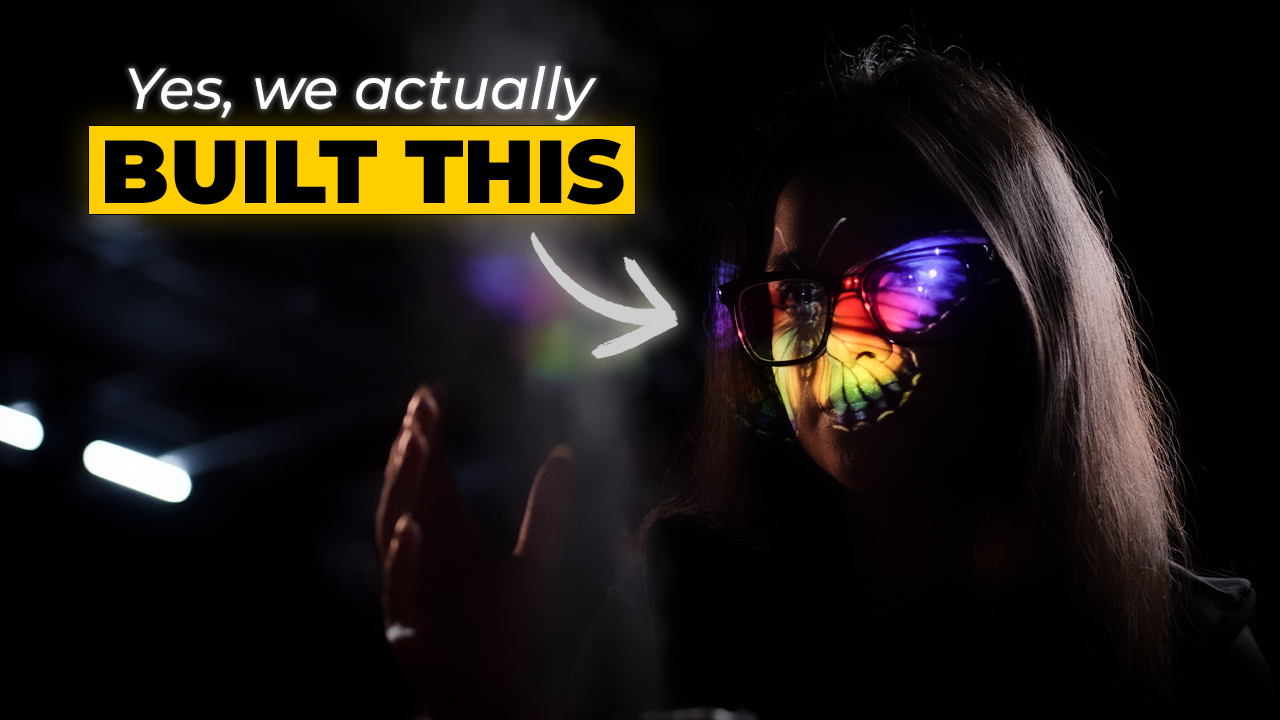
Imagine being able to visualize your thoughts as you watch them right in front of your eyes rather than viewing them on a screen. That is the very essence of the HoloMentor, a hologram based system invented by Amity students Manan Parmar and Priyanchi. It is a combination of artificial intelligence, voice recognition, gesture control, and projection systems.
It all started in 2024 when all the students had some rough designs and an idea. Then they proceeded with experiments, playing with different technologies and transforming drawings into a real product. The whole process consisted of studying, improving, and getting back to the drawing board whenever something went wrong.
This technique involves the use of fine air particles with some moisture content capable of bending the light rays. On interaction of light rays with such particles, light is thrown back towards the viewer, thus giving an appearance of a floating image in the air.
However, the projection is not all there in the process. The HoloMentor also makes use of artificial intelligence, voice recognition, and gesture control. Essentially, AI takes care of the processing of the information supplied to the system, while voice recognition allows for the interactive command mode, and gesture control facilitates the interaction with the visual display.
It is pretty simple in concept: the interaction with the system, understanding of the request, and visualization of the same using the technology.
The journey to the prototype was much harder than coming up with the initial design. In the process of creating the project, the students had to go through many iterations. Every technical problem presented an opportunity for them to return to the prototype and figure out what should be changed and try again. During this process, they had to use technologies that were unfamiliar to them.
Working in the AIDC Lab, they had the opportunity to test the idea and create their project. Mentoring was another important aspect of the project. As the students noted, there were times when they doubted if their idea was really going to work. The mentoring allowed them to continue developing their project instead of stopping after the first failure.
This part of the work is one of the most interesting ones. While the prototype itself looks very futuristic, the process of creating it was anything but easy.
However, very soon, the project went out of the laboratory and classrooms. Manan and Priyanchi took part in many technology-related competitions and platforms, including Techkriti at IIT Kanpur, where they won an award. In addition, the technology was exhibited during an AI Summit, and thus the opportunity to demonstrate the technology to several famous individuals was created.
The most memorable experience was the demonstration of the technology to Mukesh Ambani and Akash Ambani. For the students, the chance of exhibiting their innovation before such successful businessmen and technology gurus became another achievement on the way of developing HoloMentor.
The students also took part in Invasion Internationals, which included the participation of institutions and participants not only from India but also from other countries around the world.
This is more than just getting something to hover above the screen. The students have a bigger challenge: can technology alter the way we experience information?
Consider the student who tries to get his head around an idea from a book or a two-dimensional image. Now imagine he gets a visualization of this idea presented in a three-dimensional format that he can interact with. This could make some aspects of learning more visually appealing and engaging.
There is much potential for further growth, of course, as this is only a prototype at this point. But this is precisely what makes this invention so intriguing.
But for Manan and Priyanchi, their experience with HoloMentor is far from over.
Their story with the tool proves how an idea can develop if there is enough room for experimentation and improvement for the students. What began in early 2024 with the help of sketches has already become a working technology that has been successfully presented at competitions, technology expos, and in front of notable figures like Mukesh Ambani and Akash Ambani.
What awaits now is exploring the potential of the new technology further.
That is probably the most interesting thing about the innovation of young people some ideas do not always have a limit on their evolution. It is rather a starting point for a more exciting journey ahead.
Stay tuned for more Amity Spotlight episodes!
Amity University Noida's Official Blog: Your Destination for Career Guidance, Course Insights, Rankings, and Expert Tips for a Future Full of Possibilities.
Contact us: admissions@amity.co.in