
From Script to Screen: How Film Students Bring Stories to Life
31-03-2026

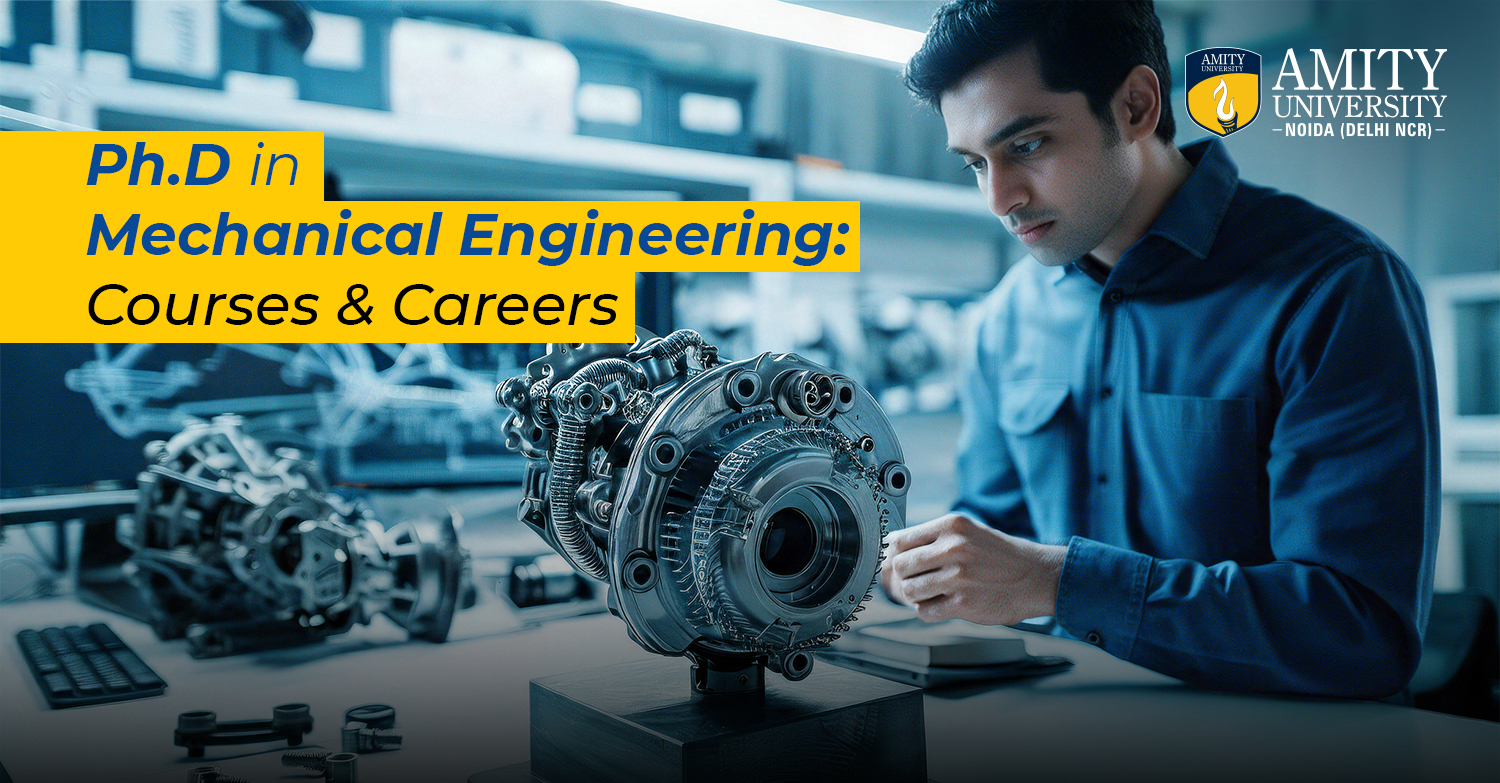
Mechanical Engineering remains one of the most versatile branches of engineering, including various industries like automobiles, aerospace, manufacturing, robotics, energy, defence, materials, and automation. For those interested in taking a step further from traditional engineering and taking part in research and development of innovative technology, doing a PhD in Mechanical Engineering would be a good choice.
PhD study in mechanical engineering is based on gaining specialisation in a particular field of research and mastering skills related to problem-solving, experiments, modelling, analysis, and scientific writing. In India, PhD programmes in various specialisations of mechanical and allied engineering are offered by various educational institutions.
The PhD programme admission process usually includes satisfying the institution's criteria for admission, sending the application, passing the selection process and formulating a research project in line with existing research specialisation at the institution.
PhD in Mechanical Engineering is a research-oriented doctoral programme meant for those who wish to pursue research and contribute to the domain of mechanical engineering.
While undergraduate and postgraduate studies focus more on theory and practice, PhD programmes mainly comprise research work. Researchers identify a research question, perform an extensive literature review, design a methodological framework, run simulations or conduct experiments, interpret results, and add to the body of knowledge in their discipline.
Such a programme might appeal to candidates in the following fields:
Engineering Research
Product/Technology Development
Academia
Research & Development
Innovation/Patents
Advanced Simulation and Modeling
Sustainable Engineering
Robotics and Automation
Energy and Thermal Systems
UGC's Minimum Standards and Procedure for Award of Ph.D. Degree Regulations, 2022 form the overall regulatory structure of PhD programs in India.
Eligibility criteria can differ from one university to another and from one PhD program to another within the same university. The prospective candidate must therefore verify the current eligibility criteria of the university he/she intends to apply to.
Usually, the prospective candidates will be admitted to a PhD program in mechanical engineering upon completion of necessary postgraduate degrees like ME, MTech or MS. However, in some universities, candidates are allowed the option of pursuing a PhD program right after a four-year bachelor's program, depending on their eligibility criteria at the respective university.
For instance, eligibility criteria for the Mechanical and Automation Engineering PhD program offered at Amity University Noida include relevant qualifications of BE/BTech and ME/MTech/MS along with the respective minimum marks, and the direct route for those candidates who qualify in BE/BTech with at least 75% or 7.5 CGPA.
Some common eligibility criteria include:
Relevant bachelor's or master's degree
Minimum qualifying marks or CGPA
Relevant academic qualification
Selection by the university selection procedure
Research aptitude and interest in the proposed field of study
The process of applying for PhD admission normally comprises of many steps. Although the exact process varies with institutions, it usually includes the following steps:
1. Selection of the research field
The first step includes selecting a field that is in line with the academic background and future career prospects.
2. Eligibility criteria check
One must review the academic requirements, qualifying marks, degree requirements and other criteria.
3. Filing of application
An online application form is usually filled and relevant academic papers and documents are submitted by the candidates.
4. Written or entrance test
Some universities or based on the category of candidates require the candidate to clear an entrance test conducted by the university.
5. Personal interview
Selected candidates may have a personal interview conducted to assess their subject knowledge and area of interest in the research field.
For instance, Amity University's Mechanical and Automation Engineering PhD requires a written test in the subject followed by a personal interview in the selection process.
6. Research proposal and supervisor allocation
Following the selection process, candidates prepare their research problem and get guidance from a faculty member as per the university guidelines.
PhD is not merely a continuation of the study that one does in an MTech program. As time progresses, the focus shifts from classroom education to research work.
The beginning stages may involve studying subjects like:
For example, the Amity University Noida Mechanical and Automation Engineering PhD course structure involves studying Research Methodology, Quantitative Techniques, Research and Publication Ethics and Comprehensive Viva in the first semester.
Once they have completed all their coursework, the scholars normally continue with more intense research through:
Literature Survey > Research Problem > Methodology > Experiment/Simulation > Data Analysis > Research Publications > Thesis > Viva Voce
This is just a sample of what might be involved.
One of the best things about a PhD in Mechanical Engineering is that there are many different fields of study to choose from.
1. Thermal Engineering- The research can be in heat transfer, thermodynamics, thermal management, combustion and energy systems. Applications could be in:
Energy systems
Cooling systems
Thermal management of electronics
Energy systems
Industrial heating and cooling
2. Manufacturing and Production
The research field will aim to improve processes in manufacturing, their efficiency, and automation. The fields of study might include:
Advanced manufacturing
Additive manufacturing
CNC machining
Precision manufacturing
Optimised manufacturing
Computer-integrated manufacturing
3. Robotics and Automation
There are many new areas in mechanical engineering due to the integration of the latter with automation, artificial intelligence, and control systems. Some fields of study are:
Industrial robotics
Autonomous systems
Manipulator robotics
Intelligent manufacturing
Human-machine interfaces
Automation systems
4. Mechanical Design
The topic of mechanical design research deals with designing, developing, and optimisation of components, machines, and engineering systems. It may comprise:
Machine design
Optimisation of structures
Computational modelling
CAD/CAE
Failure analysis
Lightweight engineering
5. Fluid Mechanics- Research in fluid mechanics has applications in aerospace, automotive, energy, and industrial engineering. It includes:
Computational Fluid Dynamics
Aerodynamics
Turbomachinery
Multiphase flows
Fluid-structure interaction
Flow optimisation
6. Renewable and Sustainable Energy- Increasing awareness of sustainability issues has broadened the scope of research in clean energy and energy-efficient technologies. These may involve:
Solar energy
Alternative energy systems
Energy storage
Energy efficiency
Sustainable manufacturing
Waste heat recovery
7. Materials and Advanced Engineering- Mechanical engineers conduct research in the field of advanced materials and their behaviour in varying operating conditions. Some of the areas are:
Composite materials
Nanomaterials
Smart materials
Material characterisation
Wear and corrosion
Manufacturing materials
8. Automotive and Mobility Technologies- Research in automotive engineering is continuously evolving due to the advancements in electric vehicles, autonomy, and alternative propulsion. Some of the areas are:
Electric vehicles
Battery thermal management
Vehicle dynamics
Alternative fuels
Lightweight vehicle structures
Advanced propulsion systems
|
Aspect |
Overview |
|
Degree |
Doctor of Philosophy (PhD) |
|
Primary focus |
Original research and knowledge creation |
|
Major areas |
Thermal, manufacturing, robotics, design, fluid mechanics, energy, materials and automotive |
|
Typical eligibility |
Relevant bachelor's/master's qualification, depending on university |
|
Admission |
Application, entrance/written test and/or interview as prescribed |
|
Research activities |
Literature review, experimentation, simulation, analysis and publication |
|
Career sectors |
Academia, R&D, manufacturing, automotive, aerospace, energy, robotics and consulting |
There are various doctoral program opportunities available at Amity University through the Amity School of Engineering and Technology. The campus located at Noida has a PhD in Mechanical and Automation Engineering with both full-time and part-time modes. The Mechanical Engineering Department of Amity University also offers a PhD in its list of doctoral courses.
The regular PhD in Mechanical and Automation Engineering is 3 years, depending on the appropriate route of entry into the PhD program at Amity University. There is also a four-year PhD program available for those who have completed a four-year degree course.
This course consists of research-oriented classes like Research Methodology, Quantitative Techniques, and Research and Publication Ethics.
Amity says that its PhD courses are available in both full-time and part-time formats and are not available in distance learning mode. Amity also says that the minimum duration of full-time PhD programmes is three years following the master's programme, whereas the minimum duration may be four years for the eligible candidate coming from a four-year bachelor's programme.
The university also emphasizes interdisciplinary research and gives opportunities to full-time students to be research fellows on research projects.
Note: The dates for admission, availability of courses, eligibility requirements, and fees may vary per intake.
PhD in Mechanical Engineering will provide you with career prospects in academia, research institutions, and industries using technology.
1. University Professor/Faculty Position
Academia is one of the common career prospects for people with a PhD degree. Doctoral degree will be helpful in pursuing an academic career, depending on recruitment and eligibility criteria.
2. Research Scientist
People with a PhD can get into research labs and organizations like universities, research and development institutions, and technology organizations to invent new technologies and conduct research at advanced levels.
3. Industrial R&D
Modern industries require researchers who are capable of solving engineering problems and developing technologies. Some of the industries are as follows:
Automotive
Aerospace
Defence
Manufacturing
Energy
Robotics
Heavy Engineering
Advanced Materials
4. Design and Development
PhD in mechanical engineering with knowledge of simulation and modeling can choose a design and development career path.
5. Robotics and Automation
As the trend towards automation in manufacturing continues to grow, researchers in the field of robotics, mechatronics, and control systems will find opportunities for application.
6. Energy and Sustainability
Researchers in thermal systems, renewable energy, and energy efficiency have the skills to create more sustainable technology.
7. Entrepreneurship
The ability to conduct research can help you develop products that can be used in entrepreneurship.
A PhD in mechanical engineering opens up avenues to specialise in latest domains such as robotics, manufacturing, energy, materials and automobile engineering. Given the right focus in research area and study environment, a PhD in mechanical engineering leads to successful careers in academia, R&D, engineering, innovations and technology.







Amity University Noida's Official Blog: Your Destination for Career Guidance, Course Insights, Rankings, and Expert Tips for a Future Full of Possibilities.
Contact us: admissions@amity.co.in